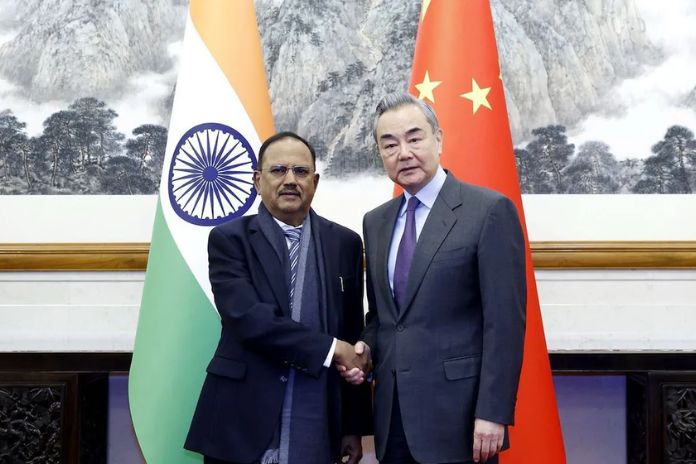
India and China have agreed to speed up work on an “early and substantial harvest” of boundary delimitation and to hold the next meeting of their Expert-Level Mechanism on trans-border rivers in September. The two sides also pledged to keep communicating on hydrological data sharing, a key issue for flood forecasting in Brahmaputra/Siang basin states.
The outcomes follow the 25th round of Special Representatives (SR) talks between National Security Advisor Ajit Doval and Chinese Foreign Minister Wang Yi in Beijing, which produced an eight-point consensus aimed at stabilising the Line of Actual Control (LAC) and advancing the long-pending border question.
What “early and substantial harvest” means
The phrase refers to identifying relatively less contentious stretches of the 3,488‑km disputed frontier where technical agreement on alignment is feasible, so that partial delimitation can be locked in ahead of a comprehensive settlement.
In practice, this would mean the Expert Group on Boundary Delimitation and the Working Group on Border Management—both under the Working Mechanism for Consultation and Coordination (WMCC)—first finalise their terms of reference, then prioritise sectors with lower friction for early progress.
Media reports have flagged Sikkim (about 220 km) and the Middle Sector in Himachal Pradesh–Uttarakhand (about 545 km) as plausible candidates for an early deal, given comparatively fewer flashpoints than parts of the western sector.
Trans-border rivers and hydrological data
Both sides decided the next Expert-Level Mechanism meeting on trans-border rivers will be held in September, a step India has been pushing for to discuss technical details of upstream projects and data protocols.
They also agreed to “maintain communication” on sharing hydrological data, which is critical for flood forecasting and water management during monsoon seasons. This includes renewing relevant MoUs on data exchange, a mechanism that had lapsed amid broader tensions.
Eight-point consensus and border management
Alongside delimitation, the two sides agreed to add military meeting points and hotlines and to improve border management mechanisms along the LAC. The eight-point outcomes underscore commitments to:
- Maintain peace and tranquillity along the border
- Strengthen institutional mechanisms under the WMCC
- Advance discussions on boundary delimitation and border management
- Hold the next SR meeting in India in 2027
- Keep dialogue open on trans-border rivers and hydrological data
Both New Delhi and Beijing reaffirmed that they will work towards a “fair, reasonable and mutually acceptable package solution” to the boundary question, in line with political guiding principles agreed in 2005.
Why this matters for India
For India, an early delimitation in Sikkim and the Middle Sector could reduce patrol friction, clarify alignment on maps, and create a template for managing more complex sectors later. On the rivers front, regular hydrological data from Chinese stations upstream is vital for early warnings in Assam, Arunachal Pradesh and other northeastern states.
At the same time, analysts caution that “structural differences” over the broader boundary remain, and that stability along the LAC is being prioritised over an immediate final settlement. The new hotlines and meeting points are designed to prevent local incidents from spiralling, even as high-level talks continue.
What to watch next
Key indicators in the coming months will include:
- The first meeting of the Expert Group on Boundary Delimitation under the WMCC and its agreed work plan
- The September trans-border rivers mechanism meeting and any renewal of data-sharing MoUs
- Whether new military hotlines and meeting points become operational on the ground
- Preparations for the 26th SR meeting scheduled in India in 2027
If these steps translate into clearer patrol protocols, mapped alignments in priority sectors, and reliable monsoon-season data flows, the “early harvest” approach could deliver tangible risk reduction along the India–China border even before a full political settlement is reached.