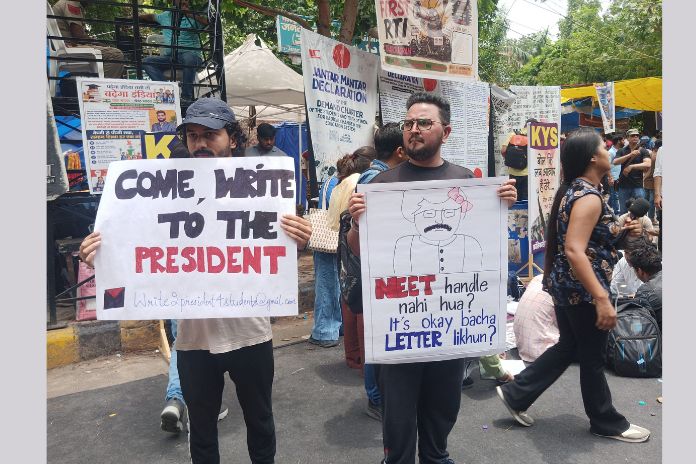
The demand for accountability echoed loudly at Jantar Mantar as students gathered to protest repeated examination paper leaks. Placards called for the resignation of the Union Education Minister, reflecting growing frustration over a system that many believe has repeatedly failed honest aspirants. Yet, beneath the slogans, a more complex story emerged.
During conversations with several protesters—many of them UPSC aspirants—a recurring pattern became evident. Most participants were familiar with the demand for resignation, but when asked about the Public Examinations (Prevention of Unfair Means) Act, 2024, many admitted they had little or no knowledge of the legislation. This raises an important question: Can public debate on examination reforms remain effective if awareness of the legal framework itself is limited?
The Public Examinations (Prevention of Unfair Means) Act, 2024
The Act was introduced after a series of major paper leak controversies, with the objective of strengthening deterrence against organised cheating, paper leaks, and examination fraud. Its very existence indicates that the government has acknowledged the seriousness of the problem and attempted a legislative response. Therefore, portraying the issue as one of complete governmental inaction would overlook an important development.
However, passing a law and achieving results are not the same.
The more relevant question today is whether the Act has translated into effective enforcement. If examination fraud continues to erode public trust, policymakers, investigators, and citizens must ask where the bottleneck lies. Is it delayed investigations? Weak coordination among agencies? Challenges in collecting evidence? Limited institutional capacity? Or is it simply too early to evaluate the impact of a law enacted only in 2024?
Beyond Political Accountability
Interestingly, one interaction at the protest reflected this complexity. A protester initially argued that the resignation of the Education Minister was the primary solution. Yet, when asked what reforms she would introduce if she herself became Education Minister, she acknowledged that entrenched power dynamics and systemic barriers could still prevent meaningful reform. The conversation shifted from individual accountability to institutional challenges—highlighting that public opinion itself often recognises the limits of leadership changes alone.
This does not diminish the importance of political accountability. Democratic systems require ministers to answer for failures within their departments. But accountability should not end with resignation. It must also include transparent investigations, effective implementation of existing laws, timely prosecution of offenders, institutional reforms, and continuous public scrutiny.
Institutional Credibility and the Way Forward
Perhaps the biggest lesson from the protest was not the slogans, but the questions they left behind. India’s paper leak crisis is no longer merely a political controversy—it is a test of institutional credibility. Restoring trust will require more than changing individuals; it will require ensuring that laws are understood, enforced, and capable of protecting the aspirations of millions of students.
The debate, therefore, should not stop at who is responsible. It must also ask what will actually prevent the next paper leak. That is where meaningful reform begins.