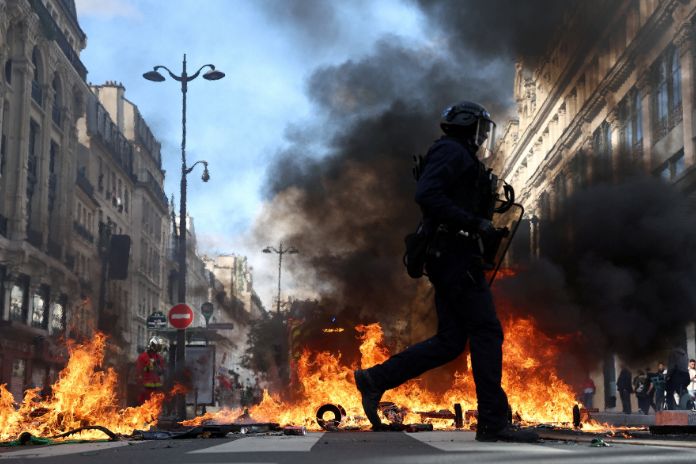
France witnessed some of its worst street unrest in years as protests over poor school conditions, rising living costs and weakening public services spread across the country on Saturday.
According to the French Interior Ministry, around 5.5 lakh people joined demonstrations across France, including nearly 1.1 lakh in Paris. The protests began as a student-led movement against teacher shortages, damaged school buildings and funding cuts in education. They later drew support from trade unions and Yellow Vest activists, turning into a wider protest against inflation, low wages and social inequality.
Violence broke out in several cities after largely peaceful marches. Police used tear gas and water cannons to control crowds in Paris, while cars were set on fire and shops were looted. Authorities reported damage to public buildings in Paris, Marseille, Nice, Nantes, Bordeaux, Lille, Toulouse and Strasbourg.
Prime Minister Sebastien Lecornu said around 1,200 people were arrested during the unrest and 150 police officers were injured. The government described the violence as unacceptable and said those involved in looting and arson would face legal action.
Why people are angry
Protesters say everyday life has become more expensive, with higher prices for food, fuel, energy and housing. Many families say wages and pensions have not risen at the same pace as inflation.
Students and teachers have also raised concerns about the condition of French schools. They say many institutions suffer from a shortage of teachers, poor infrastructure and insufficient public funding. These education-related demands became the starting point of the current movement.
The protests reflect wider frustration with the government’s handling of public services and economic pressure. Demonstrators are demanding higher wages and pensions, lower prices, better school facilities and stronger support for public services.
Political pressure on Macron
The unrest has increased political pressure on President Emmanuel Macron ahead of the 2027 presidential election. His government now faces growing public anger over the cost of living and the state of education and public services.
Macron was reported to be preparing to address the nation after the protests. Political observers say the government will need to offer concrete measures on prices, wages and education funding to calm public anger.
The demonstrations also come at a time when similar public protests have been reported in several other countries, highlighting global concern over inflation, inequality and declining public services.
What happens next
French authorities are expected to maintain tight security in major cities as further demonstrations are possible. The government may announce new measures to address the cost-of-living crisis and school funding concerns.
For now, the France protests have shown that public frustration is no longer limited to students. It has become a broader social and political challenge for the government, with rising prices and public-service concerns at its centre.