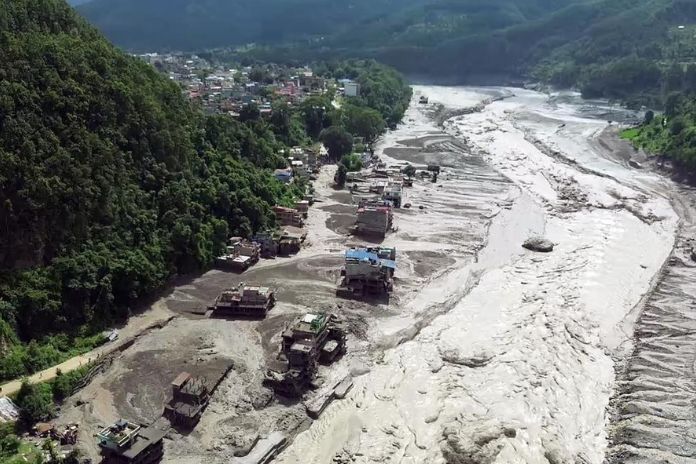
Nepal’s death toll from the devastating flash floods has climbed to 1,295, even as rescuers pulled two hydropower workers alive from a debris-filled tunnel on Friday—nine days after the disaster struck.
The tragedy began on August 26, when a massive ice–rock avalanche near the Nepal–Tibet border triggered a wall of water, mud and debris that swept down the Trishuli River corridor and other valleys. Entire settlements, roads and hydropower sites were destroyed in minutes.
Rising death toll, thousands still missing
According to Nepal Police and disaster authorities, the nationwide death toll reached 1,295 on Friday after two more flood victims died in Kathmandu hospitals. Of these, 1,293 bodies have been recovered from eight districts, with northern and central Nepal bearing the worst of the impact.
A joint command of security forces is now searching for 4,798 people reported missing from different areas, as rescue and recovery operations continue across multiple districts. In just two districts—Rasuwa and Nuwakot—around 600 children remain unaccounted for, underscoring the human cost of the disaster.
More than 13,000 people have been rescued so far, but entire communities face severe disruption to housing, schools and livelihoods.
“Miracle” tunnel rescue raises hopes
In a rare and emotionally charged breakthrough, rescuers extracted Sanjay Sah (30), a mechanical foreman, and Kabir Maharjan (45), a mechanical supervisor, from the Trishuli 3A hydropower tunnel in the Nuwakot–Rasuwa area.
The two men were found alive at a depth of about 170 metres inside the main tunnel, which had been sealed by mud and debris after the floods. Officials said they survived in a relatively stable underground section with an air pocket containing breathable oxygen, along with limited supplies, which likely helped them endure for nine days.
Both workers were reported to be in stable condition after being brought to the surface. They received initial medical care locally before being airlifted to a hospital in Kathmandu for further treatment.
The rescue has intensified hopes that other trapped workers—hundreds are still missing from multiple hydropower tunnels—could still be found alive. However, access remains extremely difficult due to unstable terrain, continuing landslide risk and debris-choked tunnels.
Ongoing search and relief efforts
Search teams are using drones, heavy machinery and manual efforts to clear tunnels and river channels, but progress is slow. Unstable slopes and the threat of fresh landslides are complicating operations, especially in remote mountain areas.
Authorities have set up relief camps and are distributing food, clean water and medical aid to displaced families. Schools in Rasuwa, Nuwakot and Dhading have suffered extensive damage, affecting thousands of students.
The government, with support from security forces and international partners, is focusing on three priorities: locating the missing, providing emergency relief, and beginning early recovery work in the worst-hit districts.
What comes next
As the death toll continues to rise, attention is turning to long-term recovery and disaster preparedness. Experts say the scale of loss highlights the need for better early-warning systems, stricter regulation of construction in high-risk zones, and improved safety protocols at hydropower sites.
For now, the survival of the two tunnel workers has offered a glimmer of hope to families still waiting for news of their loved ones. With nearly 4,800 people officially missing, the search operation is far from over.