Large Protests are uniquely Indian. And as the beating heart of the world’s largest democracy, Delhi has seen its fair share of them. The city and its politics, are used to dancing to their own tune, uncaring about the pronunciations of doom from others. What seems like revolution to the rest of the world, is a simple day in the organised chaos that is India.
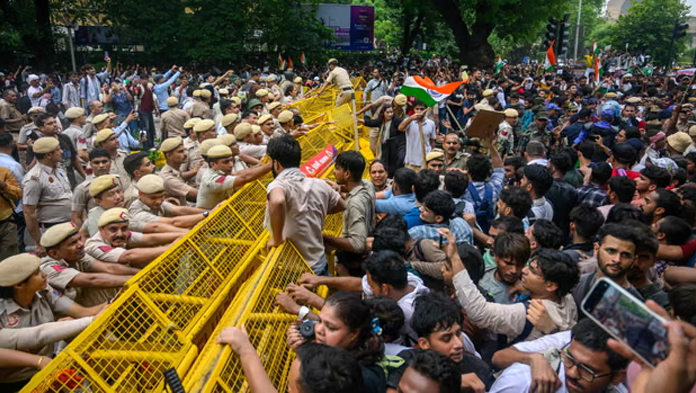
These past few days have witnessed Young India and her students, out on the streets. Demanding change. And it feels like deja vu, all over again. I am not afraid to admit that in 2012, during the massive protests that engulfed Delhi, following the brutal Nirbhaya Gang rape incident, I too, as a young student, was out on the streets: protesting, shouting and breaking police barricades as I tried to march on Raisina Hill, the centre of Indian political power.
It seems like destiny, that India will see each generation of her children rise and shake the politics of the day. After all, most of our current political leaders, from every party, have participated and led their own share of students protests in their youth.
So why should this generation of Indian students not have their own movement?
What surprises me however, is not the anger of Indian youth, but the response of the State. In 2012, as young students marching on the streets, we too were lathi charged (baton charged), tear gassed and water cannoned. We too were arrested and told to stay at home. Today in 2026, it’s a new generation, leading a different protest, against another government in power, but the response remains the same.
Perhaps, when faced with the overwhelming might of people marching towards the very centre of Indian political power, every Government of India is faced with a scarcity of choices, most of them bad.
Either the government of the day let’s the protesters overrun State institutions and symbols, as we saw in 2021 during the farmers march on Red Fort, or it digs in its heals and pushes back, using force, as we saw in 2012 and are witnessing now.
Faced with these looming bad decisions, whispers once again spread thick in the corridors of the Delhi Darbar, dejectedly admitting “from Irom Sharmila to Sonam Wangchuk, every Indian government fears giving in. They can’t admit protests work.”
Inquilab
For these current ongoing protests, the 2026 NEET paper leak became the tipping point, after years of repeated leaks, cancelled exams and little accountability.
The fury of Inquilab – a uniquely hindustani word, meaning ‘revolution’ – burst out and spilled onto the streets.
Of all the words in all the many Indian languages, Inquilab holds a special place. Its power does not come from its meaning, but from the great legacies of those mighty Indians who have wielded it, with flair, across history and against brutal Indian enemies.
India, in all its ways, remains a land that worships Mahatma Gandhi and Bhagat Singh with equal reverence. And no Government of India has till date, been able to find a way, to deal with Indians marching fearlessly on the streets shouting Inquilab Zindabad (long live the revolution).
Which makes dialogue and our open call for it, the only sensible option.
Dialogue
The fact is, that the very wonderful idea of Viksit Bharat (advanced India) cannot be hoisted on the shoulders of India’s youth, who have broken ribs. The brutality of Indian hard power must give way to the encouraging words and open reassurance, young people often find in the voices and actions of their family elders.
The Modi Government is talking to the young protesters, and this Dialogue needs to intensify. Looked upon simply in terms of age, the youth out there on streets, are of the same age as the grandchildren of most of our political leaders. They need to be handled with love not force.
Because what the Government does now, will shape their image and impressions of their country.
They are our Young India.