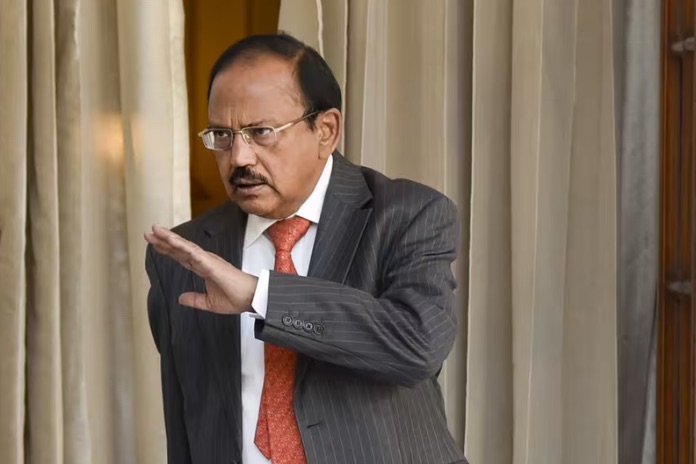
India has called for closer Indian Ocean security cooperation to address growing challenges in the region. National Security Adviser Ajit Doval made the appeal at the eighth National Security Advisers’ Meeting of the Colombo Security Conclave (CSC), held in Male, Maldives, on November 25.
Doval said India remains committed to working closely with Indian Ocean nations to build shared capacity against emerging security threats. He stressed that the Indian Ocean should bring countries together rather than divide them.
A shared maritime future
Doval highlighted the deep maritime and cultural links among countries bordering the Indian Ocean. He said the sea is not only a route for trade and travel but also a shared space that requires collective responsibility.
According to him, regional nations must work together to protect maritime security, maintain peace, and support economic growth. His message was clear: no single country can manage the complex security challenges of the Indian Ocean alone.
CSC and India’s vision
Doval described the Colombo Security Conclave as an important platform for regional cooperation. He said it reflects the meeting point of India’s Neighbourhood First policy and its MAHASAGAR vision.
MAHASAGAR stands for “Mutual and Holistic Advancement for Security and Growth Across Regions.” It reflects India’s effort to promote a secure, stable, and prosperous Indian Ocean region through partnership with neighbouring and littoral countries.
The Colombo Security Conclave brings together countries in the Indian Ocean region to coordinate on security issues. It focuses on areas such as maritime safety, counter-terrorism, cyber security, transnational crime, and disaster response.
Why cooperation matters
The Indian Ocean is one of the world’s busiest maritime regions. It carries major trade routes, connects continents, and supports the economies of many countries. However, the region also faces risks including piracy, smuggling, illegal fishing, cyber threats, and geopolitical tension.
Doval’s remarks come at a time when India is seeking stronger partnerships with Indian Ocean neighbours. The emphasis on collective action suggests that India wants regional countries to respond together to security challenges rather than depend on outside powers.
India’s message
Doval said India will continue to support its partners in strengthening their security capabilities. He underlined that cooperation should be practical, trust-based, and focused on shared interests.
His statement also signals India’s broader approach: a free, open, secure, and inclusive Indian Ocean. For India, stronger regional cooperation is not only about defence. It is also about protecting trade routes, supporting development, and ensuring stability for millions of people who depend on the ocean.
What lies ahead
The Colombo Security Conclave is likely to play a bigger role in India’s regional strategy. By linking it with Neighbourhood First and MAHASAGAR, New Delhi has positioned the grouping as a key platform for long-term maritime cooperation.
As security challenges evolve, India’s message to Indian Ocean nations is simple: greater coordination, stronger institutions, and shared responsibility will be essential for peace and prosperity in the region.