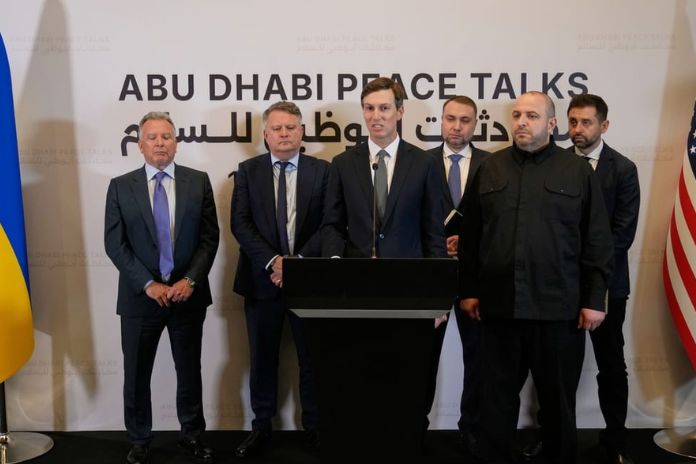
Russia and Ukraine have held their first direct, U.S.-mediated peace talks in nine months, raising cautious hopes for progress in a war now approaching its fifth year. The two-day meeting in Abu Dhabi focused on ending the conflict, humanitarian issues, postwar reconstruction, and—most importantly—security guarantees for both countries.
The talks were led by U.S. envoys Jared Kushner and Steve Witkoff. Although no major political breakthrough was announced, the negotiations produced one important result: Russia and Ukraine agreed in principle to a major prisoner-of-war exchange. The exact number of prisoners and the timing of the exchange are still being finalized.
Security Guarantees Remain the Core Issue
Security guarantees are at the center of the negotiations. Ukraine wants strong, long-term protection from future Russian aggression, ideally backed by Western allies and similar in effect to NATO’s collective-defense commitment.
Russia, however, has a very different position. Moscow wants guarantees for its own security and continues to oppose Ukraine joining NATO. It also seeks limits on Ukraine’s military capabilities. These opposing demands make a final agreement difficult.
Territory is another major obstacle. Ukraine has repeatedly said it will not voluntarily give up land that Russia has not captured through fighting. Russia, meanwhile, continues to demand territorial concessions. Until both sides find common ground on borders and security, a lasting peace deal will remain out of reach.
What Was Achieved in Abu Dhabi
The Abu Dhabi talks did not end the war, but they restarted direct communication between the two sides. Ukrainian officials described the discussions as constructive, while U.S. mediators acknowledged that major differences still remain.
The agreement in principle on a prisoner exchange is a meaningful humanitarian step. Prisoner swaps can reduce suffering for families, build limited trust between the sides, and create a foundation for further negotiations.
The talks also covered de-escalation, humanitarian concerns, and reconstruction after the war. These topics are important because any future peace agreement will need more than a ceasefire; it will require plans for displaced people, damaged cities, and long-term regional stability.
U.S. Envoys Head to Moscow
After the Abu Dhabi meetings, Kushner and Witkoff traveled to Moscow to meet Russian President Vladimir Putin. Their goal is to assess Russia’s position and determine whether the groundwork laid in Abu Dhabi can lead to another round of talks.
European involvement is another key question. The United States has suggested that a lasting settlement may require broader European security arrangements. However, Russia has so far resisted giving European countries a direct role in the negotiations.
What Happens Next
The next major test will be Russia’s response after the U.S. envoys meet Putin. Observers will watch for signs that Moscow is willing to continue negotiations, accept a prisoner exchange, or compromise on security arrangements.
Even if the fighting continues, the Abu Dhabi talks show that diplomacy has restarted. A prisoner exchange would be an immediate result, but the larger challenge remains: finding a security framework that protects Ukraine without rewarding aggression.
For now, the world is watching whether these talks can turn limited progress into a real path toward peace.