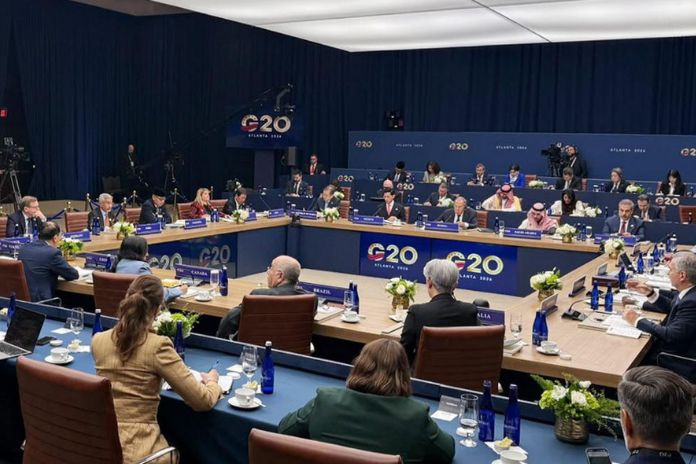
Foreign ministers from the Group of 20 major economies ended their two-day meeting in Atlanta without agreement on several major global security issues. The main reason was the deep divide over Russia’s war in Ukraine, which overshadowed discussions from the start.
Because the members could not reach consensus, the United States will not publish a joint communique. Instead, U.S. Secretary of State Marco Rubio will release a chairman’s statement summarizing the discussions.
Ukraine War Dominates Talks
Russia’s position on Ukraine remained firm throughout the meeting. Russian Foreign Minister Sergey Lavrov said Moscow would not accept a situation in which Ukraine poses what it considers a military threat to Russia’s security interests.
European diplomats strongly objected to Russia’s presence at the G20 foreign ministers meeting in Atlanta. Their objections led Rubio to cancel the traditional group photograph after several European officials said they would boycott it or walk out rather than appear alongside Lavrov.
EU foreign policy chief Kaja Kallas accused Lavrov of spreading false narratives about Ukraine, while Germany’s foreign minister said there could be “no normality” with Russia while the war continues.
Other Disputes Limit Agreement
The Ukraine conflict was not the only issue dividing G20 members. Officials also disagreed over the U.S.-Israeli war against Iran, U.S. tariffs, China’s actions in the South China Sea, and Russia’s opposition to Poland’s G20 membership.
The United States also faced criticism for not inviting South Africa, a G20 member, despite objections from other countries. These disputes added to uncertainty over global trade and contributed to higher fuel prices.
Rubio Calls for Unity
Rubio opened the meeting by urging G20 members to work together despite their differences. He said the world faces connected economic and geopolitical crises affecting energy supplies, food security, trade, and freedom of navigation.
He argued that the G20 must coordinate responses to protect shared economic interests. However, the presence of countries directly involved in ongoing wars made a common position difficult to achieve.
What Happens Next
Despite the lack of agreement, diplomats said all members agreed to keep trying to bridge their differences. Their goal is to help make the G20 leaders’ summit in Florida in December, hosted by President Donald Trump, more successful.
The Atlanta meeting shows that the G20 remains divided on major security issues. While members share concerns about trade, energy, and global stability, the war in Ukraine continues to prevent the group from speaking with one voice.