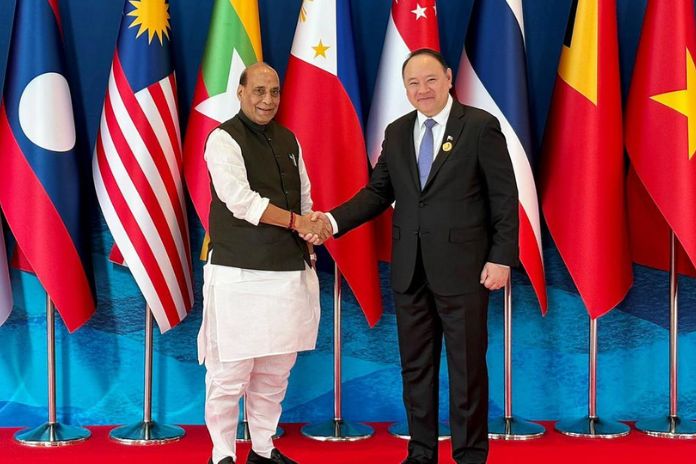
India is ready to share its practical, battle-tested anti-terror expertise with ASEAN member states and their dialogue partners, Defence Minister Rajnath Singh said at the 13th ASEAN Defence Ministers’ Meeting-Plus (ADMM-Plus) in Cebu, Philippines.
The announcement reflects India’s effort to strengthen regional security cooperation at a time when terrorism, maritime disruption, and changing geopolitical pressures continue to affect the Indo-Pacific. Singh said India’s counter-terrorism experience comes from real-world operations rather than classroom theory.
How India plans to cooperate
India proposed sharing its expertise through three main channels:
- Joint military exercises
- Capacity-building and training programmes
- Stronger intelligence-sharing arrangements
Singh said terrorism recognises no borders, and that collective action is essential to defeat it. He added that India stands prepared to work with ADMM-Plus partners to build joint capabilities and improve regional preparedness.
Operation Sindoor as an example
The Defence Minister referred to Operation Sindoor as proof of India’s operational readiness and its firm approach against terrorism. According to his remarks, the operation targeted terrorist infrastructure and reinforced India’s position that state-sponsored terrorism is unacceptable.
By highlighting this operation, India presented its counter-terrorism approach as tested through actual security challenges. The message was that India can offer useful experience to partners seeking stronger counter-terrorism systems, training, and coordination.
Maritime security in focus
Singh also raised concerns about disruptions affecting important maritime trade routes. He said that words alone are not enough to protect global commerce and that nations need a practical, visible security presence at sea.
India reaffirmed its role as a “trusted net security provider” in the Indian Ocean Region and the wider Indo-Pacific. Singh said India’s maritime approach supports peace, prosperity, freedom of navigation, freedom of overflight, and respect for international law, including the United Nations Convention on the Law of the Sea (UNCLOS).
Why the offer matters
The offer is significant because ADMM-Plus includes ASEAN’s ten member countries and eight dialogue partners: Australia, China, India, Japan, New Zealand, South Korea, Russia, and the United States. This makes it one of the region’s most important platforms for defence dialogue and practical security cooperation.
India’s proposal could lead to closer coordination on terrorism prevention, border security, intelligence exchange, maritime domain awareness, and emergency response. It also supports India’s broader Indo-Pacific strategy of building partnerships based on mutual trust and shared security interests.
India and Malaysia currently co-chair the ADMM-Plus Experts’ Working Group on Counter-Terrorism for the 2024–27 period. This existing mechanism may help turn the offer into concrete joint programmes, exercises, and training initiatives.
Overall, Singh’s message was clear: India wants to move beyond statements and contribute practical capabilities to help ASEAN and partner nations respond to terrorism and maritime security challenges together.