A powerful suicide blast at a Pakistan mosque near the old Police Lines in Kohat has killed at least 16 people and injured more than 50. The attack took place during Friday namaz, when the mosque and surrounding police complex were crowded with worshippers and security personnel.
Where and when did the blast happen?
The explosion struck a mosque located close to the old Police Lines in Kohat district of Pakistan’s Khyber Pakhtunkhwa province. Kohat lies around 60 kilometres southwest of Peshawar, the provincial capital.
The blast occurred during Friday congregational prayers on September 18, 2026. This timing meant a large number of people were gathered inside and outside the mosque, increasing the impact of the explosion.
What happened during the attack?
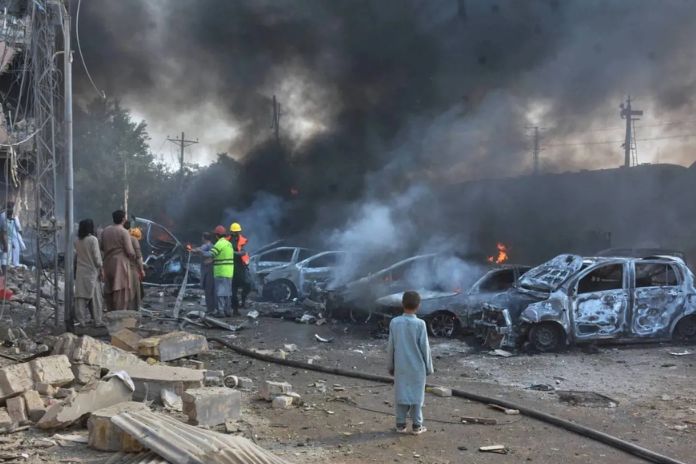
According to police and hospital sources, a suicide attacker drove an explosives-laden vehicle into the police lines area near the mosque and detonated it. The explosion was powerful enough to create a crater outside the mosque, damage its exterior, and partially collapse a wall and roof.
After the blast, armed militants engaged in a gunfight with security forces in the complex. Police said most of the wounded were worshippers, while several police personnel were also among the dead and injured.
How many people were killed and injured?
Provincial police confirmed that at least 16 people died in the attack. Among the dead were five police personnel and 11 civilians. Hospital officials initially reported 15 bodies and more than 50 injured brought to District Headquarters (DHQ) Hospital in Kohat.
More than 50 people sustained injuries in the blast, many of them worshippers who were offering Friday prayers. Emergency was declared at DHQ Kohat, and medical teams worked to treat the injured.
What is the condition of the mosque and surrounding area?
The suicide blast at the Pakistan mosque caused significant structural damage. Reports said the explosion created a large crater outside the prayer hall and damaged the mosque’s outer walls. Part of the roof and a boundary wall also collapsed due to the force of the blast.
In the aftermath, the Kohat–Hangu road was temporarily closed to traffic, and extra security forces were deployed in and around the Police Lines area. Authorities cordoned off the site for investigation and to prevent any further threat.
Who is behind the attack?
Initial reports from some media outlets said a little-known group, Ittehad-ul-Mujahideen Pakistan, claimed responsibility for the attack. However, other reports noted that no group had officially claimed the blast at the time of writing, and security agencies were still investigating.
Khyber Pakhtunkhwa has seen several attacks on mosques, police facilities, and security convoys in recent years, often claimed by militant groups operating along the Afghanistan border.
How have leaders reacted?
Pakistan’s President Asif Ali Zardari and Prime Minister Shehbaz Sharif strongly condemned the Kohat Police Lines blast. They expressed grief over the loss of lives and offered prayers for the victims. Provincial leaders and police chiefs also vowed to strengthen security and bring the attackers to justice.
What happens next?
Local authorities have launched a full investigation into the suicide blast at the Pakistan mosque. Forensic teams are examining the blast site, while intelligence agencies are working to identify the suicide bomber and any accomplices.
Hospitals in Kohat continue to treat the injured, many of whom are in stable condition. Security has been tightened around mosques, police stations, and other sensitive sites in Khyber Pakhtunkhwa ahead of weekend prayers.
This developing story highlights the ongoing security challenges in northwest Pakistan, where militants frequently target security forces and public gatherings.