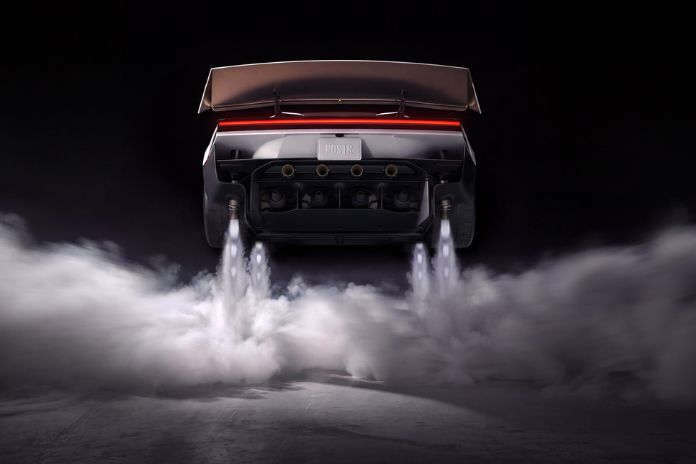
Tesla has unveiled a redesigned Tesla Roadster flying car that can perform dramatic airborne manoeuvres using thrusters developed with SpaceX technology. Elon Musk demonstrated the electric sports car at a SpaceX facility in Texas, where it drove upside down on a ramp, flipped in mid-air and landed safely with the help of onboard thrusters.
The reveal marks a major upgrade for the long-delayed Roadster, which was first shown nearly nine years ago. Tesla now says the new two-seater will enter production in 2028.
How the Tesla Roadster flies
The new Roadster is equipped with 10 thruster nozzles and high-pressure compressed-air tanks supplied through SpaceX technology. Unlike a conventional rocket, it does not use rocket fuel. The compressed air provides extra thrust for acceleration, lift and control during airborne movements.
During the demonstration, the Roadster climbed a steep curved ramp using a suction system beneath the vehicle. Once upside down, it launched off the ramp, completed a barrel roll and landed safely.
Musk described the car as being able to “basically fly like a rocket,” although the demonstration showed short controlled manoeuvres rather than ordinary road-to-air travel.
Speed and performance
Tesla claims the Roadster can accelerate from 0 to 60 mph in under one second. The company’s engineering chief, Lars Moravy, also said the car could reach a top speed of more than 230 mph.
The vehicle uses a ground-hugging suction system to increase grip at low speeds and improve cornering at high speeds. It also has an active rear wing that can switch between high drag and high downforce, adjusting automatically while driving.
Roadster variants
Tesla has announced three versions of the new Roadster:
- Performance: The road-focused version of the electric sports car.
- Thrust: A limited model with rear cold-gas thrusters for added acceleration and aerial control.
- Rocket: An invitation-only, single-seat version with a full flight system, though it is not approved for use on public roads.
Is it really a flying car?
The new Roadster brings flying-car technology closer to reality, but it is not yet a practical flying vehicle for daily use. The demonstration showed hovering, flipping and controlled flight-style movement, not sustained independent flight.
Musk also acknowledged that the Roadster is “not necessarily a safety optimized car,” highlighting that the technology remains experimental.
Still, the unveiling is a major moment for Tesla. By combining electric power, SpaceX-inspired thrusters and advanced aerodynamics, the company has turned its long-awaited Roadster into one of the most ambitious vehicles ever shown publicly.
What happens next?
Tesla says the Tesla Roadster flying car is scheduled to enter production in 2028. If the company delivers on its claims, it could redefine what buyers expect from an electric sports car—though questions around safety, regulations, pricing and real-world flying capability remain unanswered.