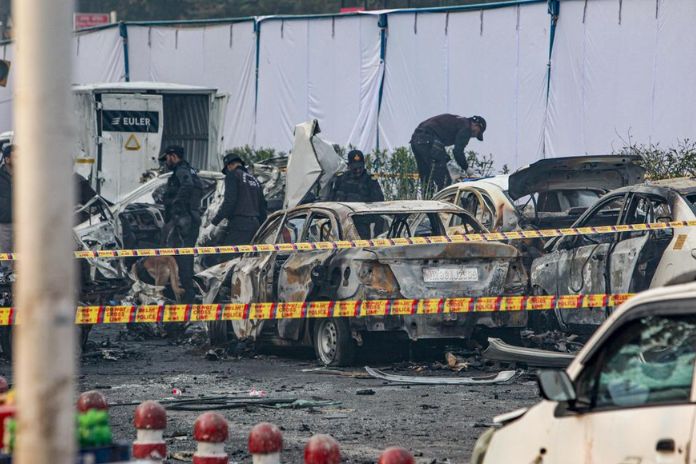
A deafening explosion ripped through a slow‑moving Hyundai i20 at a traffic signal just outside the Lal Qila metro station on Monday evening, 10 November 2025, turning a bustling corner of the capital into a scene of fire and chaos. The blast, which occurred just before 7 p.m., killed at least eight people and left 20‑plus injured, many of them critically.
Witnesses described a “bomb‑like” roar, shattered windows and thick plumes of black smoke as the car erupted into flames, engulfing nearby vehicles and sending panicked shoppers fleeing into the night. Emergency crews rushed seven fire tenders to the spot; it took almost an hour to bring the blaze under control. The wreckage was cordoned off, and the area around the historic Lal Qila was placed on high alert, with security stepped up at metro stations, airports and government buildings across the city.
Eight people died on the spot or were pronounced dead at Lok Nayak Jai Prakash Narayan Hospital, while 24 others were treated for burns and shrapnel wounds. Relatives gathered at the hospital to identify loved ones, many still in shock over the sudden loss. Prime Minister Narendra Modi, who was in Bhutan at the time, sent a message saying the perpetrators would be “All those responsible for the Delhi blast will be brought to justice” .
Investigation: Accident or Conspiracy?
Police have launched a multi‑agency probe that includes the National Investigation Agency (NIA), the National Security Guard (NSG), forensic experts and the Delhi Police Special Cell. The case has been registered under the Unlawful Activities (Prevention) Act (UAPA) – India’s principal anti‑terrorism law – as well as the Explosives Act.
Early analysis shows the blast was a directional, shock‑wave‑type explosion with no metallic residue, suggesting a crude solid or liquid explosive rather than a conventional bomb. Investigators also found a “white powder” and soil samples near the site, which are being sent to the lab for composition.
CCTV footage from the Lal Qila area captured a man in a white T‑shirt lingering near the vehicle moments before the explosion, mirroring the description from the 2024 Prashant Vihar case. Police have detained the car’s registered owner, identified only as Salman, for questioning.
Home Minister Amit Shah said “all angles” are being examined, refusing to rule out terrorism, mechanical failure, or a gas‑cylinder explosion . The lack of metal fragments and the crude nature of the device have led some investigators to consider a “crude bomb” scenario, while others keep the terror angle open.
Deadliest Past of Attacks:
The blast that rocked Delhi on the evening of 10 November 2025 was the city’s deadliest incident in over a decade, but it isn’t the first time the capital has been hit. Just 14 years earlier, in 2011, a briefcase bomb exploded outside the Delhi High Court, killing 12 and injuring dozens. Before that, a series of coordinated attacks in 2008 struck Connaught Place, Karol Bagh and Greater Kailash, leaving 25 dead and over a hundred wounded.Even further back, the late 1990s saw twin blasts in Karol Bagh, Punjabi Bagh and Rani Bagh, and another explosion near the Red Fort itself in 1997 that killed three and 70 injured. These earlier strikes—whether linked to Sikh separatists, Islamist militants, or other groups—have left a deep scar on the city’s collective memory and have repeatedly prompted tighter security measures after each tragedy.
What’s next?
Forensic teams are still sifting through debris, and mobile‑network data from the blast site is being analyzed to identify anyone who was present moments before the explosion. Authorities have promised to release further details as the investigation progresses, but for now the capital remains on edge, waiting to learn whether the tragedy was the work of a terrorist cell, a criminal act, or a horrific accident.