In recent years, maritime security has emerged as a critical global concern due to rising geopolitical tensions, piracy, cyber threats, environmental challenges and labour shortages. These issues have significantly impacted international waters, making maritime governance more complex.
Additionally, China’s expanding naval presence in the Indo-Pacific has further intensified strategic concerns. In this context, there is a growing need for collaborative efforts among nations to establish a robust maritime security framework.
As one of the fastest-growing economies in South Asia, India plays a crucial role in shaping maritime security in the Indian Ocean Region (IOR).
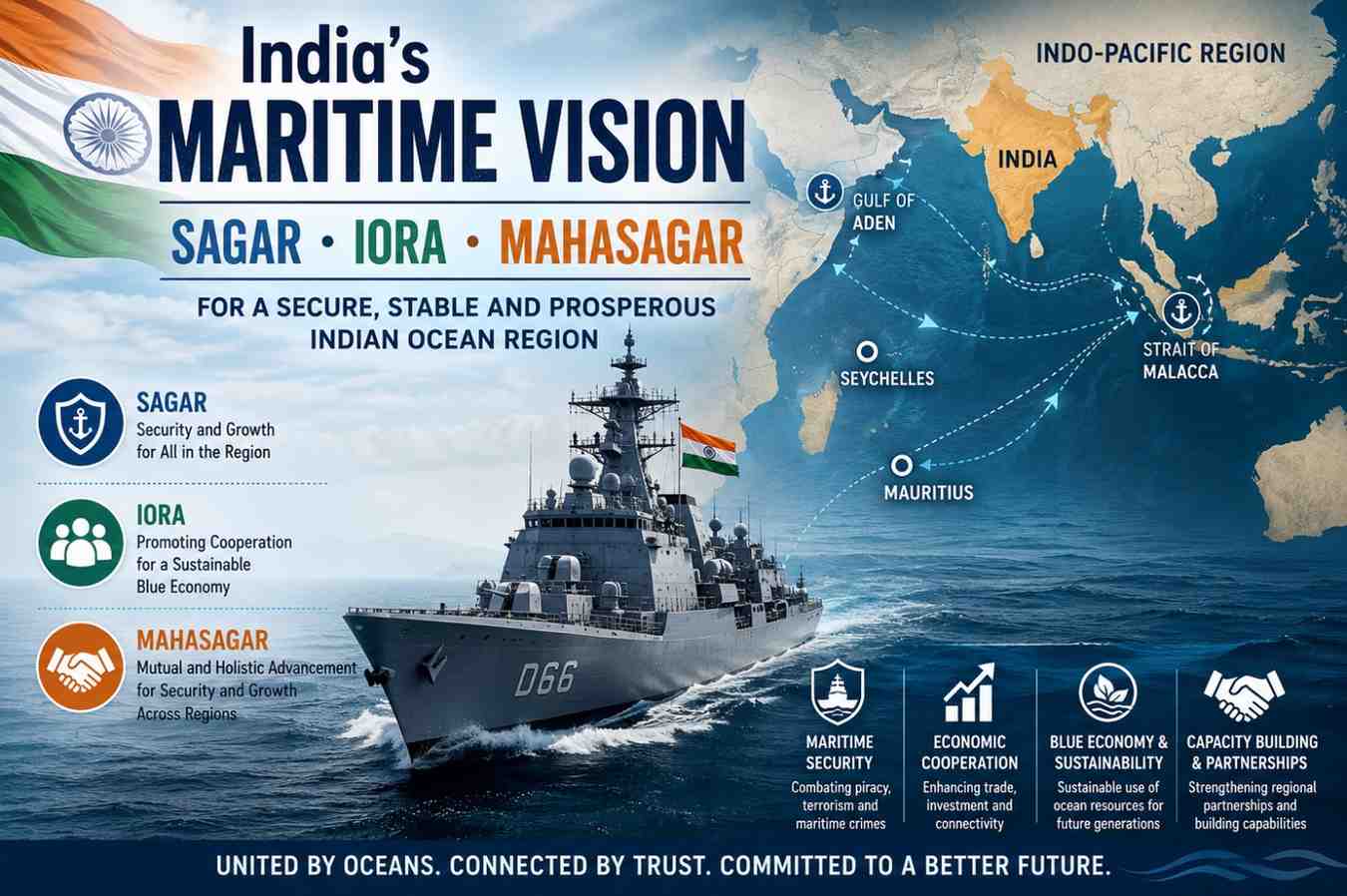
Recognising this, India has adopted a proactive approach through initiatives such as SAGAR (Security and Growth for All in the Region) and its recent expansion, MAHASAGAR, while also engaging with regional organisations like the Indian Ocean Rim Association (IORA).
Indian Ocean Rim Association:
The Indian Ocean Rim Association (IORA), established in 1997, predates the SAGAR vision and serves as a regional forum promoting cooperation among member states. It focuses on maritime security, trade, blue economy and disaster management.
The concept of the blue economy, which emphasizes the sustainable use of ocean resources, is central to IORA’s objectives. For instance, initiatives such as marine debris clean-up efforts and workshops on sustainable fishing practices highlight the organisation’s commitment to environmental sustainability.
India has actively contributed to IORA through capacity-building measures, including training programs under the Indian Technical and Economic Cooperation (ITEC) initiative. These efforts aim to enhance skills in areas such as climate adaptation and resource management. While IORA provides a broad framework for regional cooperation, India’s SAGAR vision offers a more focused strategic approach.
Both are complementary, as they share common goals of economic development, maritime security and sustainable growth.
The SAGAR Vision:
The SAGAR vision, introduced by Prime Minister Narendra Modi in 2015, represents India’s maritime doctrine for the Indian Ocean Region. It emphasizes collective security, economic cooperation and regional stability. One of the key examples of its implementation is Mission SAGAR, launched in 2020 during the COVID-19 pandemic.
Through this initiative, India provided humanitarian assistance and disaster relief (HADR) to several island nations, including Maldives, Mauritius and Seychelles. The Indian Navy played a significant role by delivering essential supplies, demonstrating India’s commitment to regional support.
The importance of the Indian Ocean Region for India cannot be overstated. Nearly 95% of India’s trade by volume and about 68% by value passes through this region, making it vital for economic growth.
Moreover, the IOR includes strategic chokepoints such as the Strait of Malacca, which connects the Indian Ocean with the South China Sea and serves as a major route for global trade and energy supplies.
To address maritime threats such as piracy and illegal activities, India has undertaken several initiatives. Since 2008, the Indian Navy has deployed warships in the Gulf of Aden to escort commercial vessels and counter piracy.
Additionally, India has strengthened surveillance through integrated coastal security systems and information-sharing mechanisms with partner nations. Platforms like the Indian Ocean Naval Symposium (IONS) further enhance cooperation through joint exercises such as IMEX, aimed at improving interoperability among naval forces.
Building upon SAGAR, India introduced the MAHASAGAR vision in 2025, which stands for Mutual and Holistic Advancement for Security and Growth Across Regions. This expanded framework reflects India’s broader ambition to strengthen its role in the Global South while addressing emerging geopolitical challenges, particularly China’s growing influence in the Indian Ocean.
Mutual and Holistic Advancement for Security And Growth Across Regions initiative:
MAHASAGAR focuses on three key areas: trade, capacity building and security cooperation. It promotes mutually beneficial economic partnerships, encourages sustainable development through concessional loans and infrastructure support, and strengthens maritime security through joint surveillance and defence collaboration. India’s engagement with countries like Mauritius, including infrastructure development at strategic locations such as Agalega Island, highlights its commitment to enhancing regional connectivity and security.
Furthermore, India’s maritime strategy aligns with its broader foreign policy initiatives, such as the Act East Policy and Neighborhood First Policy. These approaches aim to strengthen ties with neighbouring countries and expand India’s influence in the Indo-Pacific region.
India’s leadership in maritime security also reflects its aspiration to play a significant role in global governance. By promoting cooperation within the Global South, India seeks to create alternative economic and strategic partnerships, counterbalancing dominant global powers. Its strengths in sectors like pharmaceuticals, information technology and infrastructure further support this vision.
Conclusion:
In conclusion, India’s maritime initiatives, particularly SAGAR and MAHASAGAR, demonstrate a comprehensive and forward-looking approach to regional security and cooperation. While IORA provides a multilateral platform for collaboration, SAGAR and MAHASAGAR offer strategic direction and implementation.
Together, these frameworks highlight India’s commitment to ensuring a secure, sustainable and prosperous Indian Ocean Region.
As maritime challenges continue to evolve, India’s proactive engagement and leadership will remain essential in shaping the future of regional and global maritime governance.