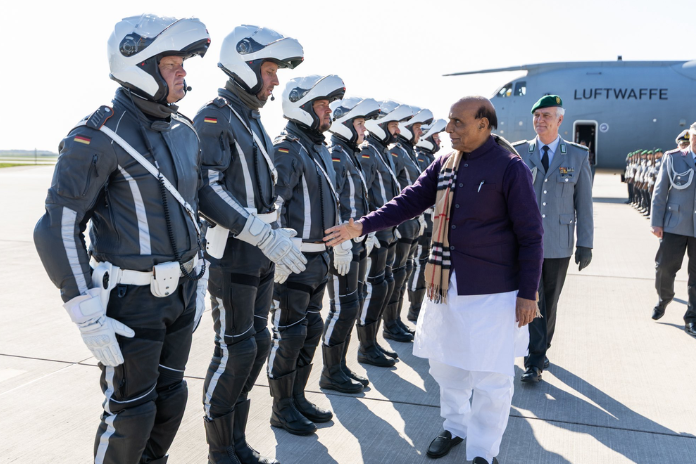
India’s Defence Minister Rajnath Singh has kicked off a significant three-day official visit to Germany, spanning April 21 to 23, 2026. This trip aims to deepen the strategic defence partnership between the two nations, marking the first such visit by an Indian Defence Minister in seven years. Arriving first in Munich and then in Berlin aboard a special German Air Force Airbus A400M aircraft, escorted by fighter jets, Singh received full military honors from the Luftwaffe honor guard.
Boosting Bilateral Defence Cooperation
The core focus of Rajnath Singh’s Germany visit is high-level bilateral talks with his German counterpart, Defence Minister Boris Pistorius. Discussions cover critical areas like artificial intelligence (AI), cyber security, unmanned systems (drones), and co-production of military hardware. A major push is on promoting India’s Make-in-India initiative through joint ventures with German defence industries. Singh is also engaging with German parliamentarians and a dedicated defence panel to explore collaborative opportunities.
This visit builds on prior momentum, including Pistorius’s trip to India in 2023 and recent telephonic consultations. It underscores growing synergy amid global security challenges, with both sides eyeing enhanced industrial ties.
Key Outcomes and Agreements Expected
Several milestones are anticipated during the visit. A Defence Industrial Cooperation Roadmap is set to be unveiled, outlining joint projects in advanced technologies. An Implementing Arrangement for training in United Nations peacekeeping operations will likely be signed in the presence of both ministers. Conversations may also advance talks on submarine procurement under India’s Project 75I, aligning with long-term naval modernization goals.
Singh’s itinerary highlights Germany’s role as a key European partner for India. The emphasis on co-development and co-production reflects a shift toward self-reliant defence manufacturing.
Strategic Importance of the Visit
Rajnath Singh’s Germany visit comes at a pivotal time for Indo-German relations. With shared interests in the Indo-Pacific and countering regional threats, the partnership extends beyond hardware to innovation in emerging domains like AI and cyber defence. This engagement reinforces India’s multi-aligned foreign policy while opening doors for German firms in the expanding Indian defence market.
The warm reception, including floral welcomes and handshakes on the tarmac, signals strong mutual commitment. As talks progress through April 23, expect announcements that could reshape bilateral defence dynamics.
In summary, this visit positions India and Germany for deeper collaboration, fostering peace, security, and industrial growth.