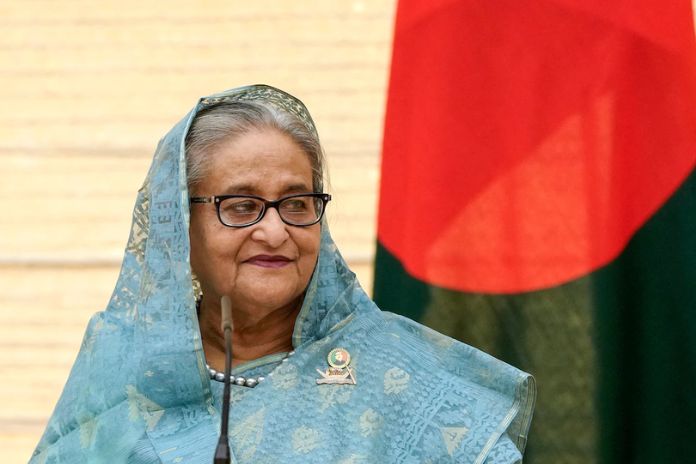
The former Bangladeshi Prime Minister, Sheikh Hasina was handed a death sentence by the International Crimes Tribunal -1 (ICT-1) in Dhaka on 17 November 2025. The three- judges panel found her guilty of crimes against humanity during the July- August protests of 2024 by students.
The verdict was delivered in her absence. As Hasina remains in self‑imposed exile in India. In addition, the court also sentenced her former home minister, Asaduzzaman Khan Kamal, to death, while former police chief Chowdhury Abdullah Al‑Mamun received a five‑year prison term after turning state witness.
Reactions have been swift. Hasina’s supporters label the tribunal a “kangaroo court” and claim the verdict is politically motivated, while the interim Bangladeshi government, led by Muhammad Yunus, hails it as a historic step toward accountability. The United Nations has called the outcome “an important moment for victims” but opposes the death penalty in all circumstances.
What is India’s stand?
After the announcement of ICT-1 about Sheikh Hasina’s death sentence, MEA said that “India remains committed to the best interests of Bangladesh’s people.
It is important to emphasize that India, where Hasina is staying, is unlikely to extradite her. The Indian government points to the political nature of the case, the lack of a fair trial in absentia, and its long‑standing policy of not sending anyone to a country where they could face execution.
History repeated once again:
This is not the first time, where former prime ministers have been sentenced to death. However, this is the first time, where a South-Asian former prime minister is sentenced to death.
In 1979, the former Prime Minister of Pakistan was hanged after a controversial trial. After a military coup led by General Zia‑ul‑Ha Khan in 1977, Bhutto was arrested and charged with murder and conspiracy for the alleged killing of a political rival, Ahmed Raza Khan.
The case was heard by a specially-created Supreme Court that many observers described as heavily politicised. Bhutto was found guilty and sentenced to death. He was hanged on 4 April 1979.
However, the verdict remains controversial. Where supporters argue it was a judicial murder, while the military regime presented it as a necessary step to restore order.
Similarly, Mansour Haq Al‑Mabhouh, former Prime Minister of Lebanon (1974‑1975), was sentenced to death. After the outbreak of the Lebanese Civil War, Al‑Mabhouh was accused of war crimes and treason by a military tribunal set up by the Syrian‑backed government. He was too, sentenced to death in absentia; he fled the country and the sentence was never carried out. The case is more an illustration of a death ‑sentence ‑in‑ absentia than an actual execution.
Hasina vs Bhutto:
Considering both the cases, comparison between Sheikh Hasina’s 2025 death sentence in Bangladesh and Zulfikar Ali Bhutto’s 1979 execution in Pakistan highlights several striking parallels and differences. Both leaders were tried after a dramatic change of power—Hasina by an interim government that emerged after a student‑led uprising and accusations that she ordered lethal force against protesters, and Bhutto by a military regime that seized control after a coup and charged him with murder and conspiracy in the killing of a political rival.
Hasina was prosecuted before Bangladesh’s International Crimes Tribunal for crimes against humanity, incitement and the use of lethal weapons, while Bhutto faced a specially created Supreme Court that many observers described as a show trial.
Their trials also diverged in format—Hasina was tried in absentia while she remained in exile in India, whereas Bhutto was present in court, though the proceedings were widely regarded as politically motivated. Both received death sentences, but on Bhutto’s sentence was carried out.
Meanwhile, Hasina’s remains a diplomatic flashpoint because India has signaled it will not extradite her to a country that applies the death penalty. International reactions have been mixed where, some governments and human‑rights groups support accountability for mass atrocities but criticize the use of capital punishment and question the fairness of the trials, while others condemn the verdicts as politically driven.
The cases underscore how death sentences for former heads of government are rare, often tied to in‑absentia judgments, heavily influenced by political motives, and increasingly scrutinized under contemporary international law and human‑rights norms.