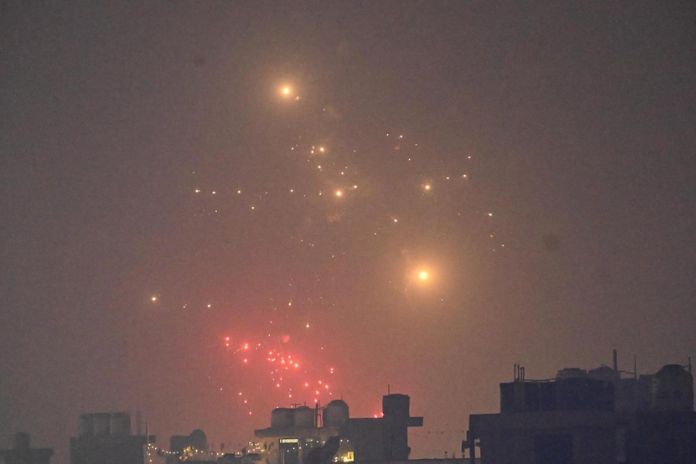
Delhi’s Deepavali night brought an alarming air-pollution spike—and an unusual problem: hourly PM2.5 readings disappeared from several government monitoring stations just as smog levels peaked. The missing data has renewed concerns that official Air Quality Index (AQI) figures may not fully reflect the severity of exposure.
What happened on Diwali night
Between midnight and 5 a.m. on November 9, researchers found 227 missing hourly PM2.5 observations across 59 CPCB-run monitoring stations in Delhi. Only 14 stations reported complete data during that period, while 45 stations had at least one missing reading.
The gaps grew as pollution intensified. At 10 p.m. on November 8, seven stations were not reporting; by 1 a.m., the number had risen to 36.
Why readings went blank
The Central Pollution Control Board (CPCB) said the issue was linked to the measurement range of its analysers. Instruments used when the National Air Quality Index was introduced in 2015 were calibrated for PM concentrations from 0 to 1,000 micrograms per cubic metre (µg/m³).
When Diwali firecracker smoke pushed PM2.5 beyond that limit, the automated validation system treated the readings as “outside range.” Those hours were therefore not used to calculate a station’s 24-hour average or its AQI.
How high did pollution go?
The Delhi Pollution Control Committee (DPCC) later released many of the delayed readings. They showed extraordinarily high PM2.5 concentrations: Mundka recorded 3,744 µg/m³ at 2 a.m., JNU recorded 3,023 µg/m³ at 4 a.m., and NSUT West Campus recorded 3,008 µg/m³ at 5 a.m.
These levels were more than 60 times India’s 24-hour PM2.5 standard of 60 µg/m³.
Why the AQI matters
PM2.5 refers to fine particles small enough to enter deep into the lungs and bloodstream. High exposure can worsen asthma, bronchitis, heart disease and other respiratory conditions.
Because readings above 1,000 µg/m³ were excluded from AQI calculations, the official index may have understated the pollution spike. An analysis by the Centre for Research on Energy and Clean Air (CREA) found 255 missing station-hour observations between 4 p.m. on November 8 and 4 p.m. on November 9—about 18% of the expected readings.
What needs to change
Delhi needs a monitoring system that can record, publish and account for extreme pollution events. Authorities should upgrade instruments, publicly display raw hourly values, clearly flag out-of-range readings, and explain how such values affect daily averages and AQI calculations.
Transparent data is essential during pollution emergencies. When monitors go blank at the worst possible moment, public trust in air-quality reporting suffers—and residents lose information they need to protect their health.