India will announce the final details of its Bilateral Trade Agreement (BTA) with the United States only after Washington offers a preferential tariff rate that gives Indian exporters an advantage over competing countries, Commerce and Industry Minister Piyush Goyal said on Thursday.
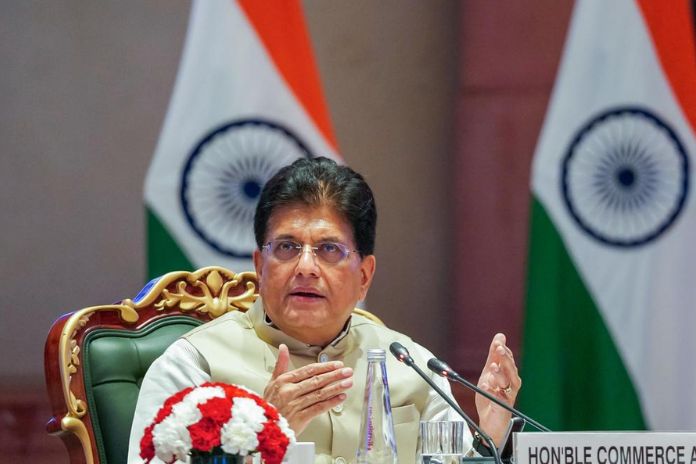
Speaking at a national workshop on “Leveraging FTAs: An Outreach Programme” in New Delhi, Goyal made it clear that New Delhi is ready to conclude the pact, but wants a clear duty edge in the U.S. market before locking in the remaining terms. “As soon as the U.S. is able to give us the preferential rate in comparison to our competition, we will finalise the BTA and announce the final details,” he said.
Preferential rate: the key condition for India–U.S. BTA
The minister’s remarks underline India’s push for a level playing field for its exporters. A preferential tariff rate would mean Indian goods face lower import duties in the U.S. than similar products from other supplier nations, improving their price competitiveness. Without such an edge, Indian companies could remain at a disadvantage even if a trade deal is signed, officials suggest.
The condition also signals that India is not in a rush to finalise technical details at any cost. Instead, it wants the BTA to translate into real market access and export gains, particularly in sectors where rivals may already enjoy better duty treatment.
Nine FTAs, $60 trillion GDP, two‑thirds of global trade
Alongside the U.S. negotiations, Goyal highlighted the scale of India’s free trade agreement (FTA) push. He said India’s nine FTAs span economies representing about $60 trillion of GDP and will provide preferential access to nearly two‑thirds of global trade.
With upcoming agreements and efforts to deepen market access, India could eventually gain access to around 75% of global trade at tariff rates lower than those faced by competitors, he added. Reported FTAs in this basket include recent or concluded deals such as India–UK CETA (2025), India–Oman CEPA (2025), India–New Zealand FTA (2025), India–EU FTA (2026), and an interim framework/arrangements with the U.S. (2026).
Nationwide push to maximise FTA benefits
Goyal also called for a focused, inclusive, and nationwide effort to ensure businesses actually use these agreements. He urged industry bodies, export councils, and state governments to work together so that small and medium enterprises can tap into lower tariffs and simpler rules under the FTAs.
The message is clear: signing deals is only the first step. The real test will be whether Indian exporters can convert preferential market access into higher shipments, better margins, and stronger global supply‑chain links.
What this means for the India–U.S. trade deal
For now, the India–U.S. BTA remains in a “ready‑to‑finalise” zone, pending Washington’s offer on preferential duties. Once the U.S. indicates a tariff structure that puts India ahead of key competitors, New Delhi expects to quickly wrap up the remaining details and make a formal announcement.
For Indian exporters, the stakes are high. A well‑structured BTA with a clear duty advantage could boost shipments in sectors such as engineering goods, pharmaceuticals, textiles, and certain services. For U.S. firms, deeper access to India’s market and clearer rules could also mean new opportunities in a fast‑growing economy.