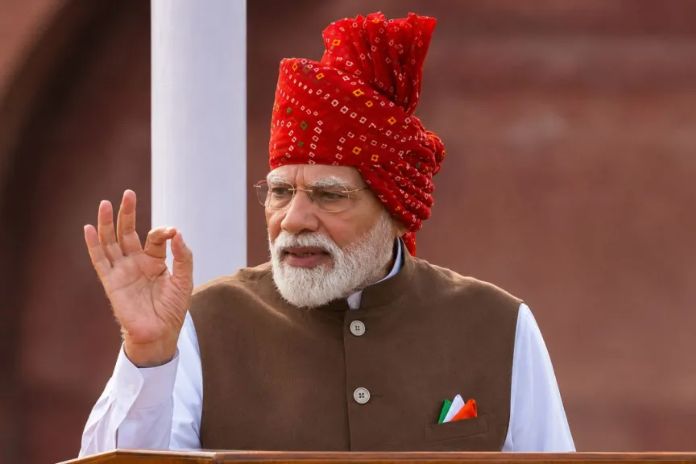
Prime Minister Narendra Modi delivered his 13th consecutive Independence Day address from the historic Red Fort on Saturday, marking India’s 80th Independence Day and the 150th anniversary of Vande Mataram. In a speech centered on ambition, self-reliance, and youth power, Modi outlined a comprehensive roadmap to transform India into a developed nation by 2047 (Viksit Bharat), introducing the Sapta Dhara (seven streams of strength) framework and announcing major initiatives for education, technology, and economic growth.
Historic Context: 80 Years of Freedom, 150 Years of Vande Mataram
This year’s Independence Day celebrations carried special significance as India commemorated 150 years of Vande Mataram*, the national song that inspired the freedom struggle. For the first time, Vande Mataram was sung from the Red Fort ramparts during the official ceremony, adding emotional depth to the occasion. The theme for 2026—“Yuva Shakti for Viksit Bharat@2047”—highlighted the central role of India’s youth in achieving the nation’s developed-country aspirations.
Modi began his address by paying tribute to freedom fighters whose sacrifices made independence possible, saying their dreams continue to inspire the journey toward a developed India. He also expressed solidarity with communities affected by recent floods, assuring that the entire nation stands with them.
The Big Dream: Viksit Bharat by 2047
Prime Minister Modi reiterated the national resolve to make India a Viksit Bharat (Developed India) by 2047, when the country completes 100 years of independence. Emphasizing that nations grow through ambition and capability, he urged Indians to “dream big” rather than settle for modest goals.
Ambitious National Targets
To operationalize this vision, Modi set specific, measurable targets for the next decade:
- 50 Indian companies in the Fortune 500
- At least one Indian bank among the world’s top five
- At least one Indian pharmaceutical company in the global top five
These targets reflect India’s ambition to become a trusted hub in the global supply chain, from design to manufacturing.
Sapta Dhara: Seven Streams of Strength for Holistic Development
A centerpiece of the 2026 speech was the introduction of Sapta Dhara (seven streams of strength), a new framework to accelerate India’s journey toward developed-nation status. Modi explained that these seven areas must be pursued simultaneously to achieve holistic national progress:
1. Manufacturing Power
- Focus on the entire value chain, from small components to complete products
- Emphasis on cost, quality, and scale
- Goal: Make India a trusted global manufacturing hub
2. Agriculture and Food Processing
- Strengthen farming and food-processing sectors
- Enhance value addition in agricultural products
3. Technology and Innovation
- Leverage emerging fields: space, quantum computing, robotics
- Push for semiconductors, critical minerals, AI, nuclear energy, telecom, and digital sectors
4. Gati Shakti (Connectivity)
- Seamless fast connectivity across the nation
- High-speed railways, modal highways, inland waterways, multi-modal logistics
5. Raksha Shakti (Defence Self-Reliance)
- Continue expanding indigenous defence production
- Modi noted that India’s defence manufacturing has “vastly increased” in recent years
6. Green and Blue Economy
- Achieve green mobility and green manufacturing
- Harness ocean resources sustainably (blue economy)
7. Soft Power
- Promote yoga, healthcare, tourism, and creative arts globally
- Leverage India’s cultural influence on the world stage
Youth Empowerment: Free Coaching, AI Training, and Census Participation
Modi placed special emphasis on empowering India’s youth, announcing several concrete measures:
Free Online Coaching for Competitive Exams
To reduce the financial burden on poor and middle-class families, the government will provide free online coaching for various competitive examinations. Modi said this will save families “thousands of crores of rupees” spent on coaching and allow young people to stay close to their families while preparing.
AI Training for 1 Crore Youth
A new scheme will train 1 crore (10 million) youth in artificial intelligence within one year, positioning India at the forefront of the AI revolution.
Appeal to Youth: Monitor the Census
Modi sought “one or two hours” from young Indians to actively participate in the ongoing Census exercise, urging them to help ensure accuracy and completeness.
Message to Young Dreamers
“I want to tell the youth of the country: come forward with your dreams; we will ensure there is no shortage of resources,” Modi said, emphasizing that the government will support ambitious young Indians.
Economic Progress: From ‘Fragile Five’ to Fastest-Growing Economy
Modi highlighted India’s economic transformation over the past 12 years, noting that the country has moved from being part of the “Fragile Five” to becoming the world’s fastest-growing major economy. He credited this progress to the collective efforts of 140 crore Indians and the principles of Atmanirbharta (self-reliance).
Key Economic Milestones Cited
- India now ranks among the top economies globally
- Defence production has increased significantly
- Major advances in railways, telecom, digital infrastructure, and nuclear energy
- Push for semiconductors and critical minerals to secure supply chains
Security and Social Challenges: Naxalism Nearing End
On internal security, Modi declared that Naxalism and Maoism are breathing their last, with violence no longer having the strength to sustain itself. He said these movements had “destroyed the future of millions of young people” and expressed satisfaction that the government’s efforts are bringing them to an end.
The Three As: Atmavishwas, Atmagaurav, Atmanirbhar Bharat
Modi linked India’s progress to three core principles:
- Atmavishwas (Self-Confidence)
- Atmagaurav (Self-Respect)
- Atmanirbhar Bharat (Self-Reliant India)
He said these values are essential for India to achieve its Viksit Bharat goals and maintain its position as a trusted global partner.
Technology Integration: AI-Powered Live Translation
In a demonstration of India’s technological capabilities, Modi’s speech was live-translated into 22 Indian languagesusing the AI-based Digital India Bhashini app. This ensured real-time accessibility for citizens across linguistic groups.
What This Means for India’s Future
PM Modi’s 2026 Independence Day speech laid out a clear, action-oriented vision for India’s next two decades. By combining economic ambition (Fortune 500 targets), structural reforms (Sapta Dhara framework), youth empowerment (free coaching, AI training), and cultural pride (Vande Mataram anniversary), the address positioned 2047 as a achievable milestone rather than a distant aspiration.
The emphasis on manufacturing, technology, and self-reliance signals continued focus on reducing import dependency and building indigenous capacity in critical sectors like semiconductors, defence, and pharmaceuticals. Meanwhile, the push for green mobility and sustainability aligns India with global climate goals while creating new economic opportunities.
For India’s youth—the primary beneficiaries of the announced schemes—the speech offered both inspiration and concrete support mechanisms, from free coaching to AI training programs. Modi’s call for youth participation in the Census also reflects a broader strategy of engaging young Indians in nation-building activities.
Conclusion: A Nation Dreaming Big
As India celebrated its 80th Independence Day, PM Modi’s message was clear: the time has come to move beyond incremental progress and embrace transformative change. With the Sapta Dhara framework providing a roadmap, youth empowerment initiatives building human capital, and ambitious economic targets setting the pace, the vision of Viksit Bharat by 2047 now has both direction and momentum.
The historic singing of Vande Mataram from the Red Fort, combined with AI-powered translation and forward-looking policy announcements, symbolized a nation honoring its past while confidently stepping into its future.