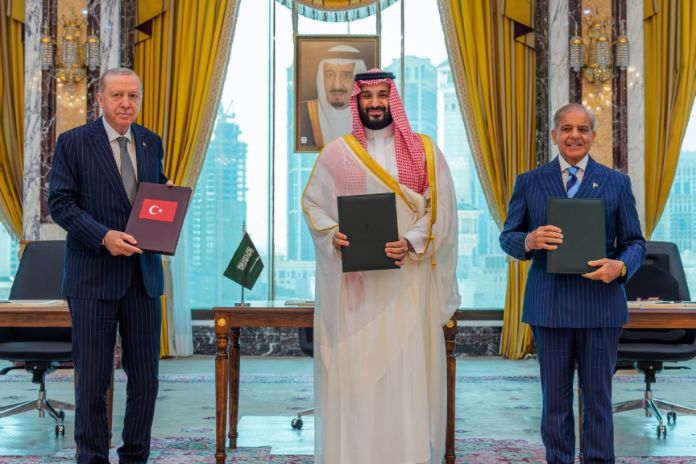
Pakistan, Saudi Arabia and Turkey have signed a new defence agreement aimed at strengthening security cooperation amid rising tensions in West Asia. The pact states that an armed attack on any one of the three countries will be treated as an attack on all. The agreement is being closely watched because it brings together three influential Muslim-majority countries with different but complementary military and strategic strengths.
The deal comes at a time when Gulf countries face growing missile, drone and maritime security threats. It also reflects concerns about the reliability of external security guarantees, particularly during the continuing regional crisis involving Iran, Israel and the United States.
Why Saudi Arabia Joined
Saudi Arabia is seeking stronger security partnerships as instability spreads across the Gulf and wider Middle East.
The kingdom has traditionally relied heavily on the United States for defence. However, repeated attacks on regional infrastructure, threats to oil facilities and risks to shipping routes have encouraged Riyadh to diversify its security relationships.
Pakistan offers Saudi Arabia military manpower, training and long-standing security links. Turkey adds advanced defence technology, drones and a large conventional military. Together, the partnership gives Riyadh additional options beyond its relationship with Washington.
What Pakistan Gains
For Pakistan, the agreement provides political support, military cooperation and possible economic benefits.
Islamabad has maintained close defence ties with Saudi Arabia for decades. It also has expanding military and technology cooperation with Turkey, including naval projects, training and defence production.
The new pact could help Pakistan gain access to greater investment and Turkish defence expertise. It may also strengthen Islamabad’s diplomatic position by suggesting that any major conflict involving Pakistan could have wider regional consequences.
Turkey’s Strategic Interests
Turkey sees the agreement as an opportunity to expand its influence in the Muslim world and promote its growing defence industry.
Ankara has developed strong defence relations with Pakistan and has become a major exporter of drones, naval systems and other military equipment. Cooperation with Saudi Arabia could provide new markets and investment for Turkish defence companies.
The pact also allows Turkey to pursue a balancing strategy. While it remains a NATO member, Ankara is building relationships with regional powers so that it is not dependent on one bloc or one major power.
What It Means for India
The agreement is likely to receive close attention in New Delhi because of Turkey’s support for Pakistan and the possibility of deeper military coordination among the three countries.
India’s main concern is that Saudi Arabia and Turkey could provide stronger diplomatic, financial or military backing to Pakistan during a future crisis. Intelligence-sharing, defence production and joint military planning could also complicate India’s security calculations.
However, the pact should not automatically be described as an “Islamic NATO”. The agreement’s command structure, enforcement mechanism and actual military commitments are still unclear. The three countries also have different interests regarding Iran, Israel, the United States and regional conflicts.
For now, the Pakistan-Saudi Arabia-Turkey defence pact is best understood as a collective deterrence arrangement and a political signal. It shows that the three countries want a larger role in shaping the future security order of West Asia.