
Political defections are often framed as betrayals of ideology or moral failures. But what if defections are not simply failures of political ethics, but natural outcomes of how political systems are structured?
Case as Evidence
Recent Indian politics has repeatedly shown that defections are rarely isolated or impulsive acts. From high-profile leaders shifting allegiance to coordinated legislative mergers designed to avoid disqualification under the Tenth Schedule, defections increasingly appear calculated and politically timed.
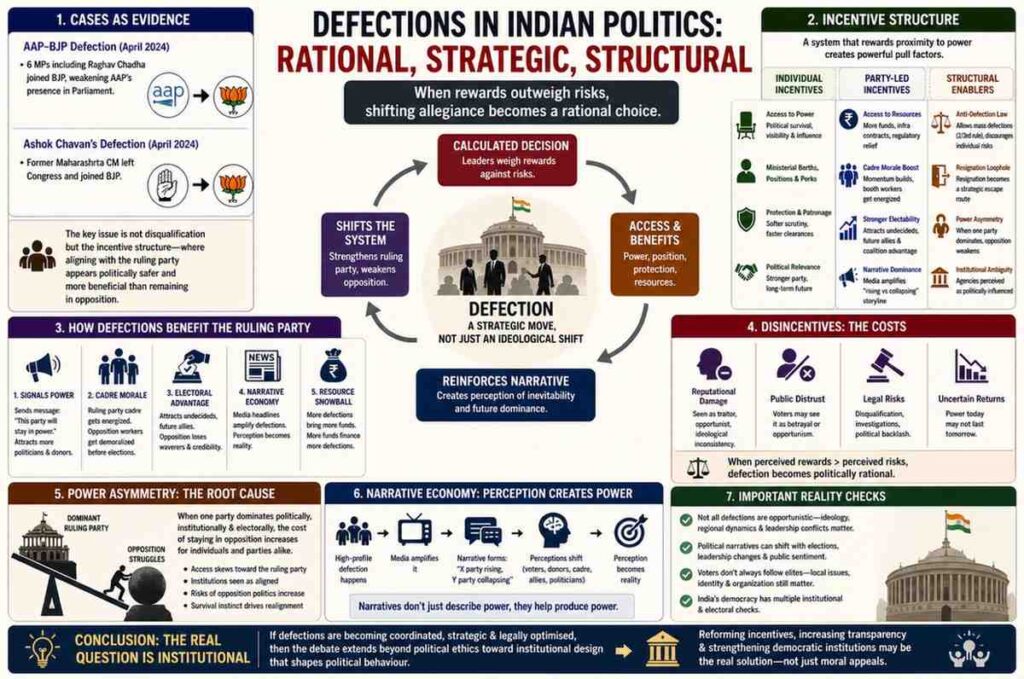
For instance, former Maharashtra Chief Minister Ashok Chavan joined the BJP in 2024 after resigning from Congress, thereby avoiding immediate disqualification under the anti-defection framework. Similarly, several state-level political realignments in recent years have involved coordinated factional shifts that remained legally protected under the merger provisions of the Tenth Schedule.
These developments suggest that the central issue is not merely disqualification, but the broader incentive structure of Indian politics. When access to power, political survival and future relevance become closely tied to proximity with the ruling establishment, defections begin to look less like exceptional acts of disloyalty and more like politically practical decisions.
Incentive Structure:
In a system where political survival often depends on proximity to power, shifting allegiance can become a rational decision rather than an ideological anomaly.
The incentive structure behind defections operates at multiple levels — individual, party-led and structural.
First is access to power. Politicians frequently perceive the ruling party as offering greater political security, visibility and long-term relevance. Aligning with a politically dominant party may improve access to administrative influence, electoral machinery, political protection and future opportunities.
The anti-defection framework itself indirectly reflects this reality. While individual defections may invite disqualification, coordinated political shifts often remain viable under merger provisions. As a result, defections are not necessarily prevented — they are reorganised into collective and legally safer forms.
The Ashok Chavan case reflected this pattern clearly. Resignation itself became a political instrument that helped avoid immediate disqualification while allowing political realignment.
At the same time, defections are not always purely opportunistic. Ideological disagreements, leadership conflicts, regional aspirations and electoral calculations may also contribute to political realignment.
Defections also carry risks. Leaders may face reputational damage, public distrust or legal scrutiny under the anti-defection framework. However, when perceived rewards outweigh perceived risks, political switching increasingly resembles strategic risk management rather than ideological transformation.
How Does Political Dominance Change Incentives?
When one party becomes politically, institutionally and electorally dominant, the cost of remaining in opposition rises significantly.
Political decisions are rarely made in isolation. The risks and rewards associated with defection are shaped by the wider distribution of power within the political system itself.
A defection does not merely transfer one MP from one party to another. It can create structural advantages for the receiving party across multiple fronts.
First, defections operate as signals of political durability. They communicate that a particular party is likely to remain influential in the future. This perception can affect donors, political allies, bureaucratic behaviour and future coalition calculations.
Critics and opposition parties have frequently raised concerns regarding selective enforcement and asymmetrical scrutiny by investigative agencies in politically sensitive cases. The 2013 “caged parrot” remark by the Supreme Court reflected broader institutional concerns regarding the autonomy of investigative agencies and their vulnerability to executive influence.
Second is cadre morale. Defections weaken organisational confidence within opposition parties before elections are even fought. When political status becomes associated with proximity to power, each high-profile defection can psychologically demoralise opposition workers while energising the dominant party’s support base.
Third, defections influence coalition politics and perceptions of viability. Political dominance is not sustained through electoral arithmetic alone. Perceptions of stability, momentum and future relevance also shape how political actors position themselves.
A party perceived as rising attracts future allies, while a weakened opposition may increasingly appear politically untouchable.
The Defection Cascade Model
Defections often function less as isolated events and more as self-reinforcing political signals.
This creates what may be called the Defection Cascade Model.
Under this model:
- A high-profile defection occurs.
- Media narratives amplify perceptions of dominance and inevitability.
- Donors, allies, undecided politicians and local cadres respond to these signals.
- Organisational confidence shifts toward the dominant party.
- Additional defections become more politically attractive.
The cycle then reinforces itself.
One defection is therefore not merely a “+1” for the ruling party and a “-1” for the opposition. It can simultaneously shift money, morale, messaging, media narratives and future coalition behaviour.
The Tenth Schedule may regulate the legal act of defection, but it does not fully address the political physics and psychological effects that follow.
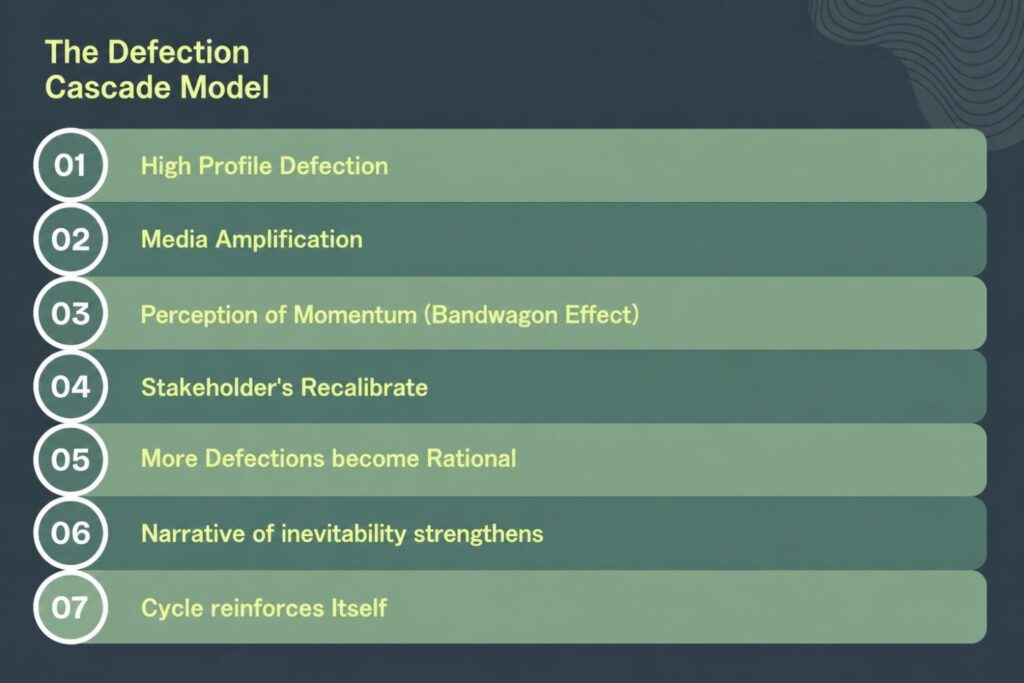
This process reflects a political bandwagon effect, where perceptions of future dominance influence present political behaviour. Defections therefore operate not merely as numerical shifts, but as political signals that reshape expectations, alliances and political calculations.
Narrative Economy: When Perception Produces Power
In contemporary politics, power is not only exercised — it is perceived.
High-profile defections shape narratives of dominance and decline. Even when they do not immediately alter electoral outcomes, they can reshape the psychological environment in which future elections are fought.
Media coverage often amplifies these shifts through headlines suggesting that one party is “rising,” while another is “collapsing” or “losing control.” Such narratives influence floating voters, political donors, future allies, party workers and politicians themselves.
Defections therefore operate as coordination signals. They communicate where influential political actors believe future power will concentrate.
As perceptions spread, they can begin producing real political effects. Voters may increasingly view the ruling party as “inevitable,” while opposition parties risk being perceived as unstable or declining. In this sense, narratives do not merely describe political power — they can help produce it.
Yet political dominance should not be treated as irreversible. Democratic politics remains fluid. Electoral setbacks, leadership changes, public dissatisfaction and regional political identities can rapidly reshape political momentum.
Voters do not always follow elite political calculations, particularly where local organisational structures and ideological loyalties remain strong.
Additionally, India’s democratic structure still contains multiple institutional and electoral checks that complicate any linear concentration of power.
Conclusion:
If defections are increasingly coordinated and legally protected, then the debate extends beyond individual morality toward the institutional incentives that shape political behaviour itself.
The persistence of defections may reveal less about personal ethics and more about how democratic systems distribute power, risk, access and political survival.
The real question, therefore, is not simply whether politicians are ethical, but whether existing political structures reward ethical behaviour at all.