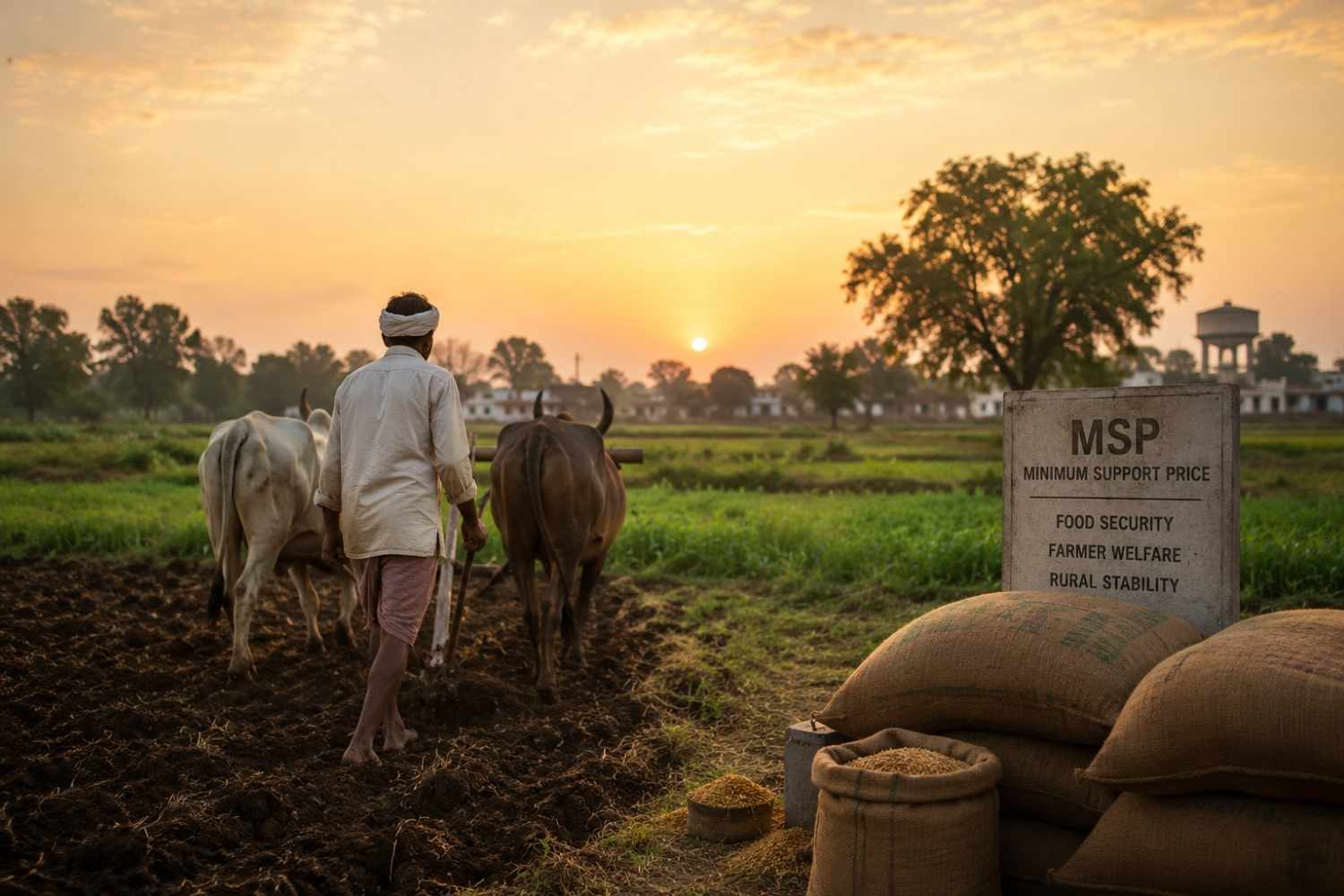
India liberalised much of its economy after 1991, yet agriculture remains one of its most protected sectors through Minimum Support Price (MSP), public procurement, subsidies, and regulated markets. This raises an important question: if market-oriented reforms improve efficiency, competition, and investment, why has India remained cautious about liberalising agriculture? Is this protection merely political populism, or does it reflect deeper historical, structural, and institutional realities? The answer lies not in economics alone, but in India’s unique experience of food insecurity, state-building, and rural dependence.
Historical Memory: Why Food Security Became a Strategic Priority
India’s agricultural institutions cannot be understood without examining the country’s historical experience of food insecurity. During the colonial period, devastating famines such as the Bengal Famine of 1770 and the Bengal Famine of 1943 exposed the vulnerabilities of an extractive agrarian system and the limitations of relying solely on market forces during crises. Following Independence, food shortages persisted as Partition altered the geography of agricultural production while rapid population growth placed additional pressure on domestic food supplies.
The situation became more challenging during the 1950s and 1960s when India depended heavily on imported food grains, particularly under the United States’ Public Law 480 (PL-480) programme. The 1965-66 drought and the resulting “ship-to-mouth” situation demonstrated how dependence on external food aid could expose India to strategic vulnerability. Rather than viewing food merely as a commodity, policymakers increasingly recognised food security as an essential component of national sovereignty and policy autonomy.
These experiences shaped India’s agricultural strategy. The Green Revolution, supported by scientists such as M. S. Swaminathan and backed by government investments in irrigation, procurement, agricultural research, and high-yielding varieties, transformed India from a food-deficit nation into one that was largely self-sufficient in cereals. Institutions such as the Food Corporation of India (FCI), Minimum Support Price (MSP), buffer stocks, and the Public Distribution System were therefore created not simply as welfare measures but as permanent safeguards against a return to chronic food insecurity.
The Economic Case for Market Reforms
While India’s agricultural institutions emerged from historical necessity, economic thinking has gradually shifted towards greater market orientation. Economists argue that competitive markets allocate resources more efficiently than excessive government intervention. Greater market participation can improve price discovery, encourage private investment in storage and logistics, promote technological innovation, diversify cropping patterns, and strengthen India’s export competitiveness. Liberalisation can also reduce market distortions and lower the fiscal burden created by extensive subsidies and procurement programmes. For these reasons, many economists support gradual and well-regulated market reforms rather than complete state withdrawal.
However, these arguments assume the existence of competitive markets, adequate infrastructure, and institutions capable of protecting vulnerable participants during economic transition. It is precisely these conditions that remain uneven across Indian agriculture.
Why Market Reforms Alone Cannot Fix Indian Agriculture
Unlike most sectors of the economy, agriculture performs multiple functions simultaneously. It is not only an economic activity but also a source of food security, employment, political stability, and rural livelihoods. According to the Ministry of Statistics and Programme Implementation (MoSPI), nearly 89.4% of operational landholdings are below two hectares, limiting farmers’ bargaining power and increasing their vulnerability to market fluctuations. At the same time, inadequate storage facilities, weak transport networks, insufficient cold-chain infrastructure, and limited access to competitive buyers mean that deregulation alone cannot guarantee efficient markets.
Agriculture also continues to support a significant share of India’s workforce despite contributing a much smaller proportion to GDP. Sudden exposure to unrestricted market competition without adequate institutional support could therefore increase income volatility, accelerate rural distress, and deepen existing inequalities. Moreover, increasing climate uncertainty, groundwater depletion, and erratic monsoons have made farming inherently riskier, strengthening the case for continued state support alongside market reforms.
The Political Economy of Reform: Lessons from the Farm Laws
The debate surrounding the three Farm Laws of 2020 demonstrated that agricultural reform cannot be understood solely through economic logic. The reforms sought to expand farmers’ marketing choices beyond APMC mandis, promote contract farming, and encourage private investment in agricultural supply chains. From a market perspective, these measures were intended to improve competition and efficiency. However, many farmers feared that the reforms would gradually weaken MSP procurement, increase corporate bargaining power, and reduce legal protections available to small cultivators. Concerns over implementation, dispute resolution, and the absence of statutory guarantees for MSP resulted in year-long protests, eventually leading to the repeal of the laws in 2021. The episode illustrated that economically desirable reforms cannot succeed without institutional trust, political legitimacy, and confidence among those most directly affected.
Transition to the next section: The Farm Laws debate therefore shifts the focus from a broader question of liberalisation to a more specific one: has the institutional framework created after the Green Revolution outlived the problems it was originally designed to solve? This brings the discussion to the role of MSP and related agricultural institutions in contemporary India.
MSP: Symptom or Solution?
Has the institutional framework created after the Green Revolution outlived the problems it was designed to solve? The answer is more nuanced than a simple yes or no. India’s post-Green Revolution institutions—including the Minimum Support Price (MSP), Food Corporation of India (FCI), Public Distribution System (PDS), input subsidies, agricultural credit, irrigation investments, and APMC mandis—were established in response to the severe agricultural crisis of the 1960s. At the time, India faced chronic food shortages, low agricultural productivity, recurring droughts, and dependence on foreign food aid. Together, these institutions increased food-grain production, stabilised farm incomes, built buffer stocks, and transformed India from a food-deficit nation into one that is largely self-sufficient in staple cereals.
However, the challenges confronting Indian agriculture today differ significantly from those of the 1960s. The central concern is no longer achieving food self-sufficiency alone, but ensuring higher farm incomes, sustainable resource use, efficient markets, and resilience to climate change. Consequently, institutions that were once highly effective in addressing scarcity now face criticism for creating unintended distortions.
Assured procurement of wheat and rice under MSP, for instance, has encouraged monocropping in states such as Punjab and Haryana, contributing to groundwater depletion, declining soil health, and excessive dependence on chemical fertilisers. Likewise, universal input subsidies have often promoted inefficient use of water and fertilisers while imposing a growing fiscal burden on governments.
The APMC mandi system presents a similar paradox. It was originally established to protect farmers from exploitation through regulated markets and transparent auctions, and in many regions it continues to perform this role effectively. Yet in several states, limited competition, restrictive licensing, and fragmented market structures have reduced efficiency, often preventing farmers from realising better prices despite improvements in agricultural productivity. These shortcomings suggest that while the objective of protecting farmers remains relevant, the institutional framework requires adaptation to changing economic conditions.
Nevertheless, declaring these institutions obsolete would overlook India’s continuing structural realities. A large proportion of rural households still depend directly or indirectly on agriculture, while most cultivators remain small and marginal farmers with limited bargaining power. Agricultural production also faces increasing risks from erratic monsoons, climate change, pest outbreaks, and global price volatility. Under such conditions, MSP procurement, buffer stocks, and the Public Distribution System continue to play an essential role in ensuring food security, stabilising prices, and protecting vulnerable households during periods of economic or environmental distress.
The debate, therefore, should not centre on whether these institutions should be dismantled, but on how they should evolve. Many economists advocate reforms that preserve the protective functions of the existing framework while addressing its inefficiencies. These include targeted procurement, diversification towards pulses and oilseeds, strengthening Farmer Producer Organisations (FPOs), expanding storage and logistics infrastructure, encouraging competitive but well-regulated markets, and gradually replacing blanket input subsidies with more efficient forms of income and risk support.
In this sense, the institutional framework created after the Green Revolution has not outlived the problems it was designed to solve; rather, the nature of those problems has evolved. Food security and farmer protection remain indispensable, but they must now be balanced with sustainability, productivity, diversification, and market competitiveness. The challenge before policymakers is therefore one of institutional evolution rather than institutional replacement.
Conclusion
India’s agricultural policies are shaped not only by economic considerations but also by memories of food insecurity, historical dependence, and decades of institution-building. While market reforms can improve efficiency and competitiveness, they cannot by themselves resolve the structural challenges facing Indian agriculture. The real challenge is not choosing between markets and the state, but reforming institutions in a way that balances efficiency with food security, farmer welfare, and long-term sustainability.