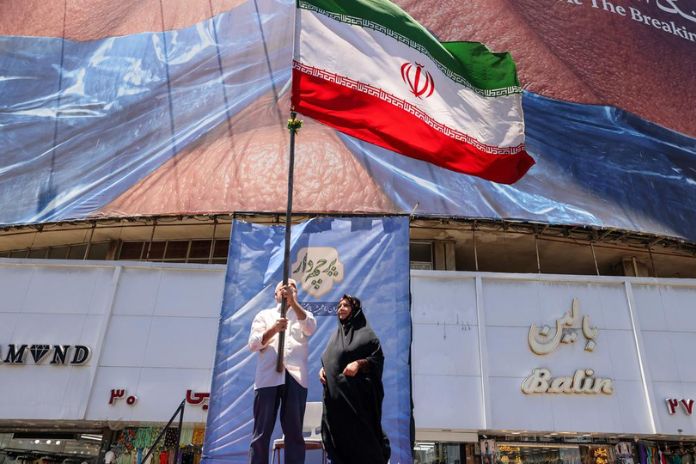
An senior official from Iran’s Islamic Revolutionary Guard Corps (IRGC) has said the chance of a renewed war between Iran and the United States is low. Mohammad Akbarzadeh, deputy political chief of the IRGC Navy, made the remarks on Wednesday, May 27, 2026. He credited what he called “the enemy’s weakness” and emphasized that Iran’s armed forces remain fully prepared if needed. “Our armed forces are lying in wait with full magazines,” Akbarzadeh said. “We are ready for any scenario.” He added a strong warning for any potential aggressors: Iran would turn its southern coastline, from Chabahar to Mahshahr, into a “graveyard for aggressors” if attacked. This statement comes after an April 2026 ceasefire between the United States and Iran, mediated in part by Pakistan. While open fighting has paused, diplomatic and military tensions remain high in the region.
U.S. Senator Lindsey Graham (Republican, South Carolina) publicly criticized Pakistan’s role as a mediator in the U.S.–Iran conflict. In a post on X (formerly Twitter) on May 26, 2026, he called Pakistan’s involvement “more than problematic.” Graham’s main concern centers on Pakistan’s longstanding stance toward Israel. He pointed to comments by Pakistan’s Defence Minister Khawaja Asif, who said Pakistan would not recognize Israel until a Palestinian state is established. Graham wrote, “The clip may be a year old, but I fear the sentiment is fresh.” He urged Pakistan to respond positively to President Donald Trump’s call to join the Abraham Accords, which normalize relations between Israel and several Muslim-majority countries. Graham expressed worry that Pakistan’s official position remains openly hostile to Israel. In a previous Senate hearing, Graham went further, saying, “I don’t trust Pakistan as far as I can throw them.” He also suggested that Washington should consider another mediator if reports about Iranian aircraft operating from Pakistani bases were confirmed.
Pakistan’s emergence as a mediator marks a rare diplomatic breakthrough. In April 2026, Pakistan used its longstanding ties with Iran and its strengthened relationship with the Trump administration to help broker a ceasefire between the two long-standing adversaries. Pakistan helped facilitate an 11th-hour ceasefire deal in April 2026 and is now set to host peace talks between the United States and Iran. Some analysts call this Pakistan’s “biggest diplomatic win in years.” Despite this achievement, criticism from U.S. lawmakers like Graham highlights the complexity of Pakistan’s position. As a country with deep historical ties to Iran but also increasing strategic cooperation with the U.S., Pakistan walks a delicate diplomatic line.
The implications for the region are significant. For Iran, the IRGC’s message is clear—war is unlikely for now, but Iran remains militarily ready and rhetorically tough. For the U.S., Senator Graham’s comments reflect growing skepticism in parts of Washington about relying on Pakistan, especially given its stance on Israel. For Pakistan, the country faces pressure to prove its neutrality and reliability as a mediator, while balancing relationships with Iran, the U.S., and the broader region. For Israel and the broader Middle East, any shift in U.S.–Iran tensions directly affects regional security, including the ongoing Israel–Iran conflict and wider Gulf stability.
In summary, an Iran Guards official has said the possibility of renewed war with the U.S. is low, while simultaneously issuing a firm warning against any future attack. At the same time, U.S. Senator Lindsey Graham has labeled Pakistan’s mediation role “problematic,” citing Pakistan’s anti-Israel stance as a major concern. The situation remains fragile: a ceasefire is in place, but trust is low, and the diplomatic path forward is far from smooth.