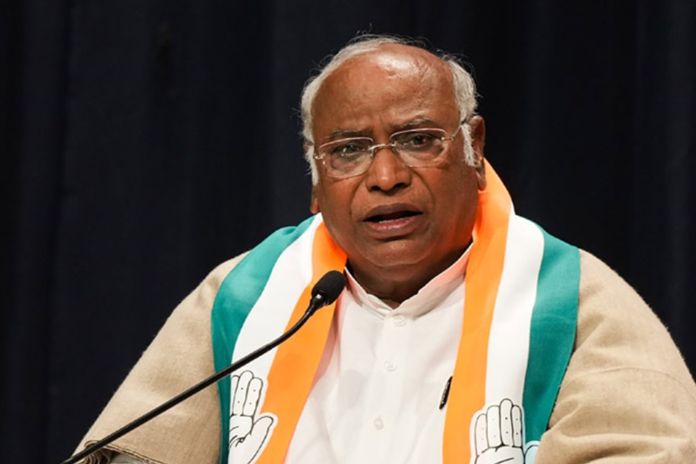
Congress president Mallikarjun Kharge has sharply criticised the Modi government over Delhi’s worsening air pollution, asking why India is becoming a “vishwaguru” in toxic air rather than in clean development. His comments came as the national capital struggled with severe smog after Diwali.
Kharge’s Main Attack
In a post on X, Kharge accused the BJP-led Centre of relying on “piecemeal measures,” public-relations exercises, broken promises and blame games instead of lasting action. He said clean air should be treated as a fundamental right, not a privilege granted by the government.
His demand for a “Hawa Ka Hisaab”—an account of the air—calls for transparency on pollution data, public spending, enforcement and emission reduction.
Missing PM2.5 Data
A major part of Kharge’s criticism concerns air-quality monitoring. He alleged that PM2.5 readings disappeared from 36 of Delhi’s 59 monitoring stations just as pollution reached its peak.
PM2.5 refers to fine particles small enough to enter deep into the lungs and bloodstream. Reliable, real-time readings are essential for residents, doctors and policymakers trying to assess health risks and respond to pollution spikes.
Funds Left Unspent
Kharge also questioned the use of money meant to fight pollution. According to his post, ₹1,154 crore—nearly 60% of Delhi’s environmental compensation collections—remained unspent, based on a September 2026 RTI response.
He further claimed that Delhi had used only 17% of the funds released under the National Clean Air Programme (NCAP) until December 2025. If accurate, this points to a serious gap between available resources and on-ground action.
Health Impact of Toxic Air
The Congress president cited research-based estimates linking air pollution to severe health consequences. He said 17,188 deaths in Delhi in 2023 were estimated to be attributable to particulate air pollution, accounting for nearly 15% of all deaths in the city.
He also referred to an estimated 1,69,400 deaths of children under five across India in 2021 due to air-pollution-related causes. These figures are model-based estimates, but they underline the scale of the public-health emergency posed by repeated exposure to hazardous air.
A Recurring Winter Problem
Delhi’s pollution crisis is not new. Every year, from October to February, a combination of vehicle emissions, construction dust, industrial pollution, waste burning, weather conditions and stubble burning in neighbouring states pushes air quality into the “very poor” and “severe” categories.
After Diwali, several monitoring stations recorded AQI levels above 400, placing them in the severe category. The official citywide AQI was reported at 372, while some areas recorded even higher readings.
What Needs to Change
Kharge’s message is clear: emergency measures and announcements are not enough. Delhi needs continuous monitoring, transparent data, timely spending of clean-air funds, stricter enforcement and coordinated action across Delhi-NCR and neighbouring states.
The Supreme Court has reportedly asked Delhi, Haryana, Uttar Pradesh and Rajasthan to submit detailed responses and proposed measures within two weeks. The real test will be whether governments can convert promises into measurable improvements in air quality.
For millions living in Delhi-NCR, the demand is simple: breathable air, honest data and accountable governance.