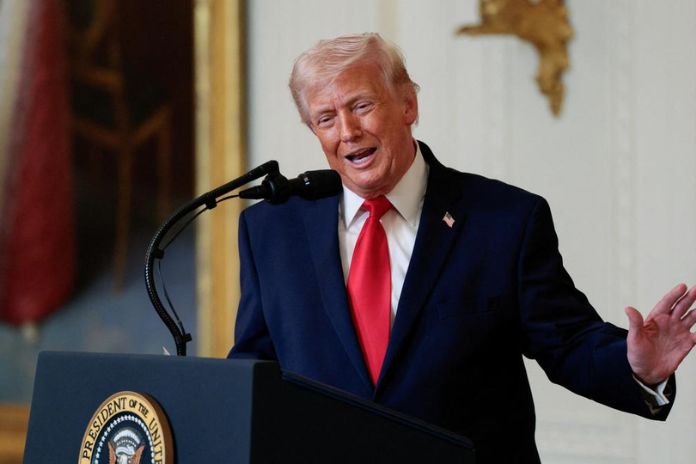
President Donald Trump has issued a stark warning to Iran: if the country acquires a nuclear weapon, “all hell will rain down” on Tehran. The president’s statement underscores Washington’s unwavering stance that Iran must never possess nuclear capabilities.
On the same day, Iranian Foreign Minister Abbas Araghchi announced a major breakthrough. He said that negotiations with the United States on a final agreement covering Tehran’s nuclear programme will likely begin on June 19, 2026.
What the talks will cover
The final negotiations will focus on two critical issues:
- Tehran’s nuclear programme – limits, monitoring, and safeguards
- Lifting of sanctions – economic relief for Iran in exchange for nuclear constraints
According to Iranian officials, the detailed negotiations will unfold over a 60-day window after a memorandum of understanding (MoU) is physically signed by both Iran and the United States.
Where and who will attend
The MoU signing is expected to take place in Switzerland, a neutral location often used for high-stakes diplomatic deals. Iran’s top negotiator will be Mohammad Bagher Ghalibaf, deputy foreign minister.
The United States is expected to send a senior team led by Vice President JD Vance. President Trump may also attend, depending on final arrangements.
Trump’s broader message
Beyond the nuclear warning, Trump said the deal would have major global economic benefits. He claimed that once the agreement is signed, the Strait of Hormuz will “completely open,”allowing free passage for oil shipments and boosting global energy markets.
The Strait of Hormuz is one of the world’s most critical oil chokepoints. Any disruption there can send oil prices sharply higher.
A history of broken promises
While the announcement marks progress, Iranian officials remain cautious. Araghchi highlighted Iran’s history of diplomatic betrayals, noting that past agreements have been “torn up” and commitments “broken.”
This skepticism reflects years of tension between the two countries, including the US withdrawal from the 2015 nuclear deal and subsequent sanction escalations.
The war backdrop
The negotiations come after nearly four months of war triggered by US and Israeli military strikes on Iranian targets. The conflict has heightened fears of a broader Middle East war involving Iran, Israel, and proxy groups.
Pakistan and Qatar have played key roles as mediators, facilitating indirect negotiations between Washington and Tehran. Their involvement has helped keep the dialogue alive even during intense military confrontations.
The Lebanon spoiler
Despite the momentum, the talks face a major risk: the ongoing conflict between Israel and Hezbollah in Lebanon. Iranian officials warn that escalation in Lebanon could derail the entire negotiation process.
Hezbollah, a powerful Iranian-backed group, has been exchanging fire with Israel. Any major expansion of this conflict could harden positions on both sides and make a deal harder to achieve.
Why this matters for India and the world
For India, a stable Middle East is crucial for several reasons:
- Oil imports: India relies heavily on Middle Eastern oil. A reopened Strait of Hormuz would help stabilize prices.
- Trade routes: The region is vital for India’s maritime trade with Europe and Africa.
- Regional stability: A nuclear-armed Iran could destabilize West Asia, affecting Indian security and economic interests.
Globally, the deal could:
- Reduce the risk of a wider Middle East war
- Prevent Iran from developing nuclear weapons
- Ease sanctions pressure and revive Iran’s economy
- Restore confidence in international nuclear diplomacy
What happens next
If the MoU is signed and talks begin on June 19, the next 60 days will be critical. Both sides will need to:
- Agree on specific nuclear limits and inspection mechanisms
- Determine which sanctions will be lifted and when
- Create enforcement and verification systems
- Address regional security concerns, including Israel’s worries
Failure to reach a final agreement within the 60-day window could restart tensions, raise the risk of further military action, and push Iran closer to nuclear capability.
Bottom line
Trump’s warning and Araghchi’s announcement mark a pivotal moment. The world is watching whether the United States and Iran can finally resolve their decades-long nuclear dispute. If successful, the deal could bring stability to a volatile region and open key oil routes. If it fails, the risk of “all hell raining down” could become real.