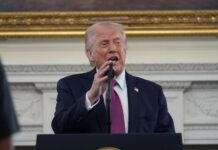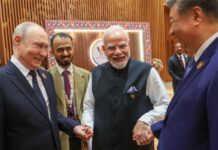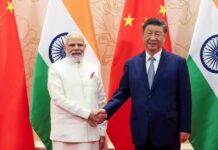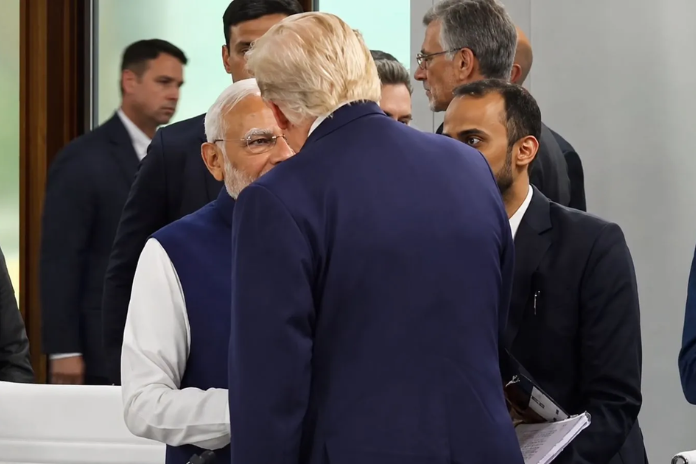
Prime Minister Narendra Modi and US President Donald Trump exchanged a warm handshake at the G7 Summit in Évian, France, on June 15, 2026, marking their first public meeting in 16 months. The brief interaction came on the sidelines of the 52nd G7 summit and has drawn attention as a symbolic reset in high-level India–US diplomacy.
Where and When the Meeting Happened
The handshake took place during the G7 outreach session hosted by French President Emmanuel Macron, where world leaders gathered for multi-lateral discussions. Both leaders were present at the summit in Évian, a town in the French Alps known for hosting major international gatherings.
This was the first time Modi and Trump had met publicly since their last high-profile encounter roughly 16 months ago. Media outlets described the moment as a “first public meeting in 16 months,” highlighting its significance in the broader context of India–US strategic ties.
A Warm Greeting After a Long Gap
The interaction was brief but friendly. Video and photo coverage showed the two leaders greeting each other warmly, with visible gestures such as a friendly pat on the arm and a relaxed, smiling exchange. Several Indian news channels described the moment as a “warm handshake” that captured良好 (good) relations between the two leaders.
Indian media highlighted that the handshake came after a long gap in direct, in-person engagement between the two heads of government, making it a notable moment for diplomatic observers and the public alike.
What Was Expected to Be Discussed
Although the handshake itself was brief, the meeting was seen as the opening to a high-stakes bilateral conversation on the sidelines of the G7. Key issues expected to be on the agenda included:
- Trade negotiations: Both countries are working to strengthen economic ties and resolve long-standing trade friction.
- Defence cooperation: Expanding joint defence production, technology sharing, and security partnerships in the Indo-Pacific.
- Energy security: Discussions on oil, gas, and clean energy cooperation to support both nations’ energy needs.
- Strategic partnership: Reinforcing the India–US strategic alliance amid global conflicts and economic challenges.
These topics reflect the core pillars of the India–US relationship and are central to both nations’ long-term strategic interests.
Timing and Global Context
The G7 summit in France comes at a time of heightened global uncertainty, with ongoing conflicts, economic pressures, and shifting geopolitical alliances. The Modi–Trump meeting is therefore seen not just as a bilateral checkpoint, but as part of a broader effort to coordinate on global stability and security.
The handshake also occurred just days after a tragic incident in the Strait of Hormuz, where three Indian sailors were killed. This timing adds another layer of seriousness to the diplomatic engagement, as security in critical maritime routes remains a shared concern for India and the US.
Why This Meeting Matters for India
For India, the meeting signals continued high-level engagement with the United States under President Trump’s second term. It reinforces the idea that India–US ties remain a priority despite changes in global politics and domestic agendas in both countries.
The handshake also serves as a visible reminder of the personal rapport between Modi and Trump, which has often been cited as a factor in strengthening bilateral cooperation over the years. Their previous meetings, including at the White House, were marked by warm gestures such as hugs and personalized gifts, reflecting a friendship that has translated into deeper strategic ties.
Looking Ahead
The G7 handshake is expected to set the stage for more detailed bilateral discussions, possibly leading to announced initiatives on trade, defence, or energy. Analysts will be watching for any formal statements, joint announcements, or follow-up meetings that could signal concrete progress in India–US relations.
For now, the image of Modi and Trump shaking hands in France serves as a clear message: after 16 months, the two leaders are back in direct contact, and the India–US partnership remains a key axis in global diplomacy.