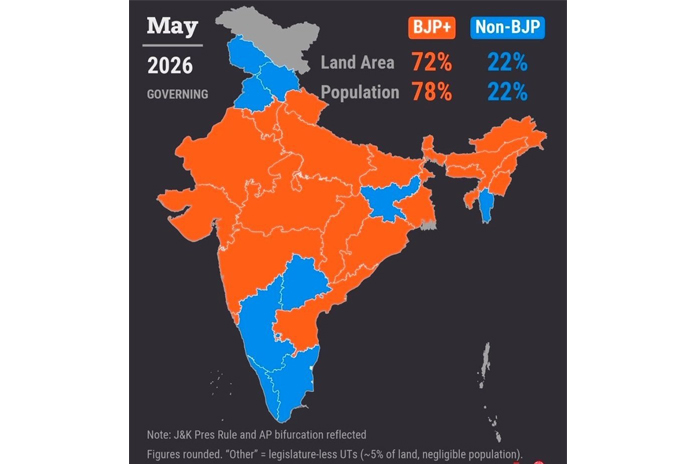
For the first time in more than five decades, eastern India stands at the threshold of political alignment, policy stability, and economic possibility. The 2026 electoral verdict is not merely another change in government; it may well mark the beginning of a structural shift in the destiny of a region that once represented the intellectual, industrial, and commercial heart of India. In a historic milestone for independent India, the BJP now governs all four major eastern states, Bihar, West Bengal, Odisha, and Assam, becoming the first party since 1974 to simultaneously hold power across the eastern belt while also having government at the Centre.
The last time such an alignment existed was during the Congress era, when the political and economic map of India looked entirely different. The significance of this development lies not only in electoral arithmetic, but in the strategic opportunities it creates for one of India’s most underutilised regions. The verdict in Assam and West Bengal is particularly noteworthy. In Assam, the BJP crossed the majority mark on its own strength, increasing its tally from 60 seats in 2021 to 82 seats in 2026, while raising its vote share from 33.21 per cent to nearly 37.8 per cent.
In West Bengal, the party achieved a historic breakthrough by securing a majority on its own for the first time in the state’s history and crossing the two-thirds mark in the 294-member Assembly. Its vote share climbed dramatically from 10.16 per cent in 2016 to 37.9 per cent in 2021 and an impressive 45.85 per cent in 2026. This verdict reflects a larger national trend: voters increasingly preferring governance stability, development orientation, and institutional coordination over fragmented regional politics. Across multiple states, there appears to be growing fatigue with politics built primarily around welfare dependency, identity mobilisation, and anti-industry rhetoric. Nowhere is this shift more consequential than in West Bengal.
At the time of independence, Bengal was among the most prosperous and culturally influential regions of India. Calcutta was not merely a city; it was India’s gateway to the world, a thriving centre of trade, manufacturing, finance, arts, literature, and intellectual excellence. Bengal produced Nobel laureates, industrial pioneers, thinkers, artists, and reformers who shaped modern India. Yet over the decades, the state steadily lost its economic dynamism. Successive governments failed to build an enabling environment for industry, investment, and enterprise. A deeply entrenched anti-business culture, policy unpredictability, labour militancy, and ideological rigidity gradually eroded investor confidence.
The result was prolonged industrial decline, capital flight, and large-scale talent migration. The numbers tell a sobering story. West Bengal’s share of India’s GDP has fallen from nearly 10.5 per cent in 1960-61 to around 5.6 per cent today. Per capita income, once substantially above the national average, has now fallen below it. More than 6,600 companies are estimated to have either shut down or relocated after 2011, further reinforcing the perception of Bengal as an uncertain destination for investment. What makes this decline particularly tragic is that Bengal never lacked natural or strategic advantages. It possesses fertile agricultural land, a long coastline, major ports, proximity to Southeast Asia, and perhaps the most strategic geography in eastern India. West Bengal serves as India’s gateway to Bangladesh, Nepal, Bhutan, and the Northeast. Few regions in the country enjoy such geographic leverage. Yet geography alone does not create prosperity. Institutions do.
For decades, the absence of political alignment between the Centre and eastern states prevented the emergence of a coherent development strategy for the region. Major projects requiring intergovernmental coordination, logistics corridors, port modernisation, industrial zones, trade infrastructure, and border connectivity suffered from fragmented execution and competing political priorities. That barrier may now be removed. A politically aligned eastern corridor creates the possibility of long-term planning on a scale not seen in decades. The East Coast Economic Corridor, development of Tajpur Port, expansion of logistics infrastructure, industrial manufacturing clusters, and deeper integration with the Centre’s Act East Policy can now move with greater policy coherence. The economic potential is immense.
India-Bangladesh trade alone has crossed Rs 1.8 lakh crore annually, yet West Bengal captures only a fraction of the value generated by this trade flow. Nepal and Bhutan depend heavily on Bengal’s transit infrastructure, while the entire Northeast relies on the region for maritime connectivity. Kolkata and Haldia remain the only major maritime gateways in eastern India, and the proposed Tajpur deep-sea port could become a transformational asset for the entire region. But infrastructure alone will not revive Bengal. The real challenge is restoring confidence – fiscal, investor, and citizen confidence. West Bengal today carries a public debt burden estimated at nearly Rs 7.7-8 lakh crore, limiting fiscal flexibility. Productive capital expenditure has often lagged behind welfare-driven spending.
The task ahead is therefore not to dismantle welfare programmes, but to transform welfare into a foundation for productivity and participation. This distinction is crucial. Programmes such as Lakshmir Bhandar, Kanyashree, and Krishak Bandhu have created extensive social protection networks and must continue. However, long-term prosperity cannot emerge from transfers alone. Welfare must evolve from being merely a safety net into a launchpad for entrepreneurship, skills, women-led enterprise, MSME growth, and agricultural value addition. The future of Bengal lies not in subsidy politics, but in enabling ordinary citizens to participate meaningfully in the economy. Equally important is governance modernisation. A transparent, digitally driven administrative framework with predictable approvals, digitised land records, direct benefit transfers, and time-bound clearances is now indispensable.
Investors seek predictability as much as incentives. Young talent seeks opportunity as much as identity. Bengal’s large-scale brain drain is not irreversible; it reflects the absence of an ecosystem that rewards ambition and innovation. The opportunity before Eastern India is therefore historic. For the first time in nearly 50 years, the region has the possibility of political coordination, strategic continuity, and a unified developmental direction. If governance remains stable, if investment confidence is rebuilt, and if infrastructure is matched by institutional reform, eastern India could once again emerge as one of the principal engines of India’s growth story. The rise of Bengal would not merely benefit Bengal. It would reshape India’s economic geography itself. After decades of drift, Eastern India may finally be approaching its defining moment.