Key Phrase:
Slug:
Meta Description: (148 characters)
Keywords:
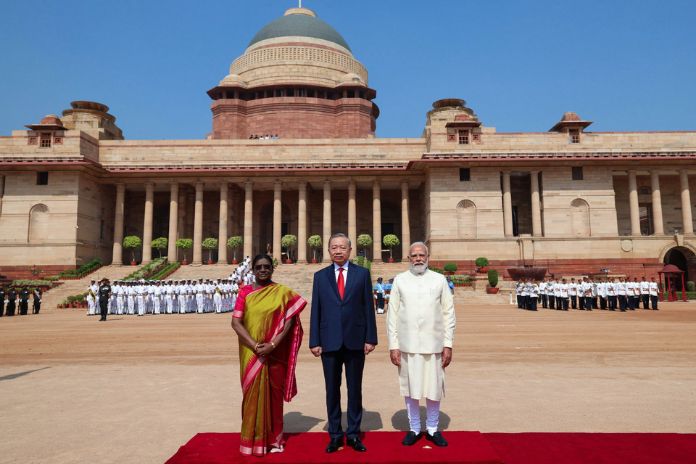
India and Vietnam have deepened their strategic alliance through a landmark review of defence ties and the signing of 13 Memoranda of Understanding (MoUs). This move, highlighted during Vietnamese President To Lam’s visit to New Delhi, focuses on enhanced maritime security, industrial collaboration, and broader economic integration. The agreements signal a robust commitment to mutual prosperity in the Indo-Pacific region.
Comprehensive Defence Dialogue
High-level talks between India’s Raksha Mantri Rajnath Singh and Vietnam’s Deputy Prime Minister and Defence Minister Gen Phan Van Giang took place in New Delhi on May 6, 2026. The discussions built on the 15th India-Vietnam Defence Policy Dialogue from November 2025, emphasizing joint military exercises, technology transfers, and capacity building. These efforts aim to counter regional challenges while fostering interoperability between the two navies.
The defence review underscores Vietnam’s growing reliance on Indian expertise in defence manufacturing. Key areas include shipbuilding upgrades, AI integration in defence systems, and cybersecurity protocols. This partnership aligns with India’s Act East Policy and Vietnam’s maritime ambitions, creating a balanced approach to regional stability.
Maritime Security in Focus
Maritime cooperation forms a cornerstone of the new agreements. Both nations pledged to advance the blue economy, including sustainable fisheries, ocean resource management, and naval patrols in the South China Sea. Initiatives involve training programs for Vietnamese personnel at Indian naval facilities and joint surveillance operations.
By prioritizing maritime domain awareness, India and Vietnam seek to protect vital sea lanes critical for global trade. This collaboration extends to disaster response mechanisms, ensuring quicker aid during cyclones or humanitarian crises. Such steps not only enhance security but also promote economic resilience through shared maritime infrastructure.
Industrial and Economic Synergies
The 13 MoUs span defence production and industrial partnerships, covering supply-chain diversification, rare earth minerals processing, and advanced manufacturing. Sectors like pharmaceuticals, digital payments, and banking will see increased two-way investments, streamlining trade flows.
A standout outcome is the elevated “Enhanced Comprehensive Strategic Partnership,” coupled with a ambitious $25 billion bilateral trade target by 2030. This builds on existing frameworks, such as the Joint Vision on India-Vietnam Defence Partnership towards 2030. Additional pacts address education exchanges (2026-2030), tourism promotion, cultural programs, and public audit reforms.
These industrial ties position Vietnam as a key hub for Indian firms diversifying from China, while offering Vietnam access to India’s burgeoning defence export market. Collaborative ventures in radioactive technology and AI further solidify technological interdependence.
Strategic Implications
The agreements reflect a shared vision for peace and prosperity amid geopolitical tensions. With Vietnam facing pressures in the South China Sea and India advancing its Indo-Pacific strategy, this partnership serves as a counterbalance. It promotes people-to-people ties through scholarships, youth exchanges, and business forums.
Economically, the $25 billion trade goal could transform bilateral commerce, currently valued at around $15 billion. Focus areas like semiconductors and green energy align with global supply chain shifts, benefiting both economies.
In summary, India-Vietnam defence ties have entered a dynamic phase. These 13 agreements pave the way for deeper maritime and industrial cooperation, ensuring long-term strategic alignment. As both nations navigate regional complexities, their enhanced partnership promises stability and growth.