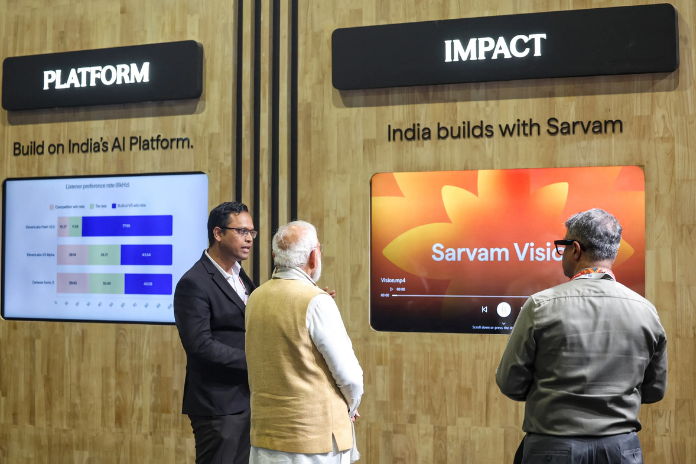
India has taken a bold step toward AI independence by unveiling three sovereign AI models—Sarvam AI, Gnani.ai, and BharatGen. Launched on February 18, 2026, at the India AI Impact Summit in New Delhi, these innovations aim to reduce reliance on foreign tech giants while addressing India’s unique linguistic and cultural needs.
Roots in IndiaAI Mission
The IndiaAI Mission, kicked off in March 2024 with Rs 10,000 crore funding, focuses on building domestic AI infrastructure. It supports startups with GPU subsidies—over Rs 100 crore disbursed since late 2024. BharatGen alone secured Rs 900 crore, fueling rapid development of these models.
Sarvam AI: Reasoning Champs
Sarvam AI debuted two from-scratch large language models (LLMs): a 30-billion-parameter version and a powerhouse 105-billion-parameter model. The bigger one shines on global benchmarks, beating rivals like DeepSeek R1 and Google’s Gemini Flash. Using a mixture-of-experts design, it excels in reasoning, coding, and task automation—all trained entirely in India.
Gnani.ai: Voice Cloning Magic
Gnani.ai’s Vachana TTS is a game-changer for text-to-speech. It mimics human voices in 12 Indian languages using just 10 seconds of audio. Perfect for low-bandwidth apps like government services and customer support, it keeps tone, pitch, and style intact while staying hosted on Indian servers.
BharatGen: Multilingual Open-Source Star
Led by IIT Bombay, BharatGen’s Param2 17B MoE is a 17-billion-parameter model tailored for Indic languages. Available open-source on Hugging Face, it’s ideal for fine-tuning in sectors like governance, education, healthcare, and farming.
Why It Matters
These sovereign AI models ensure data stays in India, handle massive scale efficiently, and cater to local challenges. At the summit, Google CEO Sundar Pichai lauded India’s developer momentum. This push positions the country as an AI leader, blending innovation with self-reliance.