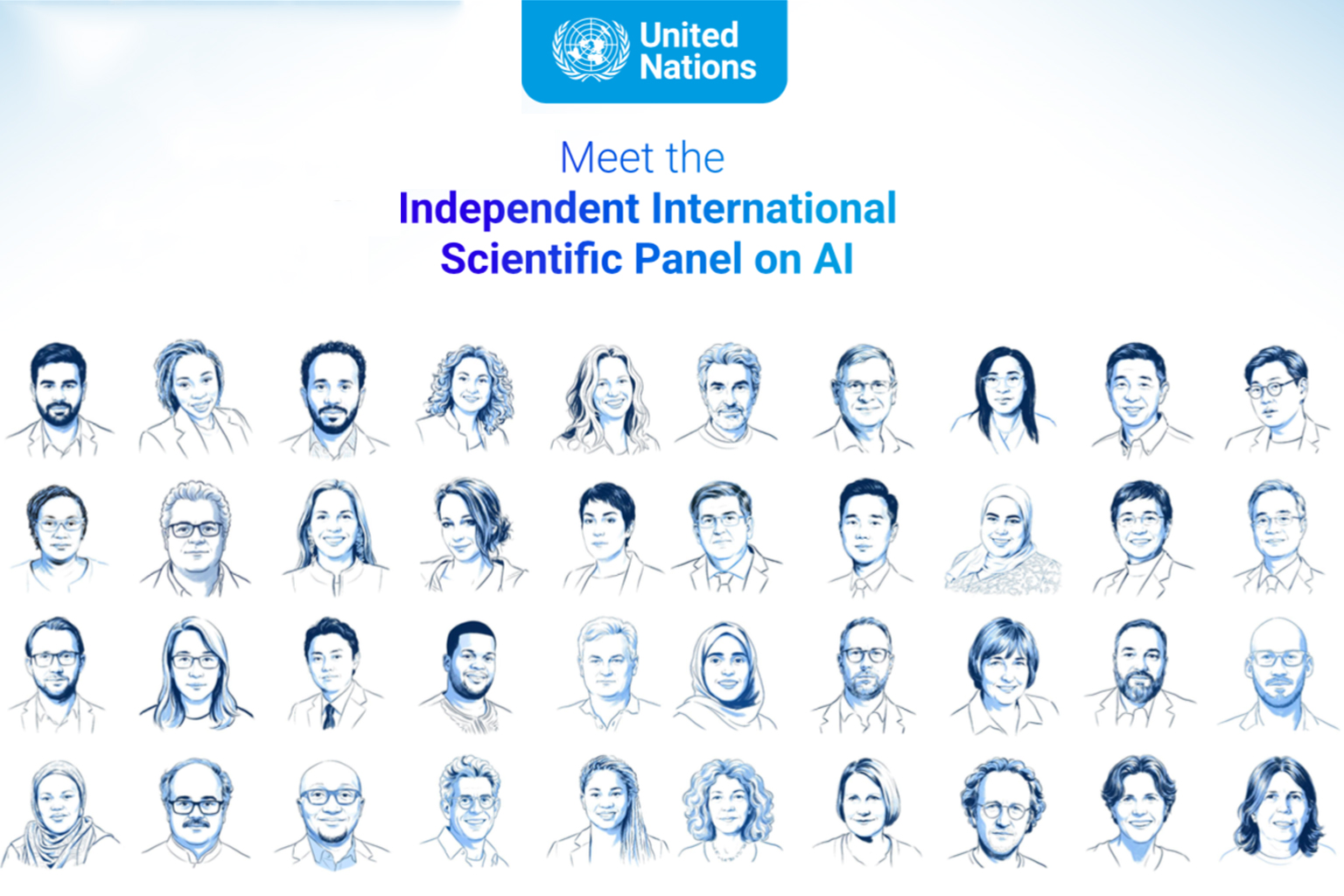
The UN General Assembly has voted overwhelmingly to approve a 40-member global scientific panel on the impacts and risks of artificial intelligence, with the United States strongly objecting.
UN Secretary-General Antonio Guterres, who established the panel, called the adoption “a foundational step toward global scientific understanding of AI”.
“In a world where AI is racing ahead, this panel will provide what’s been missing — rigorous, independent scientific insight that enables all member states, regardless of their technological capacity, to engage on an equal footing” he added, describing it as the first fully independent global scientific body dedicated to bridging the knowledge gap in AI and assessing its real-world economic and social impacts.
The vote in the 193-member assembly was 117-2, with the United States and Paraguay voting “no” and Tunisia and Ukraine abstaining. America’s allies in Europe, Asia and elsewhere voted in favour along with Russia, China and many developing countries.
From India, IIT Madras Professor Balaraman Ravindran has been appointed to the AI Panel.
Professor Balaraman heads the Department of Data Science and Artificial Intelligence (DSAI), the Wadhwani School of Data Science and Artificial Intelligence (WSAI), the Robert Bosch Centre for Data Science & Artificial Intelligence (RBCDSAI) and the Centre for Responsible AI (CeRAI) at IIT Madras.
Objection from United States
U.S. Mission counsellor Lauren Lovelace called the panel “a significant overreach of the UN’s mandate and competence” and said, “AI governance is not a matter for the UN to dictate.” As the world leader in AI, the United States is resolved to do all it can to accelerate AI innovation and build up its infrastructure, she said, and the Trump administration will support “like-minded nations working together to encourage the development of AI in line with our shared values”.
“We will not cede authority over AI to international bodies that may be influenced by authoritarian regimes seeking to impose their vision of controlled surveillance societies,” Ms. Lovelace said, adding that the Trump administration is concerned about “the non-transparent way” the panel was chosen.
Mr. Guterres said the 40 members were selected from more than 2,600 candidates after an independent review by the International Telecommunications Union, the UN Office for Digital and Emerging Technologies and UNESCO, the UN Educational, Scientific and Cultural Organisation. They will serve for three-year terms.
Members are predominantly AI experts but also come from other disciplines and include Maria Ressa, a Filipino journalist and Nobel Peace Prize laureate in 2021.
There are two Americans on the panel: Vipin Kumar, a University of Minnesota professor focusing on AI, data mining and high-performance computing research, and Martha Palmer, a retired University of Colorado professor and linguistics expert whose research includes capturing the meaning of words for complex sentences in AI.
There are two Chinese experts on the panel: Song Haitao, dean of Shanghai Jiao Tong University and the Shanghai Artificial Intelligence Research Institute, and Wang Jian, an expert in cloud-computing technology at the Chinese Academy of Engineering.
Ukraine said it abstained because it objected to Russia’s Andrei Neznamov, an expert in AI regulation, ethics, and governance, being on the panel.
Information about Panel Members
Information about all 40 members who were appointed to the UN Independent International Scientific Panel on AI can be found at www.un.org/ai-panel/