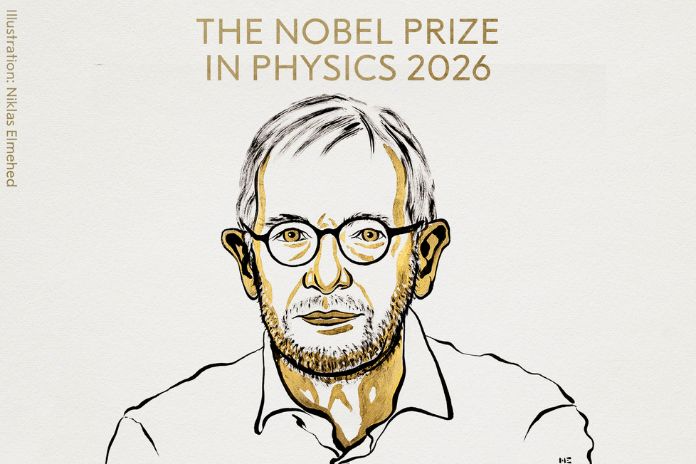
Belgian-American physicist Francis Halzen has won the 2026 Nobel Prize in Physics for his decisive contributions to the IceCube Neutrino Observatory and the discovery of high-energy neutrinos from astrophysical sources. The Royal Swedish Academy of Sciences announced the award on October 6, 2026.
Halzen’s work helped create a new method of studying the universe. Instead of observing space only through light, scientists can now use neutrinos—tiny, nearly massless particles that travel across enormous distances and rarely interact with matter.
IceCube observatory at the South Pole
Halzen realised that the clear ice beneath Antarctica could be used to detect neutrinos. His concept led to the development of the IceCube Neutrino Observatory at the South Pole.
IceCube uses around one cubic kilometre of Antarctic ice and contains thousands of light sensors buried deep below the surface. When a neutrino collides with another particle inside the ice, it produces a brief flash of light. The sensors record these flashes and help scientists identify the neutrino’s direction and energy.
Halzen proposed the idea in 1988, and the observatory was completed in 2011. Researchers later detected high-energy neutrinos linked to powerful events beyond the Solar System.
Why the discovery is important
Neutrinos are often described as “ghostly messengers” because they pass through matter with very little effect. They can travel from distant cosmic events without being easily blocked or deflected.
By studying these particles, scientists can investigate some of the most energetic processes in the universe. The IceCube project has therefore opened a new field known as neutrino astronomy.
The Nobel Committee recognised Halzen’s scientific vision and leadership, which helped researchers explore the universe in a completely new way. His work could lead to further discoveries about cosmic rays, black holes and other powerful astronomical sources.amp.dw
The 2026 award places Francis Halzen among the scientists whose research has significantly expanded humanity’s understanding of the universe.