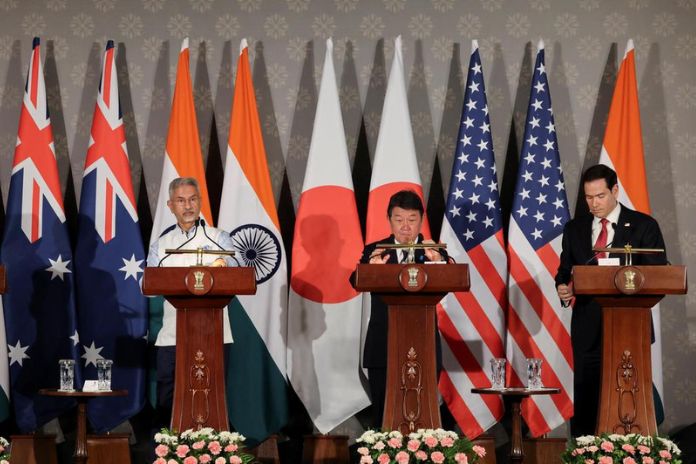
In a landmark meeting in New Delhi on May 26, 2026, the Quad foreign ministers announced a major step forward for regional security. U.S. Secretary of State Marco Rubio officially launched the Indo-Pacific Maritime Surveillance Cooperation initiative during talks with ministers from India, Australia, and Japan.
Who Attended the Meeting?
The high-level gathering brought together key diplomatic leaders from all four Quad nations:
- India: External Affairs Minister S. Jaishankar (host and presiding minister)
- United States: Secretary of State Marco Rubio
- Australia: Foreign Minister Penny Wong
- Japan: Foreign Minister Toshimitsu Motegi
Minister Jaishankar presided over the negotiations, reinforcing India’s central role in shaping the Indo-Pacific security architecture.
What Is the Indo-Pacific Maritime Surveillance Cooperation?
The newly launched Indo-Pacific Maritime Surveillance Cooperation initiative aims to enhance maritime domain awareness across the Indo-Pacific region. This program will help Quad nations track vessel movements, monitor suspicious activities, and respond more quickly to security threats in critical waterways.
The initiative builds on earlier efforts like the Indo-Pacific Partnership for Maritime Domain Awareness (IPMDA), which was first announced at the 2022 Quad Leaders’ Summit in Tokyo. IPMDA uses commercial satellite technology and radio frequency data to provide near real-time monitoring of ocean activities.
Why Does This Matter?
The Quad’s maritime surveillance push comes amid growing concerns about China’s expanding naval presence and influence across the Indo-Pacific. By strengthening surveillance capabilities, the four nations aim to:
- Improve early detection of illegal fishing, smuggling, and unauthorized military activities
- Enhance coordination during maritime emergencies and disasters
- Protect critical sea lanes that support global trade
- Maintain a free, open, and secure Indo-Pacific
Maritime surveillance is increasingly important because over 60% of global trade passes through Indo-Pacific waterways. Any disruption to these routes could have major economic consequences worldwide.
What Happens Next?
The Quad foreign ministers committed to further discussions on implementing the new surveillance framework. Future steps will likely include:
- Sharing data and intelligence among member nations
- Developing joint training programs for maritime personnel
- Expanding technological cooperation on satellite and sensor systems
- Engaging with additional Indo-Pacific partners to strengthen regional networks
A Strategic Win for Regional Security
This announcement marks a significant moment for the Quad alliance. By launching the Indo-Pacific Maritime Surveillance Cooperation, the four nations demonstrate their shared commitment to protecting maritime security and upholding international law in the region.
For India, hosting this meeting and leading the discussions reinforces its position as a major power in the Indo-Pacific. The initiative also strengthens partnerships between four democracies that share common values and strategic interests.
Bottom Line
The Quad’s new maritime surveillance initiative represents a practical, action-oriented approach to addressing security challenges in the Indo-Pacific. As the region continues to face growing geopolitical tensions, enhanced surveillance capabilities will help Quad nations respond more effectively to threats while promoting stability and peace.