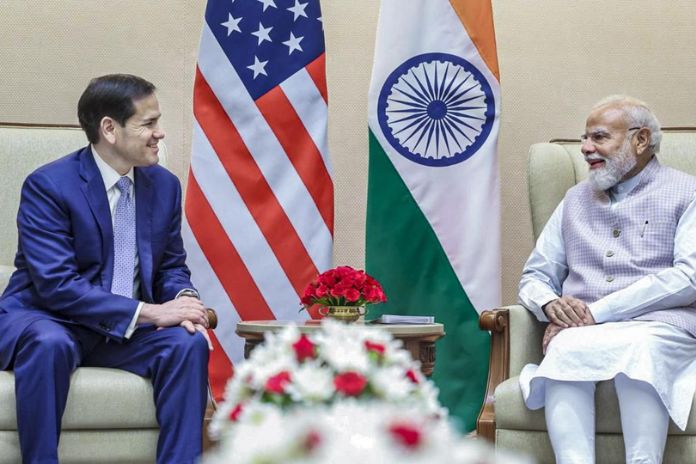
U.S. Secretary of State Marco Rubio has called India a cornerstone of America’s Indo‑Pacific policy, marking a fresh push to deepen strategic ties between the two countries. During a four‑day visit to India, Rubio met Prime Minister Narendra Modi in New Delhi and reaffirmed that India is important to the U.S.’s Indo‑Pacific policy and its broader vision for regional stability.
India as a key partner
Rubio told Indian leaders that Washington sees India as a vital partner in shaping a free, open, and secure Indo‑Pacific. He described India’s role in security, technology, and defence as central to U.S. plans in the region, especially as Washington seeks to balance China’s growing influence and diversify supply chains.
The visit comes at a time when both countries are trying to manage differences over tariffs, trade, and India’s foreign‑policy choices while building on shared interests in maritime security, emerging technologies, and defence cooperation.
White House invite to Modi
A symbolic highlight of the talks was Rubio’s invitation to Prime Minister Modi to visit Washington at the White House on behalf of President Donald Trump. The invite signals a desire to reset and strengthen high‑level engagement after a period when ties were strained by trade disputes and differing positions on global issues such as Russia–Ukraine and the Middle East.
The Indian side welcomed the gesture, viewing it as a sign that the U.S. values India’s strategic heft and role in the Indo‑Pacific region.
Four‑day diplomatic tour
Rubio’s trip spans four days and multiple cities, including Kolkata, Agra, Jaipur, and New Delhi. In each stop, he has met with Indian officials, business leaders, and civil‑society representatives to discuss trade, energy, technology, and defence cooperation.
These discussions are part of a broader effort to expand economic and security links beyond government‑to‑government ties and into the private sector, universities, and innovation ecosystems. India and the United States are also exploring new areas of collaboration in clean energy, artificial intelligence, and space technology.
Quad Foreign Ministers’ Meeting
A major diplomatic event during Rubio’s visit is the Quad Foreign Ministers’ Meeting, scheduled for 26 May 2026 in New Delhi. The United States, India, Japan, and Australia will use the gathering to coordinate on Indo‑Pacific security, infrastructure projects, and technology‑driven initiatives.
The Quad has become a key platform for minilateral cooperation, allowing the four countries to work together on issues like maritime domain awareness, cybersecurity, and resilient supply chains. For India, the meeting reinforces its role as a central player in U.S.‑led Indo‑Pacific architecture.
Why India is important to U.S. Indo‑Pacific policy
From Washington’s perspective, India is important to the U.S.’s Indo‑Pacific policy because it provides a large democratic counter‑weight to China in Asia. India’s growing military capabilities, expanding defence partnerships, and strategic location in the Indian Ocean make it a natural partner for U.S. security plans.
At the same time, India’s large market and growing tech sector offer opportunities for American companies and researchers. By aligning with India on trade, standards, and innovation, the United States hopes to shape rules and networks that are less dependent on authoritarian supply chains.
Managing differences while building trust
Despite the optimistic tone around India important to U.S. Indo‑Pacific policy, both sides still face challenges. Issues such as tariffs, digital‑services taxes, and India’s defence purchases from Russia continue to create friction. Differences also appear in their approach to global conflicts, including the Russia–Ukraine war and the situation in West Asia.
However, officials on both sides insist that these differences are not irreversible. They argue that through regular dialogue, targeted working‑group talks, and calibrated diplomacy, India and the United States can deepen their partnership without expecting full alignment on every issue.
What this means for India
For India, the visit and the emphasis on India important to U.S. Indo‑Pacific policy signal continued strategic interest from Washington. It strengthens India’s position as a key player in major groupings like the Quad and opens doors for more defence, technology, and trade deals.
At the same time, New Delhi must balance its partnership with the United States against ties with other powers and its own non‑aligned instincts. How India navigates this mix will shape not just bilateral relations with the U.S., but also its broader role in the Indo‑Pacific region over the coming years.