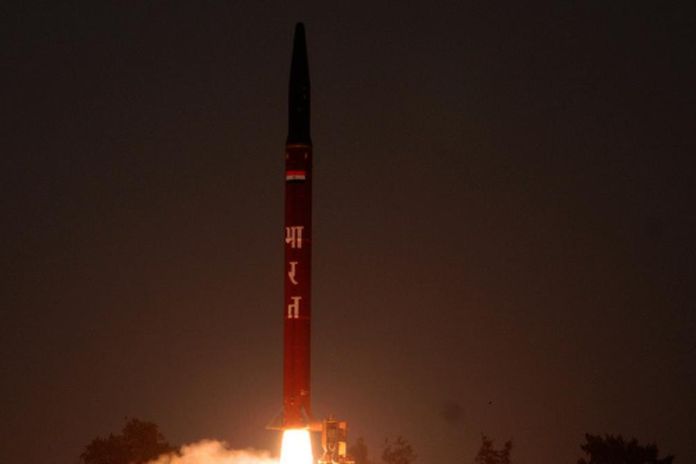
India has successfully test‑fired the Agni‑1 ballistic missile from the Integrated Test Range at Chandipur in Odisha, marking a key step in strengthening its regional deterrence and missile preparedness. The test validated the missile’s range, accuracy, and flight performance, confirming that the system remains reliable for operational deployment. The launch was carried out under the supervision of the Strategic Forces Command, which oversees India’s nuclear and advanced missile arsenal.
What is the Agni‑1 missile?
The Agni‑1 is a short‑range, nuclear‑capable ballistic missile designed for precision strikes against targets within the region. With an approximate range of about 700–1,200 km, it fits into India’s category of theatre‑level strike systems. The missile is road‑mobile, meaning it can be transported and launched from various locations, making it harder for adversaries to track or pre‑empt.
The Agni‑1 uses a single warhead and relies on inertial navigation enhanced by modern guidance systems to reach its target with high accuracy. This makes it suitable for both conventional and nuclear deterrence roles, depending on the strategic requirement. The recent test in Odisha focused on these operational parameters, including launch sequence, mid‑course stability, and terminal accuracy.
Why this test matters
The successful Agni‑1 ballistic missile test underlines India’s commitment to maintaining a credible and ready missile force. By regularly conducting such trials, the country ensures that its weapon systems remain technically sound, operationally familiar to the armed forces, and aligned with evolving defence needs.
For regional security, the Agni‑1 reinforces India’s ability to respond to short‑ and medium‑range threats without relying solely on longer‑range systems. At the same time, the test sends a message of technological capability and deterrence to neighbouring states, stressing that India can deploy precise strike options from mobile platforms.
Earlier advanced Agni‑MIRV trial
Just before the Agni‑1 launch, on May 8, India carried out a separate flight test of an advanced Agni missile equipped with Multiple Independently Targetable Re‑entry Vehicle (MIRV) technology. This test took place off Dr APJ Abdul Kalam Island, also located off the Odisha coast. The MIRV system allows a single missile to carry multiple warheads that can be directed toward different targets, enhancing the missile’s ability to penetrate enemy missile‑defence systems.
The MIRV test is part of India’s broader push to modernise its long‑range strategic arsenal. By developing multi‑warhead capability, New Delhi aims to strengthen its second‑strike potential and maintain a stable nuclear‑deterrence posture. Defence analysts note that such upgrades are consistent with India’s stated “no first use” nuclear policy, as they prioritise survivability and assured retaliation.
How these tests fit into India’s defence strategy
Taken together, the Agni‑1 ballistic missile test and the earlier advanced Agni‑MIRV trial reflect a dual‑track approach to missile development. The first track focuses on shorter‑range, mobile systems that can respond quickly to regional contingencies. The second track advances long‑range, multi‑warhead strategic missiles that underpin India’s nuclear‑deterrence posture.
Both tests were conducted from the same coastal region in Odisha, which hosts some of India’s most important missile‑testing infrastructure. The choice of location underscores the maturity of these facilities and the government’s emphasis on indigenous research and development in defence technology.
As India continues to upgrade its missile fleet, tests like the Agni‑1 launch and the MIRV‑enabled Agni trial will remain central to ensuring that the country’s deterrence remains credible, flexible, and aligned with its broader national security goals in 2026 and beyond.