

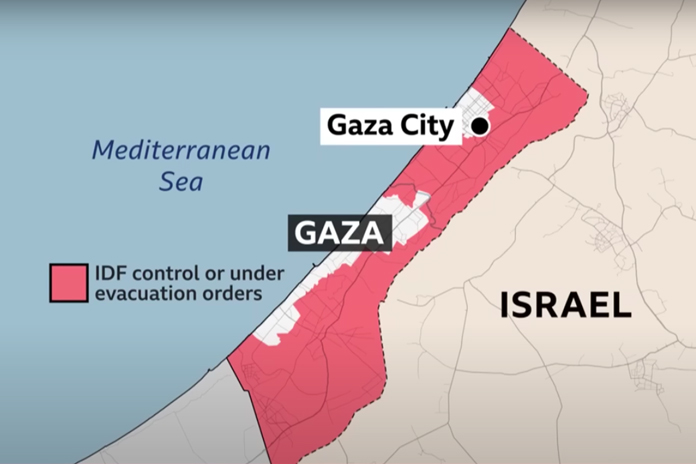
Jerusalem: Israel’s Security Cabinet in a marathon meeting lasting several hours, approved a proposal early Friday for the Israel Defence Forces (IDF) to expand the war in Gaza and take control of Gaza City, one of the last areas of the Gaza strip that is not yet under full military occupation. As a result of this decision, over one million Palestinians who are living in tents across Gaza city and its surrounding areas will have to relocate, worsening an already dire humanitarian situation.
The Security Cabinet’s meeting ran well into the night in Israel, concluding with an outline for the military to eventually control all of Gaza’s territory.
The announcement from Prime Minister Benjamin Netanyahu’s office came some 23 months into the war, which began after the horrific Oct 7 attacks on Israel in 2023. Thus far the conflict has led to a dire humanitarian catastrophe in Gaza, with at least 61,000 Palestinians, a third of them children, being killed according to the Hamas run Gazan Health Ministry.
The inability of the IDF to rescue a large number of Israeli hostages, who were kidnapped on Oct 7 and forcibly taken into Gaza, only complicates a very difficult situation.
Gaza City, the largest urban city in Gaza, has been largely destroyed by IDF airstrikes and raids through the course of the war. Still, it is home to several of Gaza’s last partially-functioning hospitals, a church where Gaza’s minority Christians are sheltering and where tens of thousands of displaced people have set up tent encampments. United Nations data suggests that somewhere between 800,000 to one million people are still encamped in and around Gaza city.
Following the Security Cabinet meeting, PM Netanyahu’s office stopped short of describing the takeover of Gaza City as an occupation, though the UN says already nearly 90% of Gaza is under military control or off-limits to Palestinians and deemed a ‘red zone’. Gaza City, parts of central Gaza and a stretch of sand along the sea are the only areas not yet occupied by the IDF.
Israeli troops already operate in eastern Gaza City under cover of near-constant airstrikes. It’s unclear how the military plans to push further into densely populated areas — or where people might be forced to flee, with experts suggesting that they will have no option but to relocate to the south of the Gaza strip, which is already overburdened and squeezed due to constant hunger and lack of basic necessities.
Several UN experts have said that a situation of famine is unfolding in Gaza, as the differences between the Israeli Government and the United Nations deepen further.
In announcing the decision, Netanyahu’s office said that aid would be distributed to civilians outside of combat zones, without elaborating.
Families of Israeli Hostages demand for the safe return
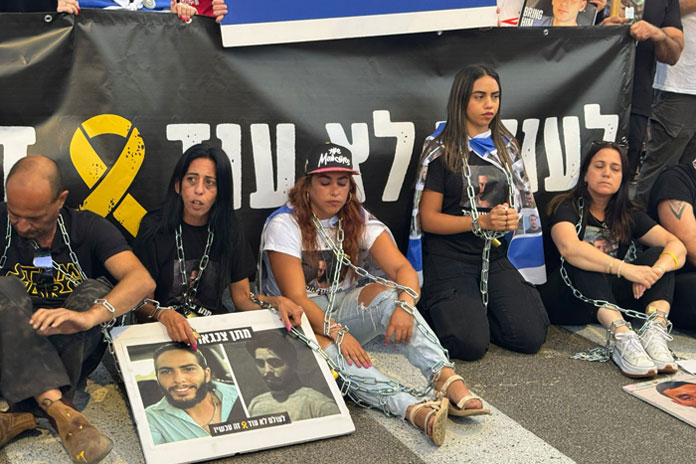
Even as the Israeli Security Cabinet met, families of Israeli hostages and their loved ones, gathered outside the Prime Minister’s Office in Jerusalem demanding a ceasefire, with growing fears across Israel that military operations could lead to their deaths.
Einav Zangauker, whose son Matan is being held hostage, publicly said this week that Netanyahu had promised her he would strike a deal to end the war and free the hostages.
“But he exploited my pain, the pain of the families of this wounded nation — he sabotaged the deal,” she said. “He lied to me — he lied to all of us!”
Israeli opposition leader Yair Lapid criticized the decision as a “disaster that will lead to many more disasters.”
“This is exactly what Hamas wanted, for Israel to get stuck on the ground without a goal, without defining the vision for the day after, in a futile occupation that no one understands where it leads,” he said in a statement.
Public opinion in Israel is bitterly divided over whether to end the war, but this week tens of thousands of Israelis protested in Tel Aviv for a ceasefire. Additionally, hundreds of former generals and security officials in Israel have signed an open letter to US President Donald Trump, urging him to bring an end to the war and end the suffering. They have said Hamas no longer poses a strategic threat to Israel.
Netanyahu, however, has constantly resisted mounting internal and international pressure to end the war and dramatically boost aid into Gaza.
When asked earlier this week about possible Israeli plans to militarily occupy all of Gaza, President Trump said the decision was “pretty much up to Israel.”
5 conditions for ending the War
The Security Cabinet, comprised of Israel’s top leaders, adopted five conditions before Israel can end the war in Gaza, namely:
1. The disarmament of Hamas
2. The return of all 50 remaining hostages, 20 of whom are believed to be alive
3. The demilitarization of the Gaza Strip
4. Israeli security control over the Gaza Strip
5. The existence of an alternative civilian government that is neither Hamas or the Palestinian Authority
The Security Cabinet’s statement did not give any details on what Israeli security control in Gaza would need to look like for Israel to end the war, nor how a civil administration would be formed, what its role would be and who would run it.
The Prime Minister’s office said an alternative plan for military operations in Gaza than the one Netanyahu had presented had been rejected by the Security Cabinet, which includes two far-right ministers who’ve openly called for the permanent expulsion of Palestinians from Gaza and the rebuilding of Jewish settlements there.
Israel faces International Condemnation
Following Israel’s decision to expand the war, British Prime Minister Keir Starmer said the Israeli government’s decision to take control of Gaza City is “wrong” and urged the government reconsider.
“This action will do nothing to bring an end to this conflict or to help secure the release of the hostages. It will only bring more bloodshed,” he wrote in a statement. “What we need is a ceasefire, a surge in humanitarian aid, the release of of all hostages by Hamas and a negotiated solution.”
Australian Foreign Minister Penny Wong also criticised the move in a statement.
“Australia calls on Israel to not go down this path, which will only worsen the humanitarian catastrophe in Gaza,” she said. “A two-state solution is the only pathway to secure an enduring peace — a Palestinian state and the State of Israel, living side-by-side in peace and security within internationally-recognised borders.”
Meanwhile the UN’s Special Rapporteur for the Occupied Palestinian Territories, Francesca Albanese called the announcement “shocking.”
In an interview with a media channel earlier today, she said the decision “speaks to the desperation of the Israeli PM,” adding it was “hard to imagine how much harm he [Netanyahu] can do because they [Gazans] are beyond the brink of collapse.”
For now there seems to be no end to the war in Gaza in sight.
(with agency inputs)







 to expand the war in Gaza and take control of Gaza City, one of the last areas of the Gaza strip that is not yet under full military occupation. Over one million Palestinians who are living in tents across Gaza city and its surrounding areas are going to have to relocate as a result of this decision, worsening an already dire humanitarian situation.)