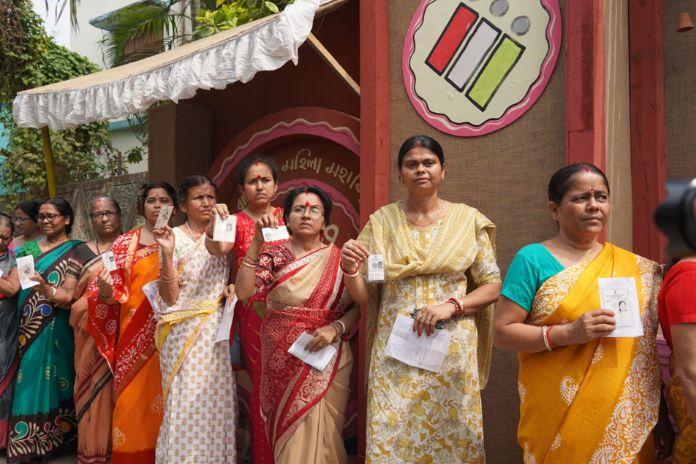
West Bengal and Tamil Nadu have recorded extraordinarily high voter participation in the 2026 Assembly elections, underscoring strong public engagement in the democratic process. According to Election Commission data, West Bengal’s voter turnout touched 89.93% by 5 pm, edging close to 90%, while Tamil Nadu’s final figure climbed to about 84.29%, setting a new record for the state. These numbers reflect a surge in electoral enthusiasm and a deep‑seated interest in state‑level governance.
West Bengal: Near‑90% turnout
In West Bengal, polling officials reported that voter turnout reached 89.93% by 5 pm, with several districts crossing the 90% mark. Dakshin Dinajpur recorded around 93%, Cooch Behar stood at about 92%, and Birbhum, Murshidabad, Jalpaiguri, and Paschim Medinipur all exceeded 90%. These figures indicate mass participation across both urban and rural constituencies, suggesting that voters actively turned out despite heat, logistical challenges, and the usual political polarization.
This level of turnout is significantly higher than many previous Assembly elections in the state, where averages often hovered around the 80% range. The near‑90% mark signals heightened awareness of local issues, greater trust in the electoral process, and the impact of sustained campaigning by major regional and national parties. It also highlights the Election Commission’s improved voter outreach and voter‑education drives, which have helped citizens understand the importance of exercising their franchise.
Tamil Nadu: A new record
Tamil Nadu’s voter turnout also reached historic levels. By 5 pm, 82.24% of eligible voters had cast their ballots, and the final figure pushed up to approximately 84.29%. This surpasses the previous record of roughly 78.3% set in the 2011 Assembly elections, making 2026 the most participatory state election in Tamil Nadu’s recent history.
The high turnout was driven by a combination of factors: sharply contested alliances, welfare‑policy debates, and a focus on youth and first‑time voters. Tamil Nadu has long had a strong tradition of political awareness, and the 2026 polls reinforced that trend. Urban centers such as Chennai, Coimbatore, and Madurai saw dense queues at polling stations, while rural areas reported smooth voting with minimal disruptions. The result is a clear signal that citizens value the opportunity to influence government formation at the state level.
Why this matters
High voter turnout in both West Bengal and Tamil Nadu is significant not only for the immediate electoral outcome but also for the long‑term health of Indian democracy. When more than nine out of ten voters in multiple districts participate, it strengthens the legitimacy of the elected government and increases pressure on parties to deliver on promises. Turnout figures above 80–90% also indicate that electronic voting machines (EVMs), voter‑verifiable paper audit trail (VVPAT) systems, and administrative reforms have helped reduce intimidation and logistical hurdles at polling booths.
Moreover, these record numbers suggest that political narratives focusing on development, social justice, and local governance resonate strongly with voters. In both states, young voters and first‑time electors played a key role, underlining the growing influence of the youth wing across party lines. High turnout also reflects the relative decline of poll‑boycott rhetoric and the reassertion of voting as the primary mode of political expression.
Looking ahead
The 2026 Assembly elections in West Bengal and Tamil Nadu set a benchmark for future polls. Governments and parties will now face greater accountability as voters have demonstrated both willingness and capacity to show up in large numbers. For election administrators, the challenge will be to maintain or even improve on these turnout figures by further simplifying voter registration, expanding awareness campaigns, and ensuring accessible polling facilities in remote areas.
In sum, West Bengal and Tamil Nadu’s record‑high voter turnout in 2026 is more than a statistic; it is a testament to the vibrancy of India’s electoral democracy. With over 90% participation in key districts of West Bengal and 84% statewide in Tamil Nadu, the message from the electorate is clear: citizens are willing to invest time and energy when they sense that their vote can shape the future.