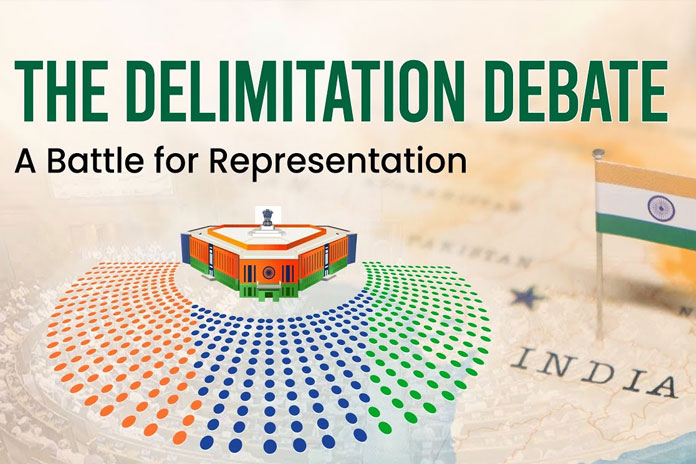
India’s democracy has long been defined by its scale, its diversity, and its remarkable continuity. Elections are frequent , governments change, and political narratives evolve, yet the underlying structure of representation has remained largely frozen for decades. The forthcoming delimitation of the Lok Sabha – expected to shape the 2029 general elections – has the potential to alter that equilibrium in a profound way. While often seen as a technical or administrative exercise, delimitation may, in fact, trigger one of the most consequential generational shifts in Indian politics since independence.
At its essence, delimitation is about aligning political representation with demographic reality. Constituency boundaries are redrawn to reflect changes in population, migration, and urbanisation. But in a political system where access to electoral space is tightly constrained, even a technical recalibration can have far-reaching consequences. When the map of representation changes, so too does the map of opportunity. One of the most immediate consequences of delimitation is the significant increase in the number of parliamentary constituencies. For decades, India has operated with a capped number of seats, even as its population has grown dramatically.
This has had a predictable effect: intense competition for a limited number of positions, favouring those who already possess political capitalname recognition, organisational backing, or dynastic lineage. An expansion of seats changes this arithmetic fundamentally. It does not merely add numbers; it lowers barriers. A larger Parliament creates space for first-time entrants who would otherwise remain on the margins. In a system where seniority and continuity have often dictated candidacy, this structural widening introduces a degree of fluidity.
Younger aspirants, who have thus far found themselves waiting in long queues behind established figures, suddenly encounter a system that has room to accommodate them. Generational change in politics is rarely achieved through intent alone. It requires opportunity. Delimitation provides precisely that: a structural opening that makes the entry of younger leaders not just possible, but inevitable. Equally significant is the disruptive effect of redrawing constituency boundaries. Indian politics has, over time, developed pockets of stability – constituencies that function as safe seats for particular individuals, families, or parties.
These strongholds are built over years, even decades, through networks of patronage, local influence, and organisational control. Delimitation unsettles these arrangements. When boundaries shift, voter compositions change. A constituency that once favoured a particular caste configuration, community alignment, or political narrative may no longer do so. The predictability that incumbents rely upon begins to erode. This disruption is particularly consequential for younger politicians. In a stable system, entry is difficult because outcomes are predictable. In a disrupted system, unpredictability creates openings. When established equations weaken, political competition becomes more meritocratic.
Campaign quality, message clarity, and voter connect begin to matter more than inherited advantage. Younger candidates, often more agile and attuned to contemporary issues, are well positioned to capitalise on such moments of flux. By 2029, India’s electorate will be markedly different from what it was even a decade earlier. The country is urbanising rapidly. Large segments of the population are moving from rural to semi-urban and urban areas, creating new clusters of economic activity and social mobility. These regions are characterise d by a yo unger demographic profile, greater exposure to technology, and a heightened sense of aspiration.
Delimitation is likely to reflect these shifts by enhancing representation from such growth centres. As new constituencies emerge in urban and semi-urban belts, the nature of electoral competition within them will also evolve. Voters in these areas are often less bound by traditional identity markers and more focused on issues such as employment, infrastructure, education, and quality of life. This transformation in voter priorities naturally favours candidates who can speak the language of aspiration. Younger politicians, who are often closer in experience and outlook to these voters, may find greater resonance. The result is not merely a change in who contests elections, but a deeper change in what elections are fought over.
Political parties, regardless of ideology, are shaped by electoral incentives. When the structure of competition changes, parties must adapt or risk irrelevance. Delimitation, by expanding seats and altering constituencies, introduces precisely such a shift. In a scenario where dozens – perhaps hundreds – of new constituencies come into play, parties cannot rely exclusively on their existing pool of senior leaders. The demand for candidates will outstrip supply.
This compels parties to look beyond traditional hierarchies and invest in new leadership pipelines. Such a transition is not merely cosmetic. It requires organisational change: identifying talent at earlier stages, nurturing grassroots leaders, and giving opportunities to individuals who may not come from established political families. Over time, this process institutionalises generational renewal. Younger leaders are no longer exceptions; they become integral to the party’s electoral strategy. A generational shift in representation inevitably leads to a shift in political discourse. Younger leaders tend to bring different priorities and styles to politics. They are more likely to engage with digital platforms, to articulate policy positions in contemporary terms, and to focus on measurable outcomes. As their presence in Parliament increases, the overall tone of political debate may evolve.
Issues such as technological innovation, climate change, startup ecosystems, and global competitiveness could gain greater prominence. This do es no t imply the disappearance of traditional political factors, but rather their coexistence with new themes. The Parliament of 2029, shaped by delimitation, could thus reflect a more complex and forward-looking conversation about India’s future. It is important to recognise that delimitation is not an easy reform. It has been deferred repeatedly in India’s history because of its political sensitivity. Redrawing constituencies affects regional balances, representation ratios, and electoral prospects. It inevitably creates winners and losers, often along state and party lines. Advancing such a reform requires a degree of political will that goes b eyond imme diate ele ctoral considerations.
The approach associated with PM Narendra Modi has been characterised by a willingness to undertake structural changes – whether in governance, infrastructure, or policy – that aim to produce long-term outcomes. In this context, pushing forward with delimitation can be seen as part of a broader vision to align India’s democratic institutions with its evolving realities. By prioritising demographic accuracy and representational fairness, the reform seeks to augment the sanctity of Parliament itself. In doing so, it also creates the conditions for a more dynamic and responsive political class. To view delimitation merely as a redrawing of maps is to miss its larger significance.
It is, in effect, a recalibration of the democratic playing f ield. By expanding representation, disrupting entrenched power structures, and reflecting new demographic patterns, it sets in motion forces that extend well beyond the mechanics of elections. The generational shift that may emerge from this process is not accidental; it is embedded in the logic of the reform. When new spaces are created, new actors inevitably fill them. When old certainties are disrupted, new possibilities emerge. And when the ele ctorate itself is changing , representation must evolve to keep pace. The 2029 general elections may thus mark more than a routine democratic exercise.
It could represent a turning point in the composition and character of India’s political leadership. A larger, more diverse, and significantly younger Parliament would not only mirror the country’s demographic profile but also enhance its capacity to address the challenges of a rapidly changing world. In that sense, delimitation is best understood not as an administrative necessity, but as an opportunity – an opportunity to renew India’s democratic institutions from within. If it succeeds in ushering in a new generation of leaders, it will have achieved something far more enduring than electoral adjustment. It will have helped reshape the trajectory of Indian politics itself.