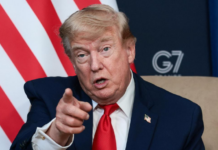
On February 28, 2026, the United States and Israel dramatically escalated their confrontation with Iran through coordinated missile strikes targeting critical infrastructure across the country. US President Donald Trump, in a stark public announcement via Truth Social and a formal address, declared that the US had initiated “major combat operations” against Iran. This followed Israel’s confirmation of launching missile attacks on multiple Iranian sites, marking a shift from decades of proxy warfare to direct, large-scale military action.
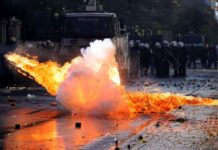
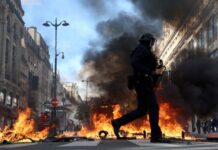
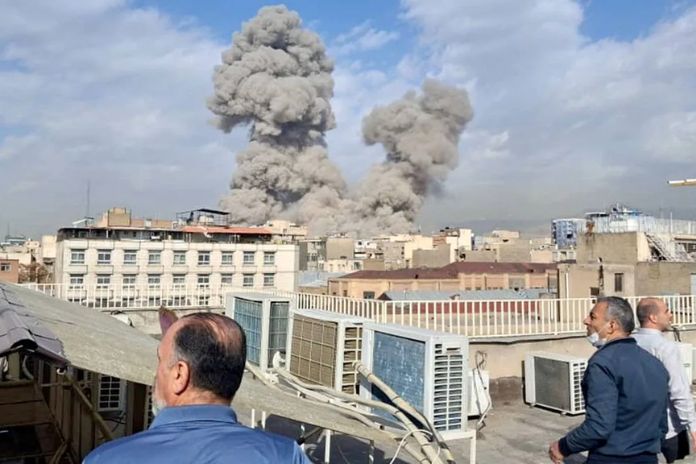
The strikes, codenamed Operation Roaring Lion by Israel and Operation Epic Fury by the US, focused on Iran’s nuclear program and military capabilities. Key targets included heavily fortified underground nuclear facilities at Fordow, Natanz, and Isfahan, as well as missile production plants in Karaj and Kermanshah. Explosions lit up downtown Tehran early in the morning local time, with thick smoke rising from areas near Supreme Leader Ali Khamenei’s residence, the presidential palace, and National Security Council offices. Iranian state media IRNA reported at least seven direct missile impacts in the capital alone, alongside blasts in Tabriz, Qom, and other provinces.
Israel’s Defense Minister Israel Katz described the operation as a “preemptive strike to eliminate existential threats to Israel,” triggering a nationwide state of emergency. Israeli airspace was immediately closed, and sirens wailed across the country starting at 8:15 a.m. local time in anticipation of Iranian counterattacks. Trump emphasized the strikes’ goal: dismantling Iran’s nuclear ambitions, crippling its ballistic missile industry, and paving the way for regime change. He urged Islamic Revolutionary Guard Corps (IRGC) members to surrender, promising immunity, while warning of “certain death” for those who resisted.
Iran’s Immediate and Widespread Retaliation
Iran wasted no time in responding, vowing a “crushing response” and unleashing a barrage of missiles and drones not just at Israel, but across a broad swath of US-allied assets in the Middle East. Targets spanned Qatar, the United Arab Emirates (UAE), Kuwait, Bahrain, Syria, Jordan, Saudi Arabia, and Iraq—focusing on US military bases and installations hosting American forces in the Gulf region.
In Qatar, the Interior Ministry issued an urgent social media alert, urging all residents to “remain indoors” amid the chaos. “Stay away from windows and open areas, and avoid leaving their homes except in cases of absolute necessity until the situation stabilizes,” the statement read. Shortly after, at least three loud blasts echoed through Doha’s capital, heightening fears of further strikes.
Dubai reported a separate “incident” in the upscale Palm Jumeirah area, where an explosion damaged a building, sparking a fire. The Dubai Media Office confirmed four people were injured and swiftly transferred to medical facilities. Emergency response teams secured the site, and Dubai Civil Defence brought the blaze under control, with authorities pledging to “take all necessary measures to safeguard the public.”
Iran’s Foreign Minister Abbas Araghchi confirmed that Supreme Leader Khamenei and the president remained unharmed, having been relocated to secure locations. Amid the fury, Iran lodged a formal complaint with the United Nations, submitting a letter to the Security Council and Secretary-General Antonio Guterres. The missive demanded an “emergency meeting without delay” to address what Iran labeled the “US and Israeli regime’s acts of aggression.” It decried the strikes as a “breach of peace” and a “real and serious threat to international peace and security,” calling on all UN Member States to “unequivocally condemn this act” and implement “urgent and collective measures” against the “unprecedented threat” to global stability.
E3 Nations Weigh In with Strong Demands
The E3 group—France, Germany, and the United Kingdom—issued a joint statement clarifying their non-involvement in the strikes while underscoring close coordination with Israel, the US, and regional partners. Having engaged in years-long negotiations with Iran over its nuclear program, the E3 reiterated calls for Tehran to fully dismantle its nuclear activities, halt ballistic missile development, cease “destabilizing activities” in the region (such as support for proxies like Hezbollah and Hamas), and end repressive measures against its domestic population. They explicitly urged Iran to “return to the negotiating table” for a peaceful resolution, signaling dim hopes for immediate diplomacy amid the violence.
Casualties, Panic, and Broader Implications
Casualty figures remain fluid and unverified in the fog of war. Iranian reports claimed 51 students died in a strike on a girls’ school, though independent confirmation is pending. No major US losses have been reported, but heavy traffic choked Tehran’s streets as residents fled in panic, supermarkets saw crowds stockpiling goods, and air raid sirens pierced the night. Israel’s Iron Dome and other defenses intercepted many incoming projectiles, but regional airspace closures amplified economic fears, particularly around the Strait of Hormuz—a vital oil chokepoint.
This outbreak builds on a violent history, including the June 2025 Twelve-Day War between Iran and Israel. That conflict saw Israeli strikes kill 1,190 Iranians (including 436 civilians) and wound 4,475 across 28 provinces, per human rights monitors. Iranian counterstrikes resulted in 29 Israeli deaths and 3,238 injuries, ending in a fragile ceasefire.
Regional and Global Fallout
Prime Minister Benjamin Netanyahu praised the strikes as neutralizing an “existential threat” and encouraged ordinary Iranians to rise against their rulers. Trump linked the action to Iran’s repeated violations of nuclear accords, rejecting further talks. As of 9:45 PM IST on February 28, 2026, exchanges continue, with sirens in Israel, blackouts in Tehran, and Gulf states on high alert. The world braces for potential wider war, oil price spikes, and diplomatic maneuvers at the UN.