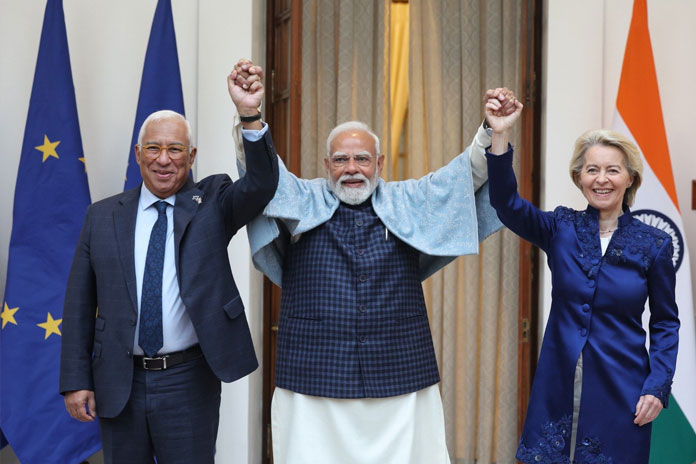
Prime Minister Narendra Modi said on Tuesday that India and the European Union had signed the “mother of all deals” ushering in a landmark partnership between two of the world’s largest economies. The free trade agreement will deliver sweeping economic gains.
Speaking in New Delhi Modi said the pact — which represents around 25% of global GDP and nearly one-third of global trade — would create significant opportunities for businesses and consumers across both regions. He said the agreement would boost key Indian sectors such as textiles, gems and jewellery, and leather goods, while deepening investment and trade ties with Europe.
“This deal will bring many opportunities for India’s 1.4 billion and many millions of people of the EU,” he said.
Negotiations on the India-EU free trade agreement resumed in 2022 after a long hiatus and have gained momentum as both sides seek to reduce dependence on China and strengthen supply-chain resilience. The talks cover not just trade in goods and services, but also investment protection, sustainability standards, digital trade and regulatory cooperation — areas that have proved contentious in earlier rounds.
The move comes days after the European bloc signed a key pact with the South American bloc Mercosur, following deals last year with Indonesia, Mexico and Switzerland.
Modi said the India-EU pact would complement India’s recently concluded trade agreement with the UK and help accelerate domestic manufacturing, aligning with New Delhi’s push to position India as a global production hub. This is a perfect example of a partnership between two major economies of the world,” the Prime Minister said.
Emphasising the broader global impact, PM Modi said the FTA would boost global confidence in India. “This Free Trade Agreement will further strengthen global confidence in India for businesses and investors across the world,” he said, adding that India is actively working on global partnerships across all sectors.
India has stepped up trade negotiations over the past few years, signing a free trade agreement with the UK and a separate pact with the four-nation EFTA bloc which includes Switzerland, Norway, Iceland and Liechtenstein, to secure greater market access, investment commitments and regulatory cooperation.