There are a few rare weeks in international relations, where decades happen. Davos 2026 was one such week, which saw true international fluidity in motion as nations, actors and governments jumped from one crises to the next, even as they battled to extinguish fires not of their own making.
The annual meeting of the World Economic Forum (WEF) is known each year for setting the agenda and bringing in new ideas to global conversations that can change the world. This year however, Davos the town in Switzerland where the WEF meets was overtaken by geopolitical events of such magnitude that even veteran journalists, politicians and global leaders were left scratching their heads.
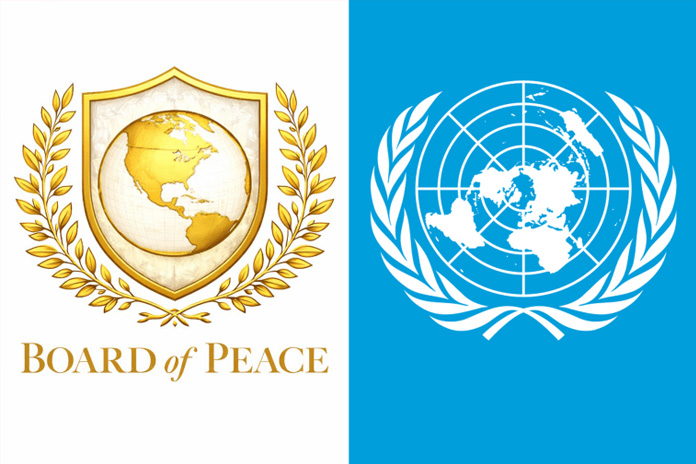
And the man behind this flux and unprecedented fluidity is of course – U.S. President Donald Trump. True to his unique style he landed in Davos and unveiled an agenda so radically different from what was expected that everything and everyone else was swept away. From declaring that the U.S. will not invade Greenland to harsh criticism of Europe and Iran to raising new hopes on a settlement of the intractable war in Ukraine, he took everyone by surprise. But he was not done yet. Revealing his Trump card, the U.S. President established a ‘Board of Peace’ headed by him, that he envisions will become an alternate to the United Nations.
That the UN led global multilateral system is in deep crises is not a new revelation. The United Nations, the world’s preeminent global intergovernmental organisation established in 1945 to maintain peace and security on the planet has failed miserably in the past years to uphold its mandate. The fact that a majority of the world’s population is not represented by the P-5 (U.S., Russia, China, France and UK), the Pantheon that rules the UN Security Council, the most powerful organ of the United Nations, has led to severe loss of legitimacy for the organisation. This combined with its abject powerlessness in conflicts like Ukraine and Gaza have made even the staunchest of UN supporters, grasp for answers.
Thus when President Donald Trump launched his Board of Peace, initially designed to ensure peace in Gaza, but which he now foresees taking a wider role worrying all other global powers, an immediate and perhaps unprecedented challenge has arisen for the UN.
“Once this board is completely formed, we can do pretty much whatever we want to do. And we’ll do it in conjunction with the United Nations,” Trump declared while announcing the ‘Board of Peace’, adding that the “UN had great potential that had not been fully utilised.”
Trump will chair the Board and has invited dozens of other world leaders to join, saying he wants it to address challenges beyond the stuttering Gaza ceasefire, stirring misgivings that it could undermine the UN’s role as the main platform for global diplomacy and conflict resolution.
And while regional Middle East powers including Turkey, Egypt, Saudi Arabia and Qatar, as well as major emerging nations such as Indonesia, have joined the board, global powers and traditional Western U.S. allies in Europe have been cautious and some countries in Europe have even said no.
Trump has said permanent members of the ‘Board of Peace’ must help fund it with a payment of $1 billion each. Ironically, the Board which was set-up to ensure lasting peace in Gaza as its primary motive, did not have any representatives from governments of Israel or the Palestinian Authority at the signing ceremony in Davos. And extraordinarily the Charter of the Board has no mention of Gaza at all – the supposed raison d’être for the Board’s existence.
In this situation, what must India do and what choice do we face now?
There are moments in a nation’s life when the question is not what we gain, but who we become. For India, this is one such moment. Since the end of British colonisation and Independence of India in 1947, there is one common thread that has been the bedrock of Indian approach to the world, which is – we do not take dictation from anybody. India decides for itself.
Faced with President Trump’s ‘Board of Peace’ where the American President has complete and absolute control over the functioning, mandate and activities of the organisation, if we decide to join we will immediately become second-class citizens on the Board. Unable to command our own actions or promote Indian national interests.
This is not a question of money for Gaza, nor even of geopolitics. It is a question of India’s constitutional morality, our strategic autonomy, and moral credibility. India must now walk the talk and uphold its strategic independence, which allows us to engage with all major powers without becoming an instrument of any.
To join the ‘Board of Peace’, an entity structured primarily by external powers, especially in the immediate aftermath of mass civilian destruction in Gaza, would place India on the wrong side of its own anti-colonial history. India cannot be a signatory to a process that treats Palestinians as subjects to be managed rather than a people entitled to their own future.
Further, accepting a $1 billion inducement tied to participation in a geopolitically loaded governance mechanism would erode our strategic autonomy in practice, even if it remains intact in rhetoric. This is not a Marshall Plan for Gaza. It is not even decisive development finance. What the $1 billion buys is not economic leverage but political positioning on a colonial board. Once India sits on such a Board, it inherits the consequences of decisions it does not control. It becomes associated with outcomes it cannot shape. It risks being blamed by one side for occupation by proxy, and by the other for insufficient obedience. Strategic autonomy means knowing when not to sit at the table.
India has spent decades cultivating trust across the Global South, as a country that understands occupation, displacement, and the long shadow of imperial arrangements. That credibility is not theoretical. It translates into diplomatic capital, coalition leadership, and moral authority in multilateral forums. Joining a Gaza peace board perceived — rightly or wrongly — as legitimising a post-conflict order without justice would fracture that trust. From Africa to Southeast Asia, from Latin America to West Asia, many countries are watching not what India says but what it does. India cannot afford to be seen as a stabiliser of injustice.
Lastly, there is a deeper, more uncomfortable truth shadowing this undertaking: Peace imposed immediately after devastation, without accountability, is rarely peace. It is pacification. And papering over of injustice. Gaza today is not merely a post-conflict zone. It is a traumatised society, with shattered infrastructure, displaced families, and unresolved political futures. Any attempt to fast-track governance mechanisms risks freezing injustice into administrative normalcy. India’s own freedom struggle teaches us that order imposed without justice is unsustainable. Stability without dignity breeds resistance.
India must not lend its name, history, or constitutional ethos to a process that confuses management with justice.
Thus for the time being, India should be ambiguous, neither saying no nor yes and watch as events and circumstances around the ‘Board of Peace’ materialise. The future is extraordinarily fluid.
But in our hearts and minds, we should be unequivocally clear that joining the Board in its present shape and form will be a misstep. If pushed on the issue immediately, India must have the capacity to say no — firmly, calmly, and without apology.
For power corrupts. And absolute power corrupts absolutely. This is the state of the ‘Board of Trump’ today.