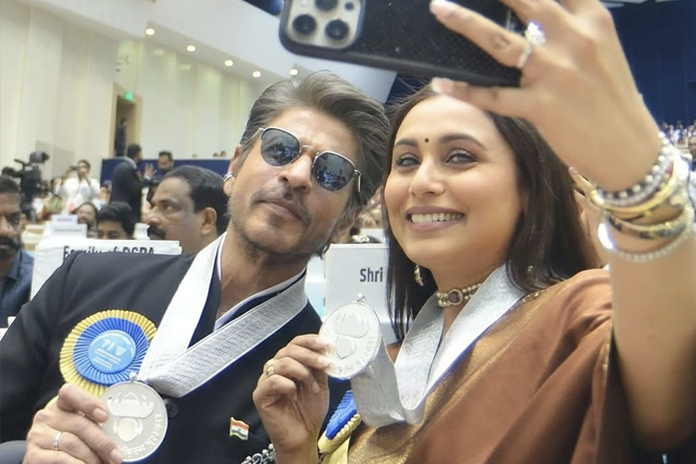
New Delhi: As India wakes on 24 September 2025, the headlines still feel like a fever dream — two of Bollywood’s most beloved and iconic figures, are finally holding the country’s highest acting honours after 30 long years of absolute cinematic magic on the Big Screen. At the 71st National Film Awards ceremony in New Delhi, Shah Rukh Khan accepted his first-ever National Award for Jawan, and Rani Mukerji received her first National Award for Mrs Chatterjee vs Norway. The wins, hailed across social media, newspapers, tabloids and TV panels, marked the end of an era for the two legendary artists who have defined modern Bollywood at different turns of their careers.
If national awards are crowns, both actors were overdue for coronation.
Shah Rukh Khan — the man, the myth, the legend; Bollywood’s favourite heartthrob who turned romantic cinema into an eternal dream, has spent decades moving between romantic hero, lovable rogue, and action star. Who can forget him as the kind NASA engineer-turned-returnee in Swades, or as the swaggering lover-boy in Dilwale Dulhania Le Jayenge? His roles have been both intimate and epic. In Jawan he fused theatre with grit in a way that finally drew the National jury’s nod. The applause that greeted him in Vigyan Bhawan, as he received the national award was not just for a performance but for an entire career’s worth of late-night monologues, tearful reunions and defiantly human moments. While Jawan is no where close to being Shah Rukh Khan’s top movies, I suspect it will be amongst his most favourite now. This is the film that finally won him his much deserved crown.
On the other side, Rani Mukerji’s victory felt like another kind of perfect symmetry. From the unbelievable intensity she brought to the globally acclaimed movie Black, to the luminous vulnerability of her earlier romantic performances in Kuch Kuch Hota Hai and Chalte Chalte, to the power and mischief of Bunty Aur Babli and Mardaani; Rani has always inhabited strong, sometimes bruised women with a rare perfection. In Mrs Chatterjee vs Norway, she blended resilience and heartbreak into a portrayal that cut straight to the bone — and the National Award recognises that long-experienced cinematic mastery. For many fans, the sight of Rani accepting the ‘Rajat Kamal’ (silver lotus, another name for the national film award) was the happy ending to countless mature, layered performances that never quite fit neatly into the usual, same old, award-season boxes. Rani has long been a fixture of Hindi cinema and with her celebrated partner Aditya Chopra, she currently runs Yash Raj Films, one of India’s most powerful and great production houses.
With the 71st National Film Awards, there’s a particular poetry in both wins arriving together. The two stars have shared the screen in films that range from the playful to the plaintive, from — Chalte Chalte and Veer-Zaara to ensemble spectacles like Kabhi Khushi Kabhie Gham. Even when their characters were caught in larger-than-life melodrama, their on-screen chemistry was a steady, humanising force. Shah Rukh and Rani’s Kuch Kuch Hota Hai has become a cultural ritual for every Indian teenager, a movie that became shorthand for an era and for the way their generation of stars transformed Bollywood’s heart. And so their simultaneous recognition feels less like coincidence and more like destiny; a long, slow handshake between two chapters of the same story.
Off-screen, their friendship has been a soft headline for years. Fans have replayed moments from Coffee with Karan, the reality tv coffee talk hosted by Bollywood’s legendary director Karan Johar, where the pair bantered, teased, and openly admired one another — a conversation-style intimacy that gave viewers a glimpse of how admiration and affection matured into a warm, lifelong camaraderie. Those televised moments — cheeky, candid and often disarmingly honest — reminded audiences that beyond reels and retakes, these are two people who have cheered and carried each other through decades under the spotlight. That friendship seemed to glow anew as they stood in the same room, both newly decorated with the country’s highest acting honours.
The narrative becomes especially sweet because both actors’ careers have been defined by reinvention. Shah Rukh’s path has never been linear: romantic leads gave way to darker experiments and then to a blockbuster bravado that made Jawan both a crowd and critic favourite. Rani, too, has moved from romantic ingenue to the weightier roles that ask an actor to break open emotionally and rebuild, right in front of us. Their awards are not just for single performances but for the sum of deliberate risks and quiet commitments to the craft.
At Vigyan Bhawan, the scene read like a family reunion. Old friends, present-day colleagues, and legions of fans watched as two names that have threaded themselves into the soundtrack of modern India, finally received formal government recognition. Comments poured in — from industry peers to weekday barista banter — as social timelines filled with throwback clips of Swades‘ solitary and Black’s raw, aching intensity. The wins also opened up conversations about the changing guard in Hindi cinema: how the industry now honours a wider range of stories, and how long careers built on versatility can still surprise us with their capacity for reinvention.
For fans, the moment was surreal. The applause extended across generations — a standing ovation for craft, charisma, and the kind of screen presence that can make any ordinary afternoon feel cinematically possible.
There’s a theatrical fairness to all of this. Both stars have emerged from a system that is at once capricious and generous; both persisted when recognition was shy and so the National accolades feel to many, like a gentle correction: acknowledgement not just of two performances but of two durable careers that have carried millions of memories and captured billions of hearts.
As the media moved past the flurry of acceptance speeches and red-carpet footage, one image lingered: Shah Rukh and Rani, standing quietly amid confetti and camera flashes, smiling in the way only those who have known the long journey can smile. Their friendship — playful on TV, steadfast off it — speaks for itself. If awards are stories, then this chapter reads like a long-awaited, beautifully earned pause in a narrative that continues on screen, in memory, and in the hearts of the audience.
That pause, however, is not an ending — it’s an exclamation. For Shah Rukh Khan and Rani Mukerji, the National Awards are a new punctuation in careers that will no doubt keep surprising us. With this long awaited Indian dream, accomplished at last, one truth feels simple and real: sometimes the crown arrives late, but when it does, it fits exactly where it belongs.