Amid rising hostility between Thailand and Cambodia resulting in the worst border clashes between the two Southeast Asian neighbours in over a decade, the leaders of both countries are set to meet in Malaysia on Monday, even as the violent skirmishes have left at least 34 people dead and displaced over 2,00,000 along the border regions.
Thailand’s acting Prime Minister Phumtham Wechayachai and Cambodian Prime Minister Hun Manet will attend peace talks in Kuala Lumpur, mediated by Malaysian Prime Minister Anwar Ibrahim. Malaysia currently chairs the ASEAN regional bloc, of which both nations are members.
Anwar confirmed that both sides had requested his help in negotiating a peace deal. “I’m discussing the parameters, the conditions, but what is important is (an) immediate ceasefire,” he told the Malaysian state-run Bernama news agency on Sunday.
Trump’s Intervention Sparks Breakthrough
Cambodian Prime Minister Hun Manet on Sunday said that his country had accepted an “immediate and unconditional ceasefire,” adding that US President Donald Trump had confirmed Thailand’s agreement to halt attacks. “This is positive news for the soldiers and people of both countries,” he said.
Hun Manet directed his foreign minister, Prak Sokhonn, to coordinate next steps with US Secretary of State Marco Rubio and engage directly with Thailand.
Additionally, Thailand’s Phumtham thanked President Trump and confirmed Thailand’s agreement in principle to a ceasefire, but stressed the need for “sincere intention” from Cambodia. He called for urgent bilateral talks to establish a peaceful resolution.
On Saturday, Trump had stated on his media platform Truth Social that he had spoken to both leaders and warned that the United States would not proceed with trade talks with either country if the violence continued. He claimed both sides agreed to hold talks following his intervention.
Death Toll Rises
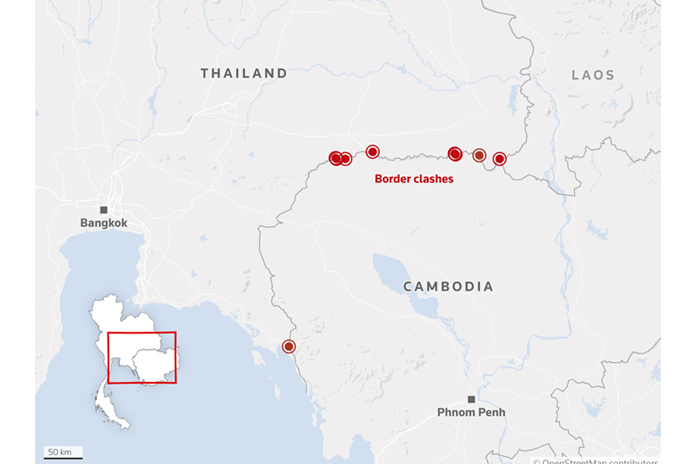
At least 34 people have died since fresh fighting erupted on Thursday near disputed territory adjoining historic temples along the jungle-clad border of the two nations. Tensions between Thailand and Cambodia have been high since May this year, when a Cambodian soldier was killed during a border skirmish. Since then troops on both sides have been reinforced amid a full-blown diplomatic crisis that has brought Thailand’s fragile coalition government to the brink of collapse and resulted in the suspension of their Prime Minister Paetongtarn Shinawatra in early July.
Till date Thailand has reported eight soldiers and 13 civilians deaths, while Cambodia has confirmed five military and eight civilian dead. More than 1,38,000 people have been evacuated from Thailand’s border areas, while 80,000 have been displaced in Cambodia.
The violent clashes, involving jets, tanks and ground troops, have escalated around ancient temple sites such as the Preah Vihear Temple, where territory along the the temple’s immediate vicinity has long been claimed by both nations. In the ongoing conflict, Thailand has accused Cambodia of attacking hospitals and using mines, while Cambodia says Thai forces have used banned cluster munitions and attacked world heritage temple sites.
Fresh Shelling Near Temples
Despite diplomatic efforts, fresh artillery fire was reported Sunday near two temples in the frontier region. At the heart of the matter lies the 900-year-old Preah Vihear temple, a Hindu shrine dedicated to Lord Shiva, which is perched on a 525 metre cliff in Cambodia’s Dangrek mountains. Built under the Khmer Empire, it is a religious site for not just Cambodians, but also their Thai neighbours. Roughly 95 km to the west lies the Ta Muen Thom temple, a 12th-century Shiva shrine.
Although largely overshadowed by the global popularity of the Angkor Wat, one of the largest ancient Hindu temples in the world, the cluster of temples of Preah Vihear and Ta Muen Thom have been at the centre of a conflict between the two nations for more than half a century.
The current hostilities this past week have focused on the Ta Muen Thom temple, which is situated along the rugged forested border in the Dangrek Mountains. Its location has made it a recurring flashpoint.
Thailand has since escalated the threat levels to “Level 4,” triggering a full closure of all border checkpoints along the shared frontier, declaring ‘martial law’ in the border region.
100 Year Old Arbitrary Colonial Borders lie at the root of the dispute
The border dispute revolves around the controversy surrounding the demarcation line between Cambodia and Thailand, much of which stems from colonial era borders. Historically Cambodia was a french colony while Thailand, then known as Siam, acted as a strategic buffer between the British Empire and French Indochina.
Following the establishment of French protection over Cambodia in 1863, several treaties between France and Siam were signed from 1904 to 1907 to define territorial boundaries. French surveyors created maps based on watershed lines but made exceptions near culturally important sites such as Preah Vihear.
The French-made maps based on European cartography gave Cambodia a distinct “geo-body,” with Preah Vihear located just inside its borders. Thailand has consistently disputed these lines, especially as more modern geographic technologies exposed inconsistencies.
Historians have long noted that arbitrary boundaries, particularly those drawn by Western powers, were alien to regional politics, much like the India-Pakistan partition line.
In 2008, Cambodia succeeded in having Preah Vihear listed as a UNESCO World Heritage site, a move that again triggered Thai opposition. Thailand’s then Foreign Minister Noppadon Pattama, who had supported the bid, was forced to resign following domestic backlash. That same year, clashes broke out near the temple, killing soldiers on both sides, and sadly this violent legacy continues.
ICJ a ray of hope for Cambodia
In an important milestone in 1962, the International Court of Justice (ICJ), the world’s highest court, ruled in favour of Cambodia regarding their claim to Preah Vihear and ordered Thailand to withdraw troops and return any artefacts removed after 1954 from the temple.
The ruling rested on the 1907 French-drawn map that placed the temple within Cambodia. Thailand, then Siam, had accepted this map at the time but later argued it had done so under the mistaken belief that the border followed a natural watershed line. The ICJ disagreed, concluding that Thailand had accepted the map and was bound by it.
In 2013, after renewed clashes between troops at the site in 2011, the ICJ clarified its original judgment, granting Cambodia sovereignty not only over the temple but also the surrounding area, and instructed Thailand to remove its forces.
A fragile Peace in the making
With immediate peace talks on the horizon, the prospect for a fragile peace is in the making. While neither country nor the region or the world wants to see an escalation of the conflict, hostile domestic public opinion on both sides is putting the governments in Bangkok and Phnom Penh under enormous pressure.
Yet the very loud and public intervention of US President Trump, may just be the off-ramp that both countries need to deescalate.
Much like India and Pakistan, Thailand and Cambodia suffer from the deep scars left by colonial powers and their indifference to the fate of the colonies they ruled and then abandoned with haste. A long lasting solution to the dispute will be possible only when the borders are clearly and mutually demarcated. How many more decades that will take remains to be seen.