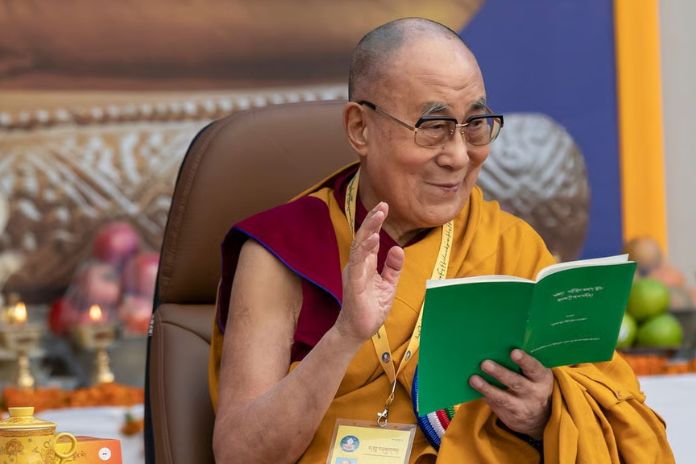
His Holiness the 14th Dalai Lama, as he approaches his 90th birthday, has made a significant and historic declaration. The Tibetan spiritual leader has confirmed that the centuries-old institution of the Dalai Lama will continue after his death, with one clear condition: the Chinese government will have no role in selecting his successor.
In a video address broadcast from Dharamshala, India, where he has lived in exile since 1959, the Dalai Lama stated that the process of identifying his reincarnation will be carried out solely by the Gaden Phodrang Trust, his official spiritual office. Emphasizing spiritual autonomy, he said, “No one else has any authority to interfere in this matter.” His successor, he added, will be born in a free country and recognized according to Tibetan Buddhist tradition.
According to Tibetan belief, the Dalai Lama is reincarnated after death, and the search for the next incarnation follows a sacred process. However, the succession has become a political flashpoint ever since China annexed Tibet in 1950. Beijing maintains that any reincarnation must be born within Chinese territory and approved by the Communist government through the use of the Golden Urn, a centuries-old ritual once used by the Qing dynasty. The Dalai Lama and the Tibetan exile community firmly reject this claim.
Over the years, the Dalai Lama had expressed uncertainty about the future of the institution. At times, he suggested there may be no successor at all or that the next Dalai Lama could be a woman. However, strong support from the Tibetan community in exile and global followers appears to have guided his final decision. He has now made it clear that the tradition will continue and that its future lies in the hands of the Tibetan people, not political authorities.
The announcement has significant diplomatic and spiritual implications. It reinforces the call for religious freedom, challenges China’s attempts to control Tibetan Buddhism, and underscores India’s role as the spiritual refuge for Tibetan culture. Many see it as a turning point in the cultural and civilizational relationship between India and China.
His Holiness concluded with a reminder that the selection of his successor must honor the values, rituals, and independence of Tibetan Buddhism. His message was not just a spiritual affirmation, but also a declaration of dignity, identity, and belief that cannot be dictated by force.