In a moment that stirred pride across the nation, Indian Air Force Group Captain and test pilot Shubhanshu Shukla became the first Indian to reach the International Space Station (ISS). As the SpaceX Crew Dragon capsule neared the orbital laboratory, Shukla offered a heartfelt greeting to Earth: “Namaskar from space.” His words echoed not only through the capsule’s comms but through the hearts of 1.4 billion Indians watching history unfold.
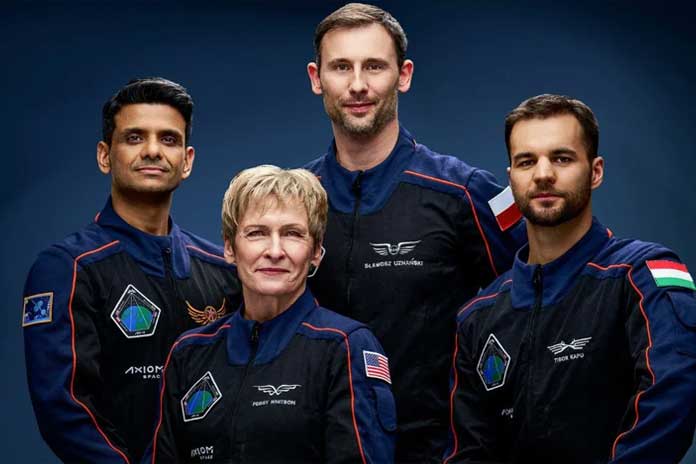
Launched on June 25, 2025, from NASA’s Kennedy Space Center, Shukla is part of the multinational Axiom Mission 4, which also includes astronauts from the USA, Poland, and Hungary. The mission lifted off aboard SpaceX’s Crew Dragon capsule “Grace,” after a brief delay due to weather conditions. Within minutes of launch, Shukla experienced the intense forces of take-off, describing it as feeling like he was being pushed deep into his seat — a rush familiar to every astronaut, yet deeply personal for India’s newest space hero.
“I felt like I was being pushed back into my seat. It was intense but truly magical,” he said, moments after reaching orbit. Floating in zero gravity, he reflected on the surreal nature of space travel, adding, “It feels like you are a baby again. Everything is new. Every movement, every sight. It’s humbling.”
This mission is historic in many ways. Shukla is only the second Indian to go to space, following Rakesh Sharma’s journey in 1984 aboard a Soviet spacecraft. But unlike Sharma, who orbited Earth in the Soyuz capsule, Shukla is the first Indian to dock with the International Space Station, joining an elite group of astronauts contributing to ongoing international scientific research.
Over the next 14 days, Shukla will participate in more than 60 experiments aboard the ISS. Several of these projects have Indian roots, including research on micro-algae and sustainable life support systems in collaboration with ISRO and the Department of Biotechnology. These studies are crucial for understanding how humans can survive and thrive on long-duration space missions, and their findings may even contribute to India’s upcoming Gaganyaan mission.
Back home, Prime Minister Narendra Modi celebrated the mission as a milestone in India’s growing stature in space. He remarked that Shukla “carries the hopes and dreams of 1.4 billion Indians,” while many in Shukla’s hometown of Lucknow organized gatherings to watch the live broadcast. Yogi Adityanath, Chief Minister of Uttar Pradesh, hailed it as a proud moment for the state and the nation.
Shukla’s journey is not just a technological feat, but a human one. His simple greeting, “Namaskar from space,” resonates far beyond science. It is a message of humility, unity, and ambition — a reminder that India is once again reaching for the stars, not as a follower, but as a leading partner in the future of space exploration.