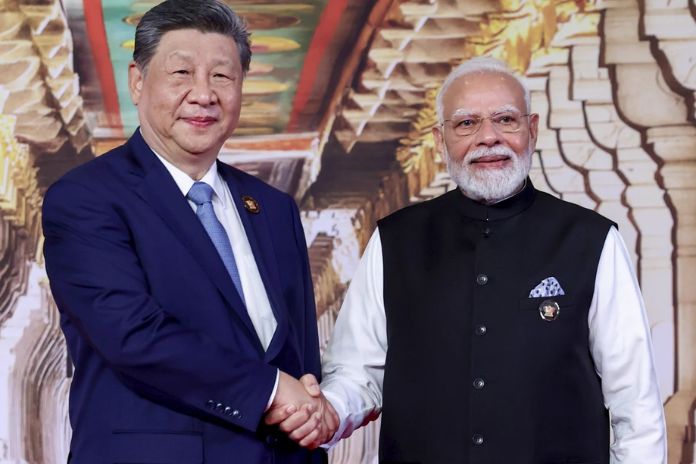
Prime Minister Narendra Modi and Chinese President Xi Jinping held bilateral talks on the sidelines of the BRICS Summit in New Delhi on Saturday. The meeting came after the two leaders interacted during the opening session of the summit.
Xi Jinping’s visit to India has attracted significant attention as the two countries seek to maintain dialogue and improve bilateral engagement. The talks also took place against the backdrop of major global challenges, including tensions in West Asia, the conflict in Ukraine and uncertainty in the global economy.
New Delhi Declaration adopted
BRICS leaders unanimously adopted the New Delhi Declaration 2026 during the first day of the summit. The document underlined the need for stronger international cooperation and a more representative global governance system.
The declaration called for reforms in global institutions, including the United Nations Security Council. BRICS leaders said developing countries should have a greater voice in decisions affecting the international political and economic order.
The grouping also stressed the importance of cooperation among member countries in areas such as trade, investment, energy, technology and digital payments.
Focus on economic cooperation
The declaration highlighted the need to deepen economic ties within BRICS. Leaders discussed ways to promote stable trade, strengthen supply chains and improve cooperation in energy and technology.
The grouping also favoured greater coordination to protect the interests of developing economies. BRICS members said global trade should remain open, stable and predictable.
Cooperation in emerging areas such as artificial intelligence, digital infrastructure and cross-border payments is also expected to remain an important part of the BRICS agenda.
Call for peace in West Asia
The New Delhi Declaration expressed serious concern over continuing hostilities in West Asia. BRICS leaders urged all sides to exercise maximum restraint and avoid actions that could further escalate the conflict.
The declaration supported dialogue, consultation and diplomatic efforts to resolve disputes. It also stressed respect for national sovereignty, territorial integrity and international law.
BRICS leaders called for the protection of civilians and civilian infrastructure. They also underlined the importance of providing humanitarian assistance to people affected by conflicts, including those in Gaza.
India highlights Global South
Prime Minister Modi used the summit to call for a stronger role for developing countries in global decision-making. He said nations of the Global South should not remain limited to implementing rules created by others.
India also advocated reforms in international institutions so that they better reflect present-day geopolitical and economic realities. New Delhi said BRICS can play an important role in promoting a fairer and more balanced global order.
What lies ahead
The adoption of the declaration reflects an effort by BRICS members to find common ground despite differences on several international issues. The group’s focus is expected to remain on economic cooperation, global governance reforms, peace initiatives and the concerns of developing countries.
The Modi-Xi meeting, meanwhile, has added importance to the summit and could support continued engagement between India and China on bilateral and regional matters.