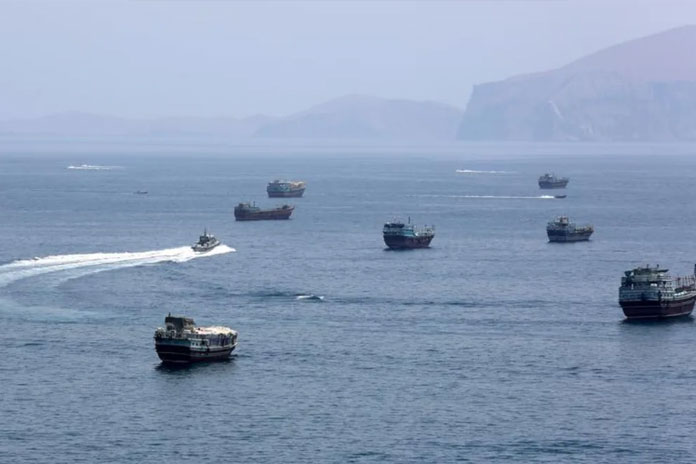
Iran is preparing to impose a new layer of restrictions around one of the world’s most sensitive shipping routes, with its top security official warning that vessels entering a proposed maritime zone beyond the Strait of Hormuz could be placed on Tehran’s sanctions list.
Mohsen Rezaei, Secretary of Iran’s Supreme National Security Council, said the restricted area would be announced in the coming days and would extend from the line of the US naval blockade into parts of the Persian Gulf.
“Any ship entering this new area will be placed on the sanctions list,” Rezaei told Iranian state broadcaster IRIB.
The announcement comes as Tehran seeks to make future access through the Strait of Hormuz conditional on changes in Washington’s military posture.
“Iran will commit to keeping the Strait of Hormuz open when the US neither threatens nor attacks Iran,” Rezaei said.
Iran plans new maritime zone beyond Strait of Hormuz
Rezaei said the proposed area would begin from what Iran describes as the US naval blockade line and cover waters extending towards the Persian Gulf.
“This area starts from the US naval blockade line to include areas of the Persian Gulf,” he said.
Ships entering the zone without coordinating with Iran could face consequences affecting insurance coverage as well as their future passage through the waterway.
Rezaei also said Iran and Oman were expected to announce a new corridor for passage through the Strait of Hormuz in the coming days. He said its entry and exit points would remain under Iranian management.
Rezaei links Hormuz access to US actions
The Iranian security chief presented access through Hormuz as part of Tehran’s wider confrontation with Washington.
He said the strait would remain closed unless the United States took practical steps to fulfil obligations under a peace memorandum of understanding signed between Tehran and Washington in June.
Rezaei said Iran would commit to keeping the waterway open if the US stopped threatening or attacking the country.
The Iranian official also rejected US claims about shipping through the strait and said some vessels were attempting to cross through a route near Oman after switching off navigation systems.
He claimed most such ships “receive blows”, while saying Iran was not seeking to sink them for now because of environmental concerns.
Iran claims anti-destroyer missile test near US carrier
Rezaei also claimed Iran had test-fired a domestically developed anti-destroyer missile above a US aircraft carrier 48 hours earlier.
He presented the test as a warning that the US naval blockade could be challenged.
Rezaei separately claimed Iranian forces had identified several American military targets but deliberately chose not to strike some of them.
“Iran had identified some American targets but did not intentionally strike them, such as their Titan base in Jordan and some of their bases in Erbil,” he said.
Hezbollah ‘upper hand’ claim amid Lebanon conflict
Rezaei also addressed the conflict involving Hezbollah and Israel in Lebanon, arguing that military campaigns could not be judged as an uninterrupted sequence of victories or defeats.
In no war does victory after victory and defeat after defeat make sense; wars have ups and downs,” he said.
He nevertheless claimed Hezbollah had retained the advantage during the fighting.
“The upper hand has always been with Lebanon’s Hezbollah,” Rezaei said.