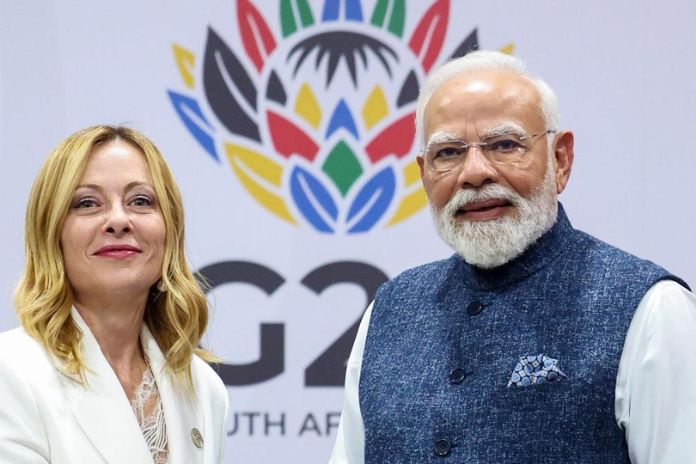
Prime Minister Narendra Modi and Italian Premier Giorgia Meloni have unveiled a sweeping road map to strengthen India–Italy ties, centred on a new Indo‑Mediterranean corridor and a €20 billion bilateral trade target by 2029. The blueprint positions India and Italy as connecting hubs between the Indo‑Pacific and the Mediterranean, blending economic ambition with strategic connectivity.
A new Indo‑Mediterranean corridor
In a joint op‑ed and summit statement, Modi and Meloni framed the Indo‑Mediterranean corridor as a bridge between the Indian Ocean and Europe, linking the Indo‑Pacific with the Mediterranean through trade, energy, digital networks, and infrastructure. The idea is to treat the two regions not as separate zones but as parts of a single, interconnected economic‑strategic space.
This corridor is designed to complement and reinforce the India–Middle East–Europe Economic Corridor (IMEC), which aims to create modern transport links, fibre‑optic digital networks, and cleaner energy systems across Asia, the Middle East, and Europe. Italy sees itself as a natural gateway for Indo‑Pacific connectivity into Europe, while India gains a stronger foothold in Mediterranean‑Europe markets and projects.
€20 billion trade target by 2029
The heart of the new road map is a clear economic target: annual bilateral trade of €20 billion by 2029, with both sides aiming to “reach and exceed” this figure. Current India–Italy trade, while growing, is still below this level, so the target implies a substantial push in goods, services, and investment flows.
Priority sectors include defence and aerospace, clean technology, machinery, auto components, chemicals, pharmaceuticals, digital technologies, critical minerals, agri‑food, textiles, infrastructure, and tourism. The plan also encourages deeper industrial partnerships, joint ventures, and technology‑sharing agreements, especially in green energy and digital infrastructure.
Special strategic partnership
Beyond trade, the partnership has been upgraded to a special strategic partnership, which broadens cooperation into several high‑tech and security‑linked domains. Key areas include artificial intelligence, space, nuclear energy, maritime connectivity, ports, and critical‑minerals supply‑chain resilience.
Both governments have agreed or signed agreements on critical minerals, agriculture, maritime transport, and ports, aiming to reduce dependence on single‑source suppliers and build diversified, resilient supply chains. Annual heads‑of‑government summits and a Joint Strategic Action Plan 2025–2029 will help translate words into concrete projects and timelines.
Connectivity and geopolitical implications
For India, the Indo‑Mediterranean vision fits neatly into its broader Indo‑Pacific strategy, allowing it to weave Mediterranean‑Europe routes into its network of ports, energy pipelines, and digital corridors. By deepening ties with Italy, a key EU member, India can enhance its influence in European‑level discussions on trade, technology, and security, especially in the Central and Eastern Mediterranean.
For Italy, this partnership is a strategic bet on India’s economic rise and its role in global supply‑chain reshaping. Rome wants to position itself as an entry point for Indo‑Pacific connectivity into Europe, hosting ports, energy infrastructure, and data hubs that tie India‑led projects like IMEC to Italian and EU markets.
In simple terms, the roadmap is about connecting two distant regions—India in the Indo‑Pacific and Italy in the Mediterranean—through trade, technology, and infrastructure, while locking in a clear goal of €20 billion in annual trade within a few years. As these plans take shape, the Indo‑Mediterranean corridor may soon appear on maps not just as a political idea, but as a functioning economic‑strategic artery linking Asia and Europe.