

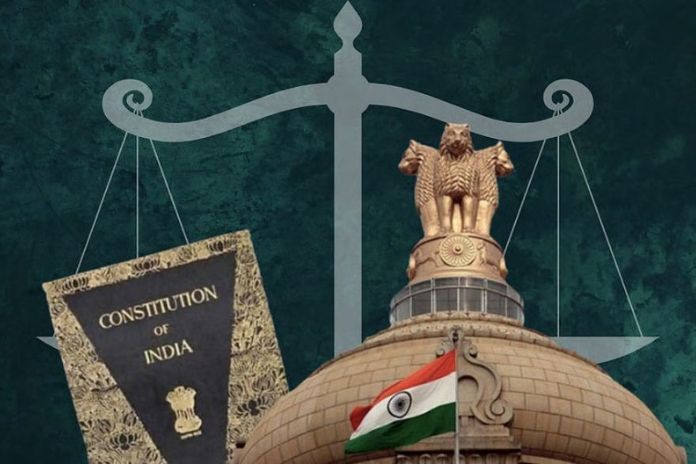
The Emergency-era constitutional amendment sought to place Parliament’s amending power beyond judicial scrutiny. The Supreme Court’s intervention in Minerva Mills reaffirmed a fundamental principle: no institution can claim unlimited power under a Constitution built on limitations.
On paper, a constitutional amendment is an exercise in democracy. Parliament debates, votes, and changes the framework through which a country governs itself. But what happens when the institution empowered to amend the Constitution attempts to remove the very limits placed upon its own authority?
This question lies at the heart of the 42nd Constitutional Amendment Act, 1976. Enacted during the National Emergency, the amendment represented one of the most significant attempts to reshape the relationship between Parliament and the judiciary in independent India. Its provisions sought to expand Parliament’s constitutional amending power and restrict the Supreme Court’s ability to review constitutional amendments.
The attempt, however, was not without a constitutional history. Three years earlier, the Supreme Court had established the Basic Structure Doctrine in the landmark Kesavananda Bharati v. State of Kerala judgment. The conflict between that doctrine and the 42nd Amendment would eventually reach the Court again, culminating in Minerva Mills v. Union of India in 1980.
The episode remains a defining moment in Indian constitutional history– not merely because of the amendment’s provisions, but because it raised a question that continues to matter: can an institution use its constitutional powers to make itself constitutionally unrestricted?
The Basic Structure Doctrine: A Limit on Constitutional Power
The foundation of this constitutional conflict was laid in 1973, when the Supreme Court delivered its judgment in Kesavananda Bharati v. State of Kerala.
The case emerged from a broader dispute over Parliament’s power to amend the Constitution, particularly in relation to property rights and laws intended to implement socio-economic reforms. The central question was whether Parliament’s power under Article 368 was unlimited.
The Supreme Court, by a narrow majority of 7:6, held that Parliament could amend any part of the Constitution, including Fundamental Rights. However, it could not alter or destroy the Constitution’s basic structure.
The judgment did not provide an exhaustive list of basic features. Over subsequent decisions, principles such as constitutional supremacy, democracy, secularism, federalism, judicial review, and the independence of the judiciary came to be recognised as essential elements of the constitutional framework.
The doctrine introduced a distinction between constitutional amendment and constitutional destruction. Parliament could transform the Constitution, but it could not use the power of amendment to dismantle its foundational principles.
This distinction became particularly significant during the Emergency.
The Emergency: A Constitutional Crisis in a Political Context
On 25 June 1975, a National Emergency was proclaimed under Article 352 on the ground of internal disturbance. The period that followed witnessed the detention of opposition leaders, restrictions on civil liberties, press censorship, and a substantial weakening of political dissent.
The Emergency created an environment in which the government could pursue major constitutional changes with limited political resistance. Parliament continued to function, but the conditions under which political debate and opposition operated were far from normal.
It was in this context that the government introduced the 42nd Constitutional Amendment Act, 1976.
Often described as one of the most extensive constitutional amendments in India’s history, the 42nd Amendment altered several provisions concerning the legislature, executive, judiciary, and the relationship between Fundamental Rights and Directive Principles of State Policy.
Among its most consequential changes were those made to Article 368.
Article 368: The Attempt to Remove Constitutional Limits
The 42nd Amendment inserted Clauses (4) and (5) into Article 368.
Article 368(4) sought to prevent constitutional amendments from being questioned in any court on any ground. In effect, it attempted to exclude judicial review of constitutional amendments altogether.
Article 368(5) went further. It declared that there would be no limitation whatever on Parliament’s constituent power to amend the Constitution.
Together, these provisions sought to address the restriction imposed by the Basic Structure Doctrine. If Parliament’s amending power was declared unlimited, and courts were prevented from reviewing constitutional amendments, the doctrine would lose its practical force.
The constitutional implications were profound.
Consider a hypothetical situation in which Parliament amended the Constitution to remove judicial independence or weaken democratic institutions. Under the principle established in Kesavananda Bharati, such an amendment could be examined by the Supreme Court if it damaged the basic structure.
The 42nd Amendment attempted to prevent precisely this kind of scrutiny.
It was not simply an expansion of legislative authority. It was an attempt to place the exercise of constitutional amending power beyond judicial examination.
Yet an important distinction must be made: the Emergency did not automatically grant Parliament unlimited constitutional authority. The government used the existing procedure under Article 368 to enact an amendment that claimed to establish such authority.
The question was whether the Constitution permitted Parliament to make that claim.
Minerva Mills: The Supreme Court Draws the Constitutional Line
The answer came in 1980 in Minerva Mills v. Union of India.
The case challenged important provisions of the 42nd Amendment. The Supreme Court struck down Section 55, which had inserted Clauses (4) and (5) into Article 368. It also struck down Section 4, which had expanded Article 31C to protect laws implementing any Directive Principle of State Policy from challenges under Articles 14 and 19.
The Court’s reasoning was central to the survival of the Basic Structure Doctrine.
It held that a limited amending power is itself a basic feature of the Constitution. Parliament derives its authority from the Constitution; it cannot use that authority to transform a limited power into an unlimited one.
The Court also reaffirmed the importance of judicial review. If Parliament could amend the Constitution without any possibility of judicial scrutiny, constitutional limitations would become ineffective. The balance between Parliament and the judiciary would be fundamentally altered.
In Minerva Mills, the Court emphasised the relationship between Fundamental Rights and Directive Principles. Neither could be given absolute supremacy at the cost of the other. The Constitution was designed to maintain a balance between individual liberty and the goals of social transformation.
The judgment therefore did more than invalidate two provisions. It reaffirmed the principle that constitutional power must remain subject to constitutional limits.
Parliament, the Judiciary, and the Meaning of Constitutional Supremacy
The conflict between the 42nd Amendment and the Basic Structure Doctrine is often framed as a contest between Parliament and the Supreme Court. However, reducing it to a struggle between two institutions misses the larger constitutional issue.
Parliament is a democratically elected body and possesses extensive legislative and amending powers. The judiciary, on the other hand, is responsible for interpreting the Constitution and ensuring that its limitations are respected.
The Constitution does not establish absolute supremacy for either institution. It creates a system of powers, responsibilities, and checks.
The Basic Structure Doctrine does not prevent Parliament from responding to changing social and political realities. Nor does it make the Constitution unamendable. It simply establishes that certain foundational principles cannot be destroyed through the amendment process.
The 42nd Amendment tested this boundary by attempting to remove judicial review and declare Parliament’s amending power unlimited. The Supreme Court’s decision in Minerva Mills reaffirmed that constitutional supremacy cannot be replaced by the supremacy of a particular institution.
This distinction is particularly important in a democracy. Electoral legitimacy gives Parliament the authority to govern, but it does not place every exercise of parliamentary power beyond constitutional scrutiny.
The Legacy of the 42nd Amendment
The 42nd Amendment remains significant because it demonstrates how constitutional change can become a means of altering the distribution of institutional power.
Its provisions concerning Article 368 were ultimately struck down, but the episode exposed the vulnerability of constitutional safeguards when political conditions weaken opposition and public scrutiny.
It also reinforced the importance of judicial review as a mechanism for protecting constitutional principles. The Supreme Court’s intervention in Minerva Mills did not eliminate the possibility of future disputes over Parliament’s amending power. Instead, it reaffirmed the constitutional framework within which those disputes must be resolved.
The sequence of Kesavananda Bharati in 1973, the 42nd Amendment in 1976, and Minerva Mills in 1980 illustrates a crucial development in Indian constitutional history. Parliament’s power to amend the Constitution was recognised, challenged, and ultimately reaffirmed as a limited power.
The central lesson is not that Parliament must remain weak or that the judiciary must always prevail. It is that constitutional democracy depends on institutions recognising the limits of their own authority.
Conclusion
A Constitution cannot protect democracy if the power to amend it can be used to eliminate every safeguard against arbitrary rule.
The 42nd Amendment attempted to make Parliament’s amending power virtually unlimited. Minerva Mills rejected that attempt and restored the constitutional principle that no institution is above the Constitution.
In the end, the strength of Indian democracy lies not in the unlimited power of Parliament or the unchecked authority of the judiciary, but in the continued existence of constitutional boundaries that both institutions are required to respect.








, and how the Basic Structure Doctrine protects India's Constitution.)