

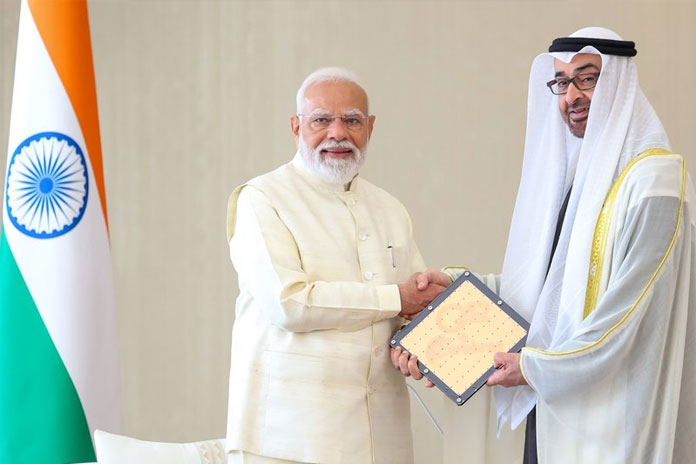
Abu Dhabi: Agreements on a “framework for a strategic defence partnership”, on strategic petroleum reserves and supplies of liquefied petroleum gas (LPG) with the United Arab Emirates (UAE) were announced Friday after Prime Minister Narendra Modi’s three-hour visit to Abu Dhabi.
“The friendship between India and UAE is very strong! Our nations will keep working together with the aim of building a better future for our planet,” Prime Minister Narendra Modi said in a statement after meeting Emirati President Mohammed bin Zayed Al Nahyan.
Amongst the key agreements signed is the framework for a “strategic defence partnership”. The framework builds on the letter of intent announced during the Emirati President’s visit to India in January.
This is PM Modi’s first visit to the region since conflict began in the region at the end of February. The UAE faced the brunt of Iran’s retaliation during the roughly 40 day war launched by the US and Israel.
The war has roiled global energy markets. The effective closure of the Strait of Hormuz has impacted the import of energy supplies from the Arab states including the UAE.
The UAE is a key energy supplier for India. In the last financial year, around 11 per cent of India’s crude oil came from the Emirates.
The Emiratis are the third largest source of liquefied natural gas for India. Abu Dhabi is also the largest source of LPG for India, underlining the key role the Emiratis play in India’s energy security.
During PM Modi’s visit, the UAE agreed deepen partnership with India on its strategic petroleum reserves, as well as continued supplies of LPG.
The visit also comes amidst the shifting lines in West Asia, with Abu Dhabi and Riyadh seemingly at loggerheads over multiple geopolitical challenges in the region.
The UAE remains India’s key strategic partner in the region and has also deepened its defence partnership with Israel during the war.
Abu Dhabi was the first country to establish a partnership with India’s strategic petroleum reserves, storing five million barrels of crude oil reserves at the Indian facility in Mangaluru.
The strategic partnership in this sector aims to deepen the already existing partnership with India’s strategic petroleum reserves.
Amongst the other announcements emanating from Modi’s visit includes a memorandum of understanding on setting up a ship repair cluster at India’s Vadinar port as well as a $5 billion investment by the UAE in Indian infrastructure including RBL Bank and Samman Capital.
PM Modi’s visit to the UAE was a last-minute addition to his itinerary. The Prime Minister is continuing on to Europe with visits to The Netherlands, Sweden, Norway and Italy.
During the visit to Europe, the Indian government is keen to strengthen the partnership in areas such as renewable energy, clean technologies and advanced manufacturing.
India continues to rely on energy imports for its domestic needs. The future of Russian oil purchases remains uncertain, given that it depends on US willingness to extend the sanctions waiver.
The US has for the last couple of months issued a waiver on the purchase of Russian oil to calm global oil markets due to its war with Iran and the effective closure of the Strait of Hormuz which has disrupted supplies.
PM Modi’s visit to the UAE and the associated outcomes are related to India’s energy security needs. It also allows New Delhi to understand the shifting geopolitical lines in West Asia as well as the possible resolution to the ongoing conflict.





 with the United Arab Emirates (UAE) were announced Friday after Prime Minister Narendra Modi’s three-hour visit to Abu Dhabi.)