

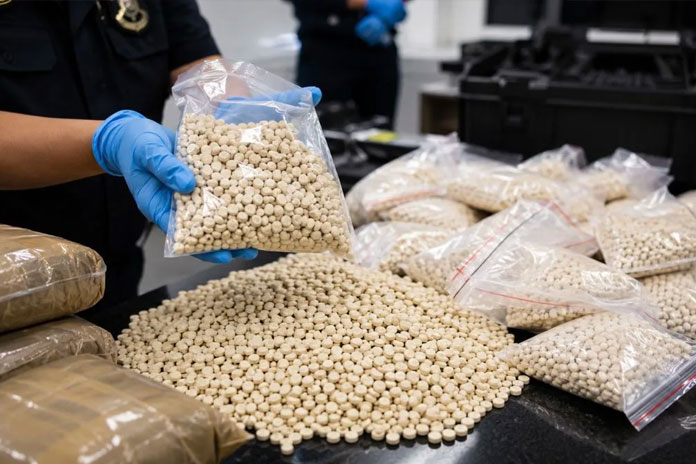
India has recorded its first-ever seizure of Captagon, the highly addictive synthetic stimulant often referred to as the ‘Jihadi drug’, with the Narcotics Control Bureau (NCB) busting a consignment worth ₹182 crore during a major anti-drug operation.
Union Home Minister Amit Shah announced the breakthrough on Saturday, describing it as a significant success in the Centre’s fight against narcotics trafficking and transnational drug networks. The seizure was made under ‘Operation RAGEPILL’, and officials also arrested a foreign national linked to the consignment that was allegedly meant for the Middle East.
The operation comes amid increasing global concern over the spread of Captagon trafficking networks across West Asia and Europe. International agencies have repeatedly flagged the synthetic drug trade as a growing security challenge because of its links to organised crime, illegal financing routes and conflict-hit regions.
In a post on X, Shah said the Narendra Modi-led government remained committed to building a “Drug-Free India”.
“Modi govt is resolved for a ‘Drug-Free India’. Glad to share that through ‘Operation RAGEPILL’, our agencies have achieved the first-ever seizure of Captagon, the so-called ‘Jihadi Drug’, worth ₹182 crore,” Shah wrote.
“The busting of the drug consignment destined for the Middle East and the arrest of a foreign national stand out as shining examples of our commitment to zero tolerance against drugs,” he added.
The Home Minister further said that authorities would continue to act against every narcotics network using India either as a destination or transit route.
What is Captagon and why is it called the ‘Jihadi drug’?
Captagon was originally developed in the 1960s as a pharmaceutical drug known as Fenethylline and was prescribed for disorders such as narcolepsy and attention-related conditions. But as addiction and abuse cases began rising across countries, the drug was eventually banned internationally.
Today, most illegal Captagon tablets are manufactured clandestinely and are believed to contain mixtures of amphetamine, methamphetamine, caffeine and other synthetic stimulants.
The drug has gained notoriety in parts of West Asia and the Middle East because of its stimulant effects, which can temporarily reduce fatigue, suppress hunger and increase alertness and aggression.
Over the years, Captagon has frequently been labelled the ‘Jihadi drug’ because intelligence reports and international investigations have linked its trafficking and abuse to extremist groups and armed networks operating in conflict zones.
Security agencies and global watchdogs have also highlighted the role of Captagon smuggling in generating illicit funds for organised criminal syndicates operating across borders.
Captagon trade under global scrutiny
According to international agencies, the illegal Captagon market has evolved into a sophisticated transnational operation involving clandestine laboratories, hawala financing, forged trade documents, maritime trafficking channels and courier networks.
Though legal manufacturing of Captagon stopped in the 1980s, illegal production has continued and reportedly expanded sharply in recent years, particularly in Europe and the Middle East.
Due to its low production cost and massive illegal demand, the drug is also sometimes referred to as the “Poor Man’s Cocaine”.
The latest seizure also comes weeks after Indian agencies secured the extradition of alleged drug trafficker and Dawood Ibrahim aide Mohammad Salim Dola from Turkey.
Dola was arrested on April 25 following a coordinated operation involving the Istanbul Police and Indian agencies.
Reacting to that development earlier, Shah had said India’s anti-narcotics agencies had strengthened their global coordination network and warned that drug syndicates would find “no safe place” to hide.


 busting a consignment worth ₹182 crore during a major anti-drug operation.)