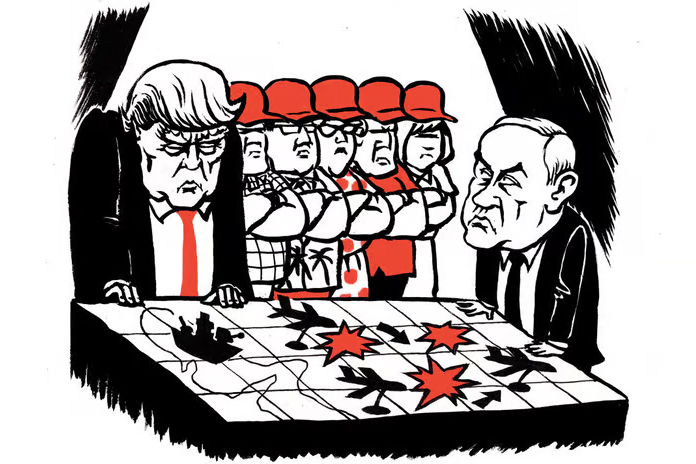
President Trump has publicly, simultaneously claimed that he has won the war against Iran, is currently winning the war, needs help from allies to win the war and doesn’t need help from anyone to win the war he has already won… all to destroy a so called Iranian ‘nuclear weapons program’ he claims to have already destroyed less than a year ago.
The contradictions are excruciating even as America and Israel weaponise hard power to new lethal extremes.
The opening attacks on Iran were swift and decisive. Bloody leadership decapitation strikes yielded immediate results in a shock and awe military campaign, designed to take the Iranian State apart. As news of Ayatollah Ali Khamenei’s assassination spread, domestic support in U.S. and Israel surged momentarily, and it looked like a new regime in Iran would be installed. But as the days turned into weeks, the brutal reality of war began to force itself on the psyche of the world, reminding us all that while one can choose how and when to start a war, the other side gets a say too. They get to control when to end it.
If lessons from Iraq and Afghanistan weren’t sobering enough, with the U.S. war in Iraq eventually resulting in the rise of ISIS and the war in Afghanistan ending in a shambolic retreat – the horrors of Vietnam serve as a brutal reminder to the sheer limits of hard power. American military forces won every major ground battle in Vietnam, using overwhelming air power. Yet in the end, they lost the war.
In asymmetric warfare, no amount of firepower and tactical military brilliance can win you the end game, if there is strategic political incoherence. This bitter history seems to be repeating itself in the war with Iran today.
We are now deep into the worst case scenario in this conflict, with hostilities entering a phase where energy infrastructure warfare, leadership decapitation and potential ground operation scenarios are beginning to intersect, making escalation less predictable and harder to contain. The escalation trap is in full momentum and rational fears of Israeli nuclear weapons being used in a do or die situation are now being whispered out loud.
The strategic differences in core war objectives of U.S. and Israel are increasingly apparent. President Trump wages war on Iran to destroy their so called nuclear weapons programme, without proof of such a programme even existing, while Israel wages war on Tehran to destroy the Iranian State and turn Iran into another Syria, Iraq, Libya or Lebanon. The problem is, in this conflict dynamic – the U.S. looses by not achieving a clear victory and Iran wins by simply avoiding an outright defeat.
Because Persia (Iran) has always been an empire. A civilisational state that has been around longer than all of the other players of the modern Middle East, be it the Gulf States, Israel or the Levant. Once a Goliath itself, Iran today has been reduced to a David, fighting off two of the world’s most advanced militaries and their overwhelming air superiority. And true to its civilisational history, which has seen all kinds of invasions and attacks, Iran is not going anywhere. It simply refuses to.
This shift is reflected in Iranian strategic thinking and the military actions of the IRGC, the Islamic Revolutionary Guard Corps, which has in effect seized control of the Iranian State after the vaccum left by Ayatollah Ali Khamenei’s death, turning the theocratic Iranian regime into an autonomous military one, with no ‘central command and control structure’. This explains why Tehran is increasingly operating under a new strategy of escalation above the threshold set by U.S. and Israel, aiming to correct what it sees as past miscalculations caused by restraint shown in the 12 day war in June 2025.
Under this new strategy, for every attack incurred, Iran escalates with equal if not broader attacks on Israel and U.S. interests in the region, by primarily targeting the Gulf States.
With each passing day, the global economic effects of this new kind of ‘open war’ are intensifying with oil prices already surging above $110 per barrel, reflecting a growing geopolitical shock, tied to the bombing of energy infrastructure across the region.
Yet incredibly, even as the U.S. bleeds economically, spending around $1 Billion a day in this war that is now in its third week; Iran continues to sustain its own oil exports through the Strait of Hormuz, while denying the critical water way to others. High oil prices and continued sales to China are generating a significant revenue stream for Tehran, reinforcing its ability to maintain the war effort, while inflicting disproportionate harm on other oil economies like the UAE, Saudi Arabia and Qatar.
The war itself has thrown nasty surprises, shattering U.S. reputation and its military umbrella in the Middle East. Years of American foreign policy, military infrastructure and ground assets are up in smoke today. Never before has American credibility been so badly hit in the last few decades.
The Gulf states, which were until two weeks ago shining islands of global stability and growth, have become outright collateral. Left unprotected by U.S. forces in the region and blamed and attacked by Iran as accomplices of Israel and America. As they suffer more and more damage to their critical infrastructure, economies and reputations, the very real prospect of an Arab military coalition, led by Saudi Arabia and the UAE, launching collective military action against Iran is emerging. A new expansion that could further entrench and enlarge the conflict.
Thus for all parties directly involved, the escalation costs are decreasing as the conflict morphs. History has shown that war plays out not as an event, but as a process. A sequence of decisions taken under pressure, watched live and read by adversaries. Once the sequence starts, restraint stops being a preference. It becomes a political cost.
Military strikes by any foreign power on any country, hardens the affected populations resolve to fight back, to intensify asymmetric leverage and survive the onslaught. War generates momentum and smart statecraft, when applied carefully, can make escalation feel uncontrollable. With every additional strike multiplying uncertainty and cost.
Iran understands this intrinsically. It is using the Strait of Hormuz not just as geography, but as a pricing mechanism. Every hint of disruption in gulf energy supplies creating a cascading impact, because fear is priced faster than facts.
Israel has laid the ‘Goliath Trap’ and President Donald Trump has walked into it.
The long war has begun.